

Dyeing pre-treatment method of cotton fabric
A technology for pre-dyeing and cotton fabrics, applied in dyeing method, fiber treatment, biochemical fiber treatment and other directions, which can solve the problems of energy consumption, time-consuming and long process.
- Summary
- Abstract
- Description
- Claims
- Application Information
AI Technical Summary
Problems solved by technology
Method used
Image

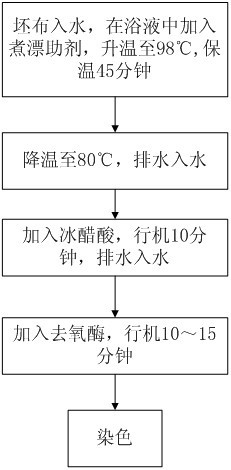
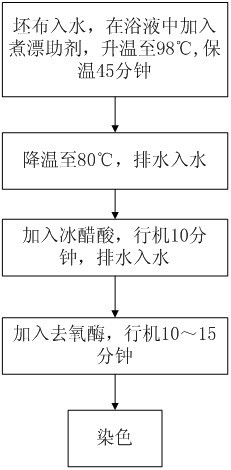
Examples
Embodiment 1
[0027] Put the cotton gray cloth into the water, add H to the bath 2 o 2 and NaOH, heat up to 98°C, keep warm for 45 minutes; cool down to 80°C, drain into water; add glacial acetic acid, run for 10 minutes, drain into water; add deoxygenase, run for 10 minutes; finally dyeing.
Embodiment 2
[0029] Put the cotton gray cloth into the water, add H to the bath 2 o 2 and NaOH, heat up to 98°C, keep warm for 45 minutes; cool down to 80°C, drain into water; add glacial acetic acid, run for 10 minutes, drain into water; add deoxygenase, run for 15 minutes; finally dyeing.
Embodiment 3
[0031] Put the cotton gray cloth into the water, add H to the bath 2 o 2 and NaOH, heat up to 98°C, keep warm for 45 minutes; cool down to 80°C, drain into water; add glacial acetic acid, run for 10 minutes, drain into water; add deoxygenase, run for 12 minutes; finally dyeing.
[0032] In terms of cost, compared with the prior art, the dyeing pretreatment method of cotton fabric of the present invention:
[0033] Calculated per ton of cloth (bath ratio is 1:8):
[0034] Water saving: save about 8 tons of water for one line;
[0035] Power saving: about 6 degrees;
[0036] Save time: about 10 minutes.
[0037] The dyeing pretreatment method of cotton fabric of the present invention, carries out boiling bleaching, acid neutralization on pretreatment, the third water of traditional craft is removed H 2 o 2 Processing is put into dye sync. Add deoxygenase to the same water that was dyed and run the machine for 12 minutes, after testing the residual H 2 o 2 Has been remov...
PUM
 Login to View More
 Abstract
Description
Claims
Application Information
 Login to View More