
Super-resolution imaging method based on fluorescence resonance energy transfer
A fluorescence resonance energy and super-resolution imaging technology, applied in the field of super-resolution imaging, can solve the problems of complex imaging software and high cost
- Summary
- Abstract
- Description
- Claims
- Application Information
AI Technical Summary
Problems solved by technology
Method used
Image

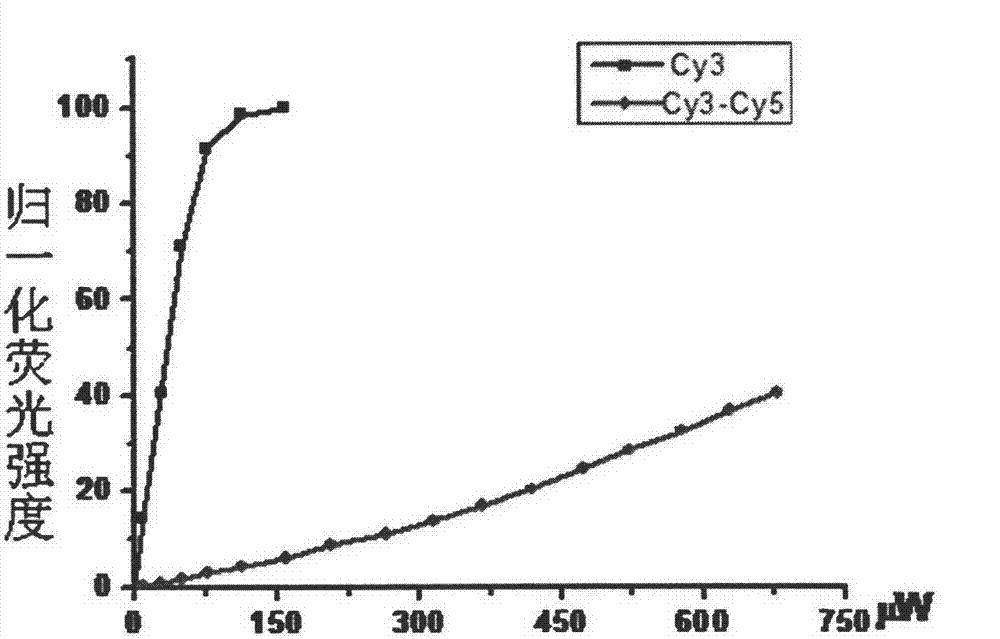
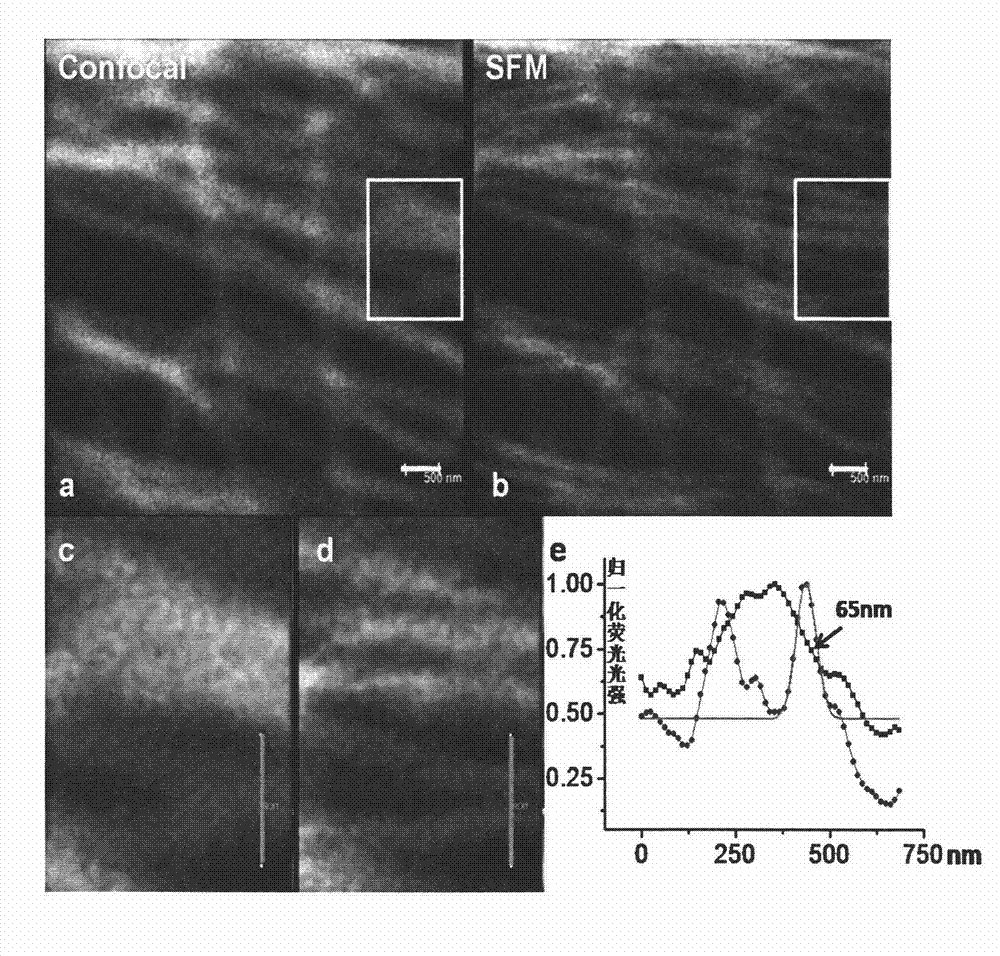
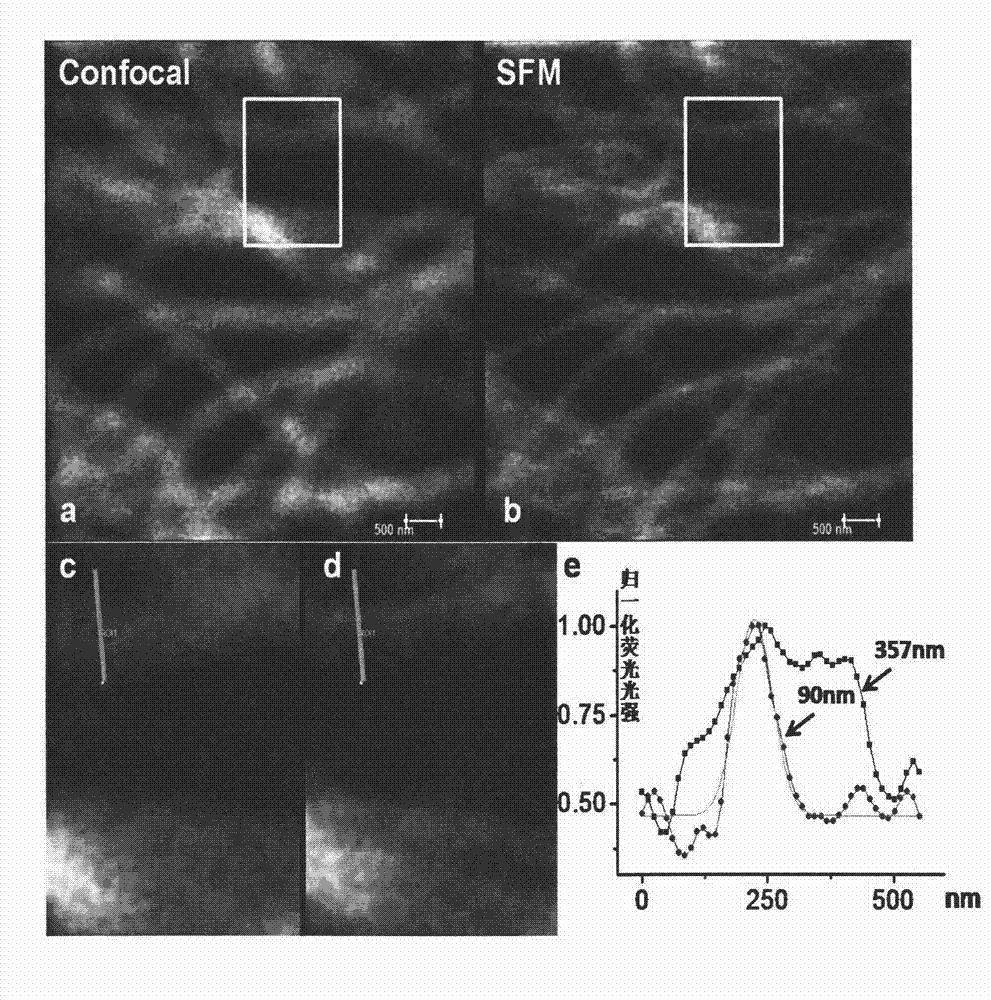
Examples
Embodiment 1
[0041] Example 1 Super-resolution imaging of Cy3-Cy5 probe-labeled Hela cell microtubules
[0042] Construction of Cy3-Cy5 fluorescent probes with high FRET efficiency: Fluorescent nanospheres were prepared by inverse microemulsion method.
[0043] Experimental materials: sodium silicate solution (water glass) (the water glass modulus is 3.1, Baume degree is 40), hydrochloric acid (concentration is 1mol / L), sodium lauryl sulfate SDS, toluene, n-amyl alcohol , deionized water (W), fluorescent dye Cy3-Cy5.
[0044] The specific steps of this technique include:
[0045] Osmotic reaction: take 0.1g surfactant SDS (S), 0.2g fluorescent dye (donor Cy3 and acceptor Cy5, donor acceptor molar ratio 1:2), 0.2ml toluene and 5ml water glass solution prepared in advance Put it into a beaker, and mix it uniformly by ultrasonic (50W ultrasonic power, 1 minute mixing time) to obtain a colostrum, add n-amyl alcohol dropwise until the system is suddenly transparent, and obtain microemulsion A...
Embodiment 2
[0055] Example 2 Super-resolution imaging of Hela cell microtubules labeled with Atto488-Atto540 probe
[0056] Construction of Atto488-Atto540 Fluorescent Probe with High FRET Efficiency
[0057] Experimental materials: sodium silicate solution (water glass) (the water glass modulus is 3.2, Baume degree is 40), hydrochloric acid (concentration is 1mol / L), sodium lauryl sulfate SDS, toluene, n-amyl alcohol , deionized water (W), fluorescent dyes Atto488-Atto540.
[0058] Take 0.1g of surfactant SDS (S), 0.2g of fluorescent dye (donor Atto488 and acceptor Atto540, donor-acceptor molar ratio 1:2), 0.2ml of toluene and 5ml of water glass solution prepared in advance into a beaker In the process, ultrasonically mix evenly (ultrasonic power 50W, mixing time 1 minute) to obtain a primary emulsion, add n-amyl alcohol dropwise until the system is suddenly transparent, and obtain microemulsion A.
[0059] Polymerization reaction: replace the water glass solution with 1mol / L HCl solut...
Embodiment 3
[0067] Example 3 Super-resolution imaging of Hela cell microtubules labeled with Atto550-Atto647N probe
[0068] Construct Atto550-Atto647N fluorescent probe with high FRET efficiency:
[0069] Experimental materials: sodium silicate solution (water glass) (the water glass modulus is 3.3, Baume degree is 40), hydrochloric acid (concentration is 1mol / L), sodium lauryl sulfate SDS, toluene, n-pentanol , deionized water (W), fluorescent dye Atto550-Atto647N.
[0070] Osmotic reaction: take 0.1g surfactant SDS (S), 0.2g fluorescent dye (donor Atto550 and acceptor Atto647N, donor acceptor molar ratio 1:2), 0.2ml toluene and 5ml water glass solution prepared in advance Put it into a beaker, and mix it uniformly by ultrasonic (50W ultrasonic power, 1 minute mixing time) to obtain a colostrum, add n-amyl alcohol dropwise until the system is suddenly transparent, and obtain microemulsion A.
[0071] Polymerization reaction: replace the water glass solution with 1mol / L HCl solution, a...
PUM
| Property | Measurement | Unit |
|---|---|---|
| laser intensity | aaaaa | aaaaa |
| modulus | aaaaa | aaaaa |
| fluorescence | aaaaa | aaaaa |
Abstract
Description
Claims
Application Information
 Login to View More