Mechanical-error calibration method for heliostat

A mechanical error and heliostat technology, which is applied in the field of heliostat mechanical error calibration, can solve the problems of inability to realize the calibration function, large heliostat error, and long time required, and achieve short time, high-precision calibration, and improved The effect of work efficiency

CN102929299AInactive Publication Date: 2013-02-13宁夏医深科技股份有限公司
5 Cites 16 Cited by

Patent Information

Authority / Receiving Office
CN · China
Patent Type
Applications(China)
Current Assignee / Owner
Publication Date
2013-02-13
Estimated Expiration
Not applicable · inactive patent

Smart Images

  • Figure 1
    Figure 1
  • Figure 2
    Figure 2
  • Figure 3
    Figure 3
Patent Text Reader

Abstract

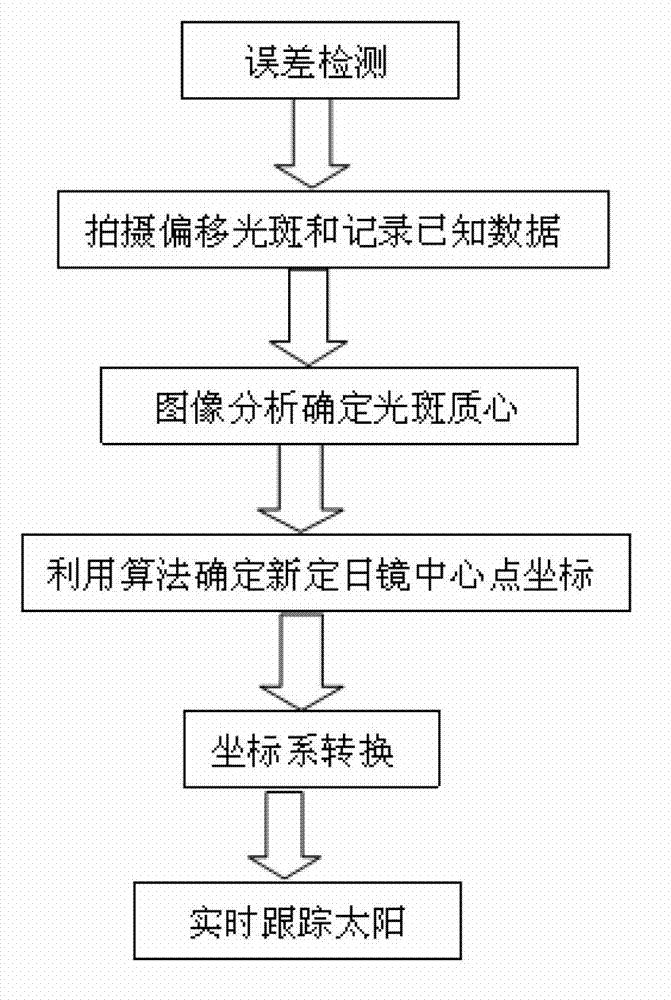
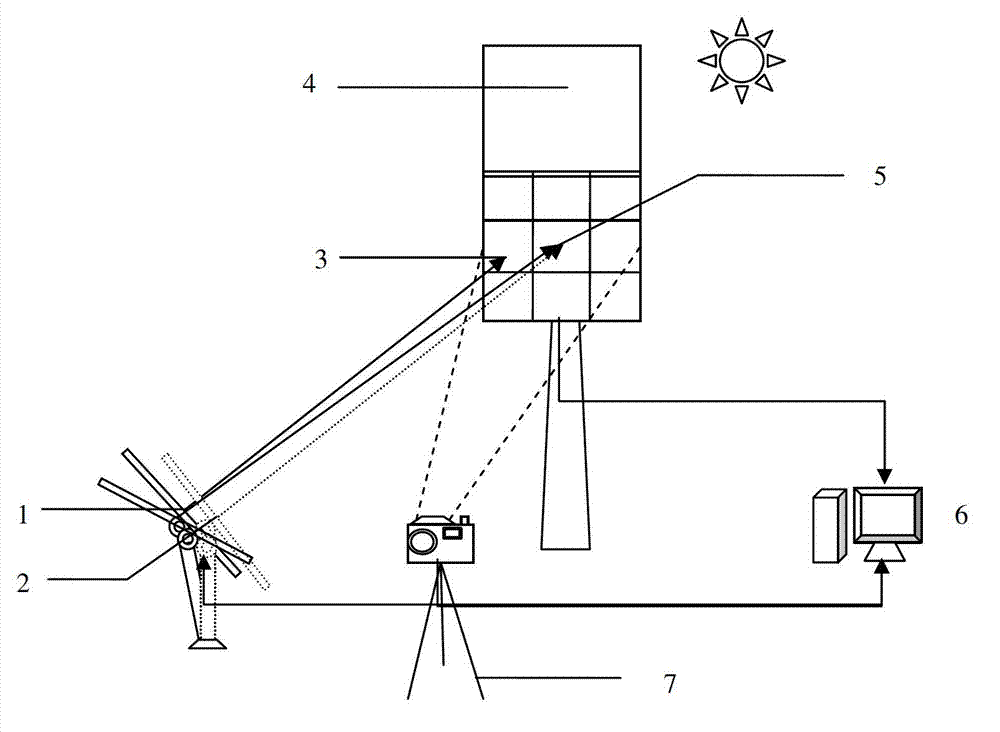
The invention relates to a mechanical-error calibration method for a heliostat, which is based on the application of a heliostat real-time follow-up solar device of a tower type solar energy heat-collection system. The method comprises the following steps: judging the position of a light spot on a heat collector through images shot by a camera; comparing the mass centre position of the light spot with an appointed position, if deviation occurs, showing that mechanical error of the heliostat exists, at the moment, recording the elevation angle and azimuth angle of the sun, as well as those of the heliostat when light spot deviates, the height of a heliostat bracket and position coordinates of the heliostat bracket relative to the center spot of the heliostat heat collector; calculating the coordinates of the deviated heliostat mass centre relative to the mass centre position of the original heliostat through a computation module; converting the deviation amount of the heliostat center spot into deviation amount of the mass centre point of the heat collector through a coordinate system, and building a new heliostat center spot; determining the appointed position coordinates of the heat collector under a coordinate system taking the new heliostat center spot as an origin; and taking the heliostat having the mechanical error as a criteria, re-calculating and re-sending so as to realize the tracking of the heliostat, and projecting the light spot data, thereby achieving the purposes of high-efficiency tracking and sunlight spot projection.
Need to check novelty before this filing date? Find Prior Art

Description

technical field

[0001] The invention relates to the technical field of tower-type solar heat collection systems, in particular to a method for calibrating mechanical errors of heliostats. Background technique

[0002] During the long-term operation of the heliostat, due to external factors such as wind and gravity, the supporting frame structure of the heliostat is deformed, resulting in an error when the heliostat tracks and projects the light spot. This error is called a mechanical error. In order to ensure that the heliostat can project the light spot with high precision, it is necessary to research and develop the calibration method and device of the mechanical error.

[0003] At present, the existing technology can realize the accurate alignment of the heliostat and the heat collector during the installation of the mirror field, and can correct the errors caused by mechanical deformation and foundation settlement during the long-term operation of the mirror field. But ...

Examples

Embodiment

[0067] 1) Use a camera to shoot the position of the heat collector, and check whether the light spot reflected by the heliostat is on the designated position of the heat collector. If the light spot is at the position of the target point, it proves that there is no mechanical error; otherwise, shoot the light spot Image of the actual position on the collector, such as figure 2 shown;

[0068] 2) Find the central position of the actual light spot taken by the method of image analysis as the known condition utilizing the above mathematical model;

[0069] Recorded data: including the altitude angle and azimuth angle of the heliostat, the altitude angle and azimuth angle of the sun, the position coordinates of the specified point and the position coordinates of the actual point; these data are also used as the known conditions of the mathematical model;

[0070] 4) Use the mathematical model to calculate the position of the new specified point:

[0071] Assuming that there is ...