
Fault analog simulation material used for fluid-solid coupling model test and preparation method thereof
A technology of coupled model and similarity simulation, applied in the field of material science, which can solve the problems of rare material ratio of similar faults, rarely considering the water characteristics of materials, and difficult to respond to seepage changes.
- Summary
- Abstract
- Description
- Claims
- Application Information
AI Technical Summary
Problems solved by technology
Method used
Image


Examples
Embodiment 1
[0031] Example 1 Preparation of similar materials for simulating faults in fluid-solid coupling model tests
[0032] The raw materials are as follows: 1 part of quartz sand, 0.12 part of talcum powder, 0.08 part of gypsum powder, 0.09 part of vaseline, and 0.13 part of water.
[0033] The preparation method is:
[0034] 1) Weigh quartz sand, gypsum powder, talcum powder, vaseline and mixing water in strict proportion;
[0035] 2) Mix the three fine-grained materials of quartz sand, gypsum powder and talcum powder and stir evenly;
[0036] 3) Add the weighed mixing water and stir thoroughly;
[0037] 4) Heat the vaseline to 55°C to melt it into a liquid state;
[0038] 5) Mix the liquid petroleum jelly with the material obtained in step 3), and stir well;
[0039] 6) Cool at room temperature for 5 minutes, ready to serve.
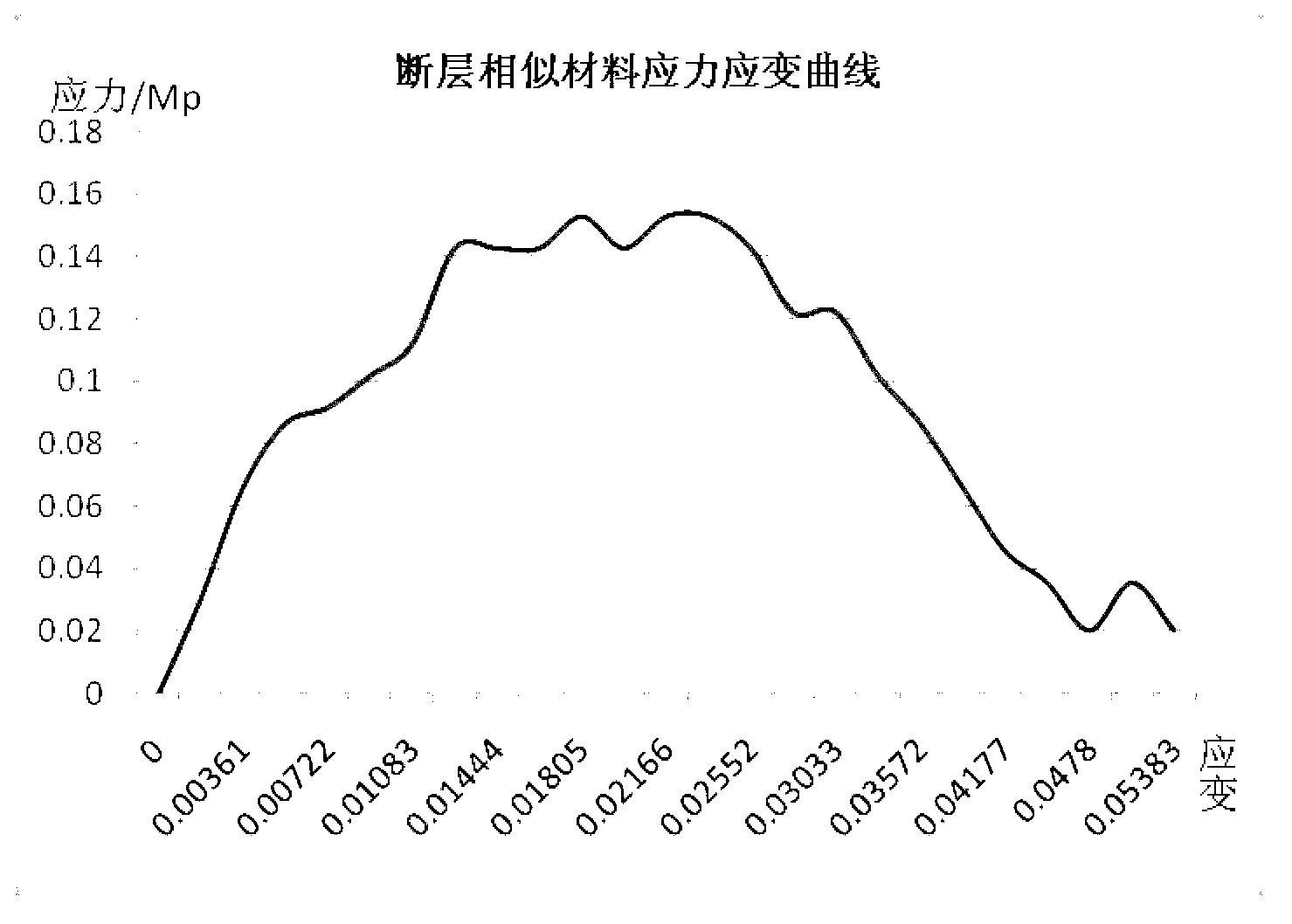
[0040] The stress-strain of the obtained material under uniaxial compressive condition is as follows: figure 1 As shown, it reflects the change proces...
Embodiment 2
[0041] Example 2 Preparation of similar materials for simulating faults in fluid-solid coupling model tests
[0042] The raw material composition is: 1 part of quartz sand, 0.18 part of talcum powder, 0.07 part of gypsum powder, 0.1 part of vaseline, and 0.12 part of water.
[0043] The preparation method is:
[0044] 1) Weigh quartz sand, gypsum powder, talcum powder, vaseline and mixing water in strict proportion;
[0045] 2) Mix the three fine-grained materials of quartz sand, gypsum powder and talcum powder and stir evenly;
[0046] 3) Add the weighed mixing water and stir thoroughly;
[0047] 4) Heat the vaseline to 55°C to melt it into a liquid state;
[0048] 5) Mix the liquid petroleum jelly with the material obtained in step 3), and stir well;
[0049] 6) Cool at room temperature for 5 minutes, ready to serve.
Embodiment 3
[0050] Example 3 Preparation of similar materials for simulating faults in fluid-solid coupling model tests
[0051] The raw materials are as follows: 1 part of quartz sand, 0.08 part of talcum powder, 0.12 part of gypsum powder, 0.13 part of vaseline, and 0.1 part of water. The preparation method is:
[0052] 1) Weigh quartz sand, gypsum powder, talcum powder, vaseline and mixing water in strict proportion;
[0053] 2) Mix the three fine-grained materials of quartz sand, gypsum powder and talcum powder and stir evenly;
[0054] 3) Add the weighed mixing water and stir thoroughly;
[0055] 4) Heat the vaseline to 55°C to melt it into a liquid state;
[0056] 5) Mix the liquid petroleum jelly with the material obtained in step 3), and stir well;
[0057] 6) Cool at room temperature for 5 minutes, ready to serve.
PUM
| Property | Measurement | Unit |
|---|---|---|
| particle diameter | aaaaa | aaaaa |
Abstract
Description
Claims
Application Information
 Login to View More