
High-dimensional service data oriented hybrid visualization method
A technology of service data and service combination, which is applied in the field of hybrid visualization for high-dimensional service data, can solve problems such as data distortion and complex display effects, and achieve the effect of reducing crossover and coverage
- Summary
- Abstract
- Description
- Claims
- Application Information
AI Technical Summary
Problems solved by technology
Method used
Image

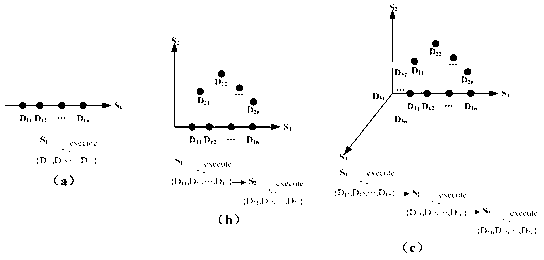
Examples
Embodiment 1
[0046] Step 1: Investigate service composition from the language level of WSDL (Web Services Description Language) and BPEL (Business Process Execution Language), and analyze the information provided by WSDL and BPEL documents.
[0047] 1.1. According to the WSDL Schema, the web service is abstracted into a two-tuple s=(n, P), where n is the name of the service (that is, the service name registered in UDDI (Universal Description Discovery and Integration)), P is the operation set of the service. Operation is the basic functional entity of Web service, and Web service composition is finally reflected in the composition of inter-service operations. An operation can be expressed as a two-tuple P=(I,O), where I represents the set of input objects received by the operation, and O is the set of output objects generated by the operation.
[0048] 1.2. The CPU reads the basic information of the WSDL file of the service resource library in the scene, extracts the service name n,...
Embodiment 2
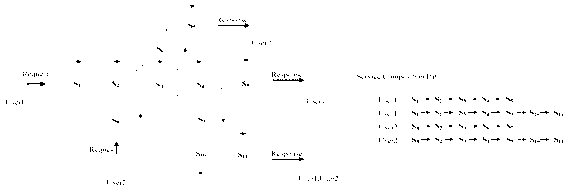
[0091] refer to Figure 7 and Figure 8 , and the rest are the same as in Embodiment 1, except that in the application occasion, Embodiment 1 visualizes the service data of the entire service resource library. In Embodiment 2, from the perspective of a single service, the service data generated by all the service combinations in which the service participates is mixed and visualized.
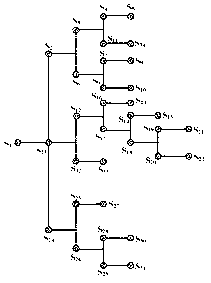
[0092] Figure 7 shows all calls to service s 4 (red node) service composition path, which contains {S 19 —S 20 —S 9 —S 7 —S 4 —S 6 } (S 4 in the fifth dimension), {S 1 —S 4 } (S 4 in the second dimension), {S 2 —S 4 } (S 4 in the second dimension), {S 7 —S 4 —S 6 —S 17 } (S 4 in the second dimension), {S 20 —S 9 —S 7 —S 4 —S 6 } (S 4 in the fourth dimension). Figure 8 Correspondingly, the specific data details of these services are given through the dot matrix.
PUM
 Login to View More
 Abstract
Description
Claims
Application Information
 Login to View More