Method and device for allocating tasks to multiple servers

A task allocation and server technology, applied in the computer field, can solve problems such as low efficiency of task execution and inability to allocate tasks, and achieve the effects of strengthening data processing capabilities, improving flexibility and availability, and rationally utilizing server resources

CN103401947AInactive Publication Date: 2013-11-20DAWNING INFORMATION IND BEIJING
5 Cites 32 Cited by

Patent Information

Authority / Receiving Office
CN · China
Patent Type
Applications(China)
Current Assignee / Owner
Publication Date
2013-11-20
Estimated Expiration
Not applicable · inactive patent

Smart Images

  • Figure 1
    Figure 1
  • Figure 2
    Figure 2
Patent Text Reader

Abstract

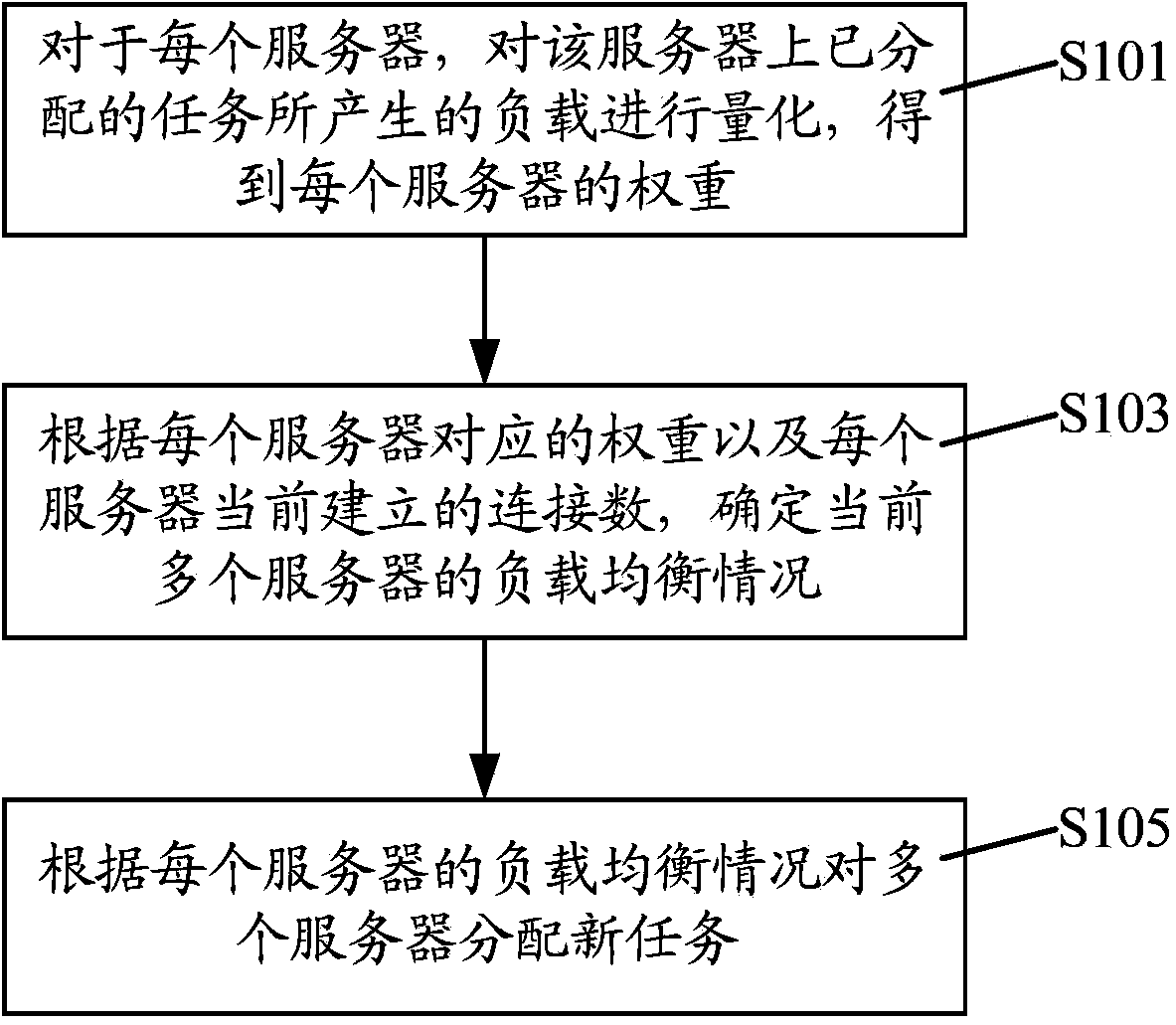
The invention discloses a method and a device for allocating tasks to multiple servers. The method comprises steps as follows: quantizing a load produced by a task allocated to each server, and obtaining a weight of each server; determining load balancing conditions of the multiple current servers according to the corresponding weight of each server and current connections established by each server; and allocating new tasks to the multiple servers according to the load balancing conditions of each server. According to the method, the load balancing conditions of the multiple current servers are determined according to the corresponding weight of each server and the current connections established by each server, so that the tasks can be reasonably allocated according to the load condition of each server, the data processing capacity is enhanced, the server resources are reasonably used, and the flexibility and the usability of the servers are improved.
Need to check novelty before this filing date? Find Prior Art

Description

technical field

[0001] The present invention relates to the field of computers, and in particular, relates to a task allocation method and device for multiple servers. Background technique

[0002] Load balancing (Load Balance, also known as load balancing), load balancing is based on the existing network structure, balances the load (work tasks), and then distributes it to multiple operating units for execution, for example, assigning to Web servers, FTP server, enterprise key application server and other mission-critical servers, etc., so as to jointly complete work tasks. It provides an effective method to expand the bandwidth of network devices and servers, increase throughput, strengthen network data processing capabilities, and improve network flexibility and availability.

[0003] Load balancing has two meanings: on the one hand, a single heavy-load operation is distributed to multiple node devices (ie servers) for parallel processing, and after each node device fini...

Examples

Embodiment Construction

[0035] The following will clearly and completely describe the technical solutions in the embodiments of the present invention with reference to the accompanying drawings in the embodiments of the present invention. Obviously, the described embodiments are only some, not all, embodiments of the present invention. All other embodiments obtained by persons of ordinary skill in the art based on the embodiments of the present invention belong to the protection scope of the present invention.

[0036] According to an embodiment of the present invention, a task allocation method for multiple servers is provided.

[0037] Such as figure 1 As shown, the task allocation method according to the embodiment of the present invention includes:

[0038] Step S101, for each server, quantify the load generated by the assigned tasks on the server to obtain the weight of each server;

[0039] Step S103, according to the weight corresponding to each server and the number of connections currently...