Quantitative analysis method of remote libs elements based on weighted multispectral calibration

A multi-spectral, remote technology, applied in the field of quantitative analysis of laser spectrum elements, can solve the problems that testers cannot approach the target, have no prior knowledge, quantitative analysis problems, etc., and achieve the effect of remote LIBS element quantitative analysis

CN103411931BActive Publication Date: 2015-07-29SHANGHAI INST OF TECHNICAL PHYSICS - CHINESE ACAD OF SCI
4 Cites 0 Cited by

Patent Information

Authority / Receiving Office
CN · China
Patent Type
Patents(China)
Current Assignee / Owner
Publication Date
2015-07-29

Smart Images

  • Figure 1
    Figure 1
  • Figure 2
    Figure 2
  • Figure 3
    Figure 3
Patent Text Reader

Abstract

The invention discloses a remote LIBS (Laser-induced Breakdown Spectroscopy) element quantitative analysis method based on weighted multispectral calibration. The method comprises the following steps: firstly, achieving remote target LIBS spectral acquisition of a test site, and in the process, qualitatively obtaining major element compositions of the remote target to be tested, as well as the line strengths of multiple spectral lines of elements to be tested; then, finishing laboratory sample calibration and obtaining the relation fitted equation between the strengths and the percentage contents of the multiple lines of the elements to be tested; finally, quantitatively calculating the percentage contents of the elements to the tested according to the multispectral weighting method. The method can solve the remote LIBS element quantitative analysis problems better.
Need to check novelty before this filing date? Find Prior Art

Description

technical field

[0001] This patent relates to a quantitative analysis method of laser spectrum elements, in particular to a remote laser-induced breakdown spectroscopy (LIBS) quantitative analysis method based on weighted multispectral calibration. Background technique

[0002] In some places where testers cannot approach, such as chemically polluted areas; areas with complex terrain such as rock walls, river valleys, and caves, it is a difficult problem to analyze the chemical element composition and content of substances, because testers cannot collect target samples for chemical analysis. In this case, remote laser-induced breakdown spectroscopy (LIBS) detection technology can be used to solve the problem.

[0003] Long-range laser-induced breakdown spectroscopy (LIBS) detection technology uses high-energy pulsed laser to focus on a remote target surface through a focusing lens, and obtains instantaneous high-power-density laser pulses at the focal point, which can ablate...

Examples

Embodiment Construction

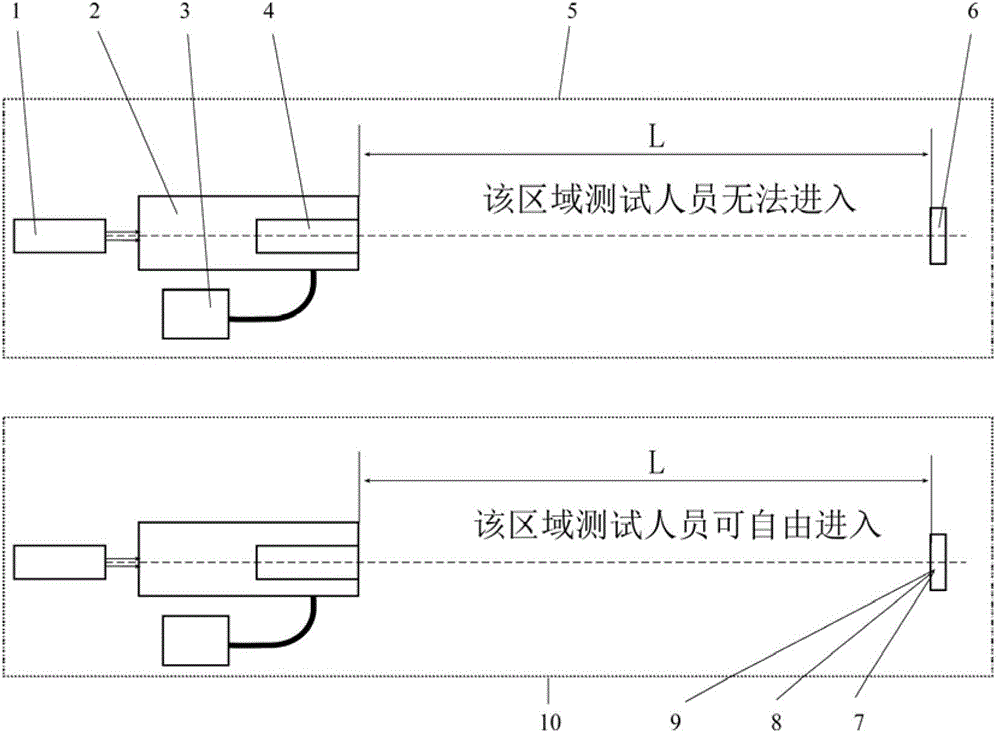
[0019] The principle of this patent is as figure 1 As shown, the remote LIBS testing equipment includes a solid-state pulsed laser 1 , a remote LIBS optoelectronic system 2 , a fiber optic spectrometer 3 and a laser rangefinder 4 .

[0020] Step 1. Complete the LIBS spectrum acquisition of the long-distance target at the test site

[0021] Remote LIBS test equipment is set up at the test site 5, and the area between the remote LIBS test equipment and the remote target 6 is inaccessible to test personnel (such as chemically polluted areas, dangerous geographical environments such as cliffs, etc.). The laser pulse emitted by the solid-state pulsed laser 1 is focused and excited by the remote LIBS photoelectric system 2 to excite the remote target 6 to induce the formation of LIBS spectrum signals, which are received by the remote LIBS photoelectric system 2 and stored in the fiber optic spectrometer 3 . At the same time, the distance L between the long-distance target 6 and the...