Motor imagery electroencephalogram voting strategy sorting method based on extreme learning machines

An extremely fast learning machine and motor imagery technology, applied in the field of pattern recognition and brain-computer interface, can solve the problem of not reducing the randomness of sample prediction categories, and achieve the effects of improving classification accuracy, reducing randomness, and low time consumption

CN103413050AActive Publication Date: 2013-11-27BEIJING UNIV OF TECH
4 Cites 17 Cited by

Patent Information

Authority / Receiving Office
CN · China
Current Assignee / Owner
Publication Date
2013-11-27

Smart Images

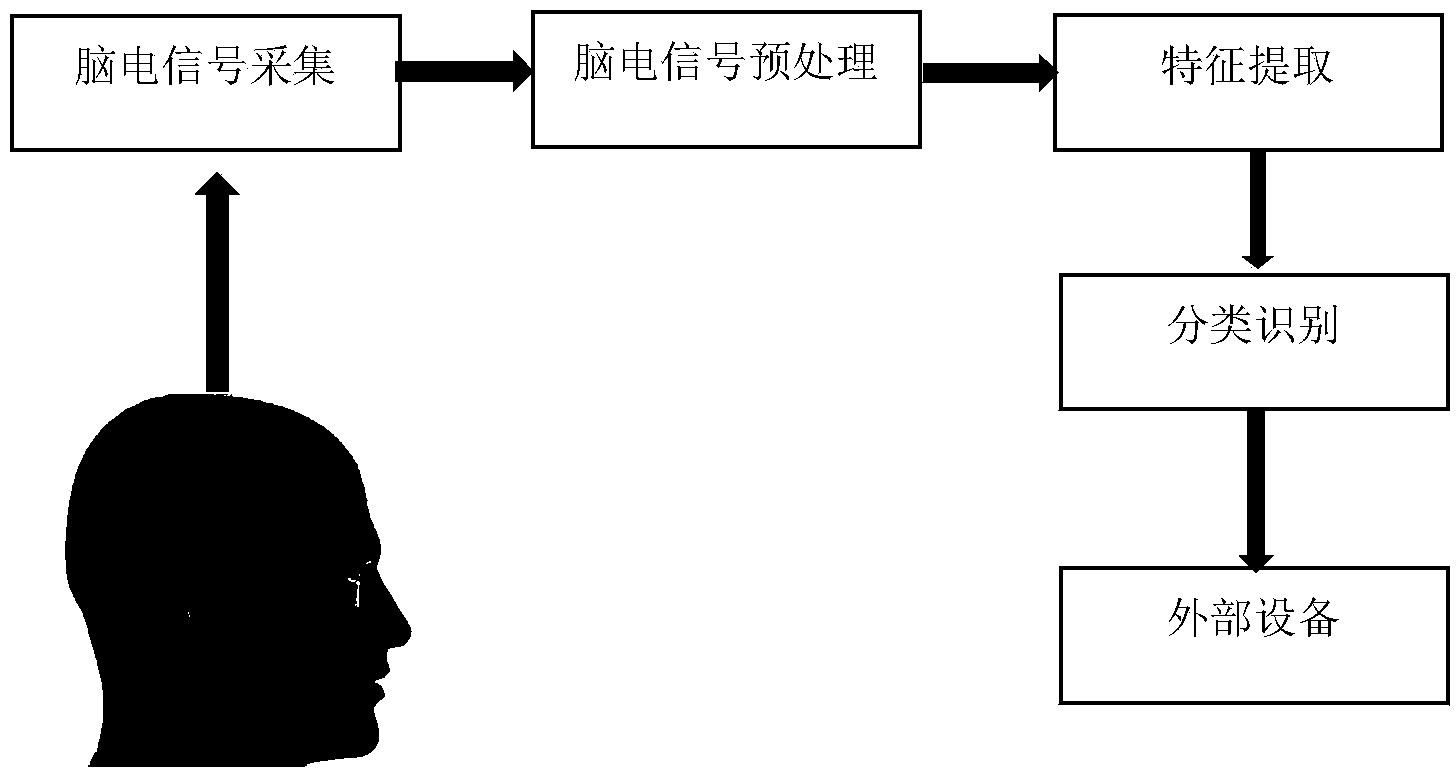
  • Figure 1
    Figure 1
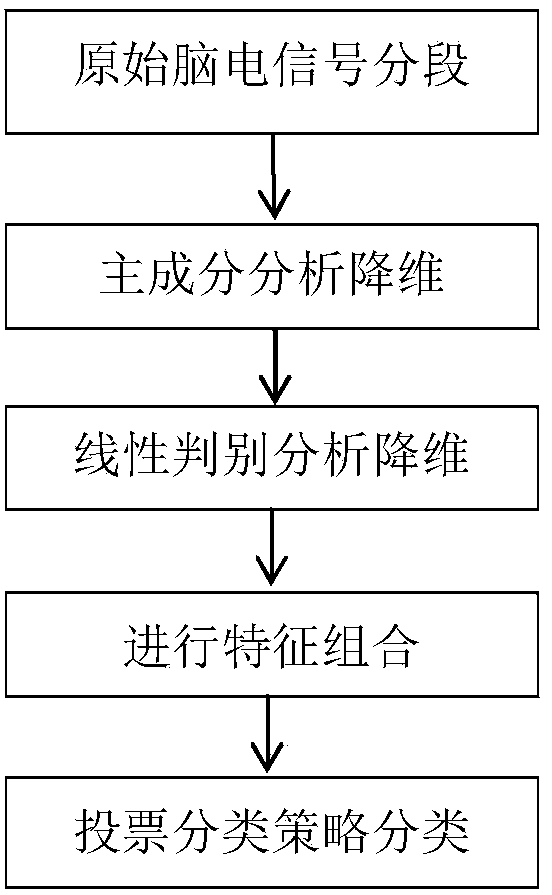
  • Figure 2
    Figure 2
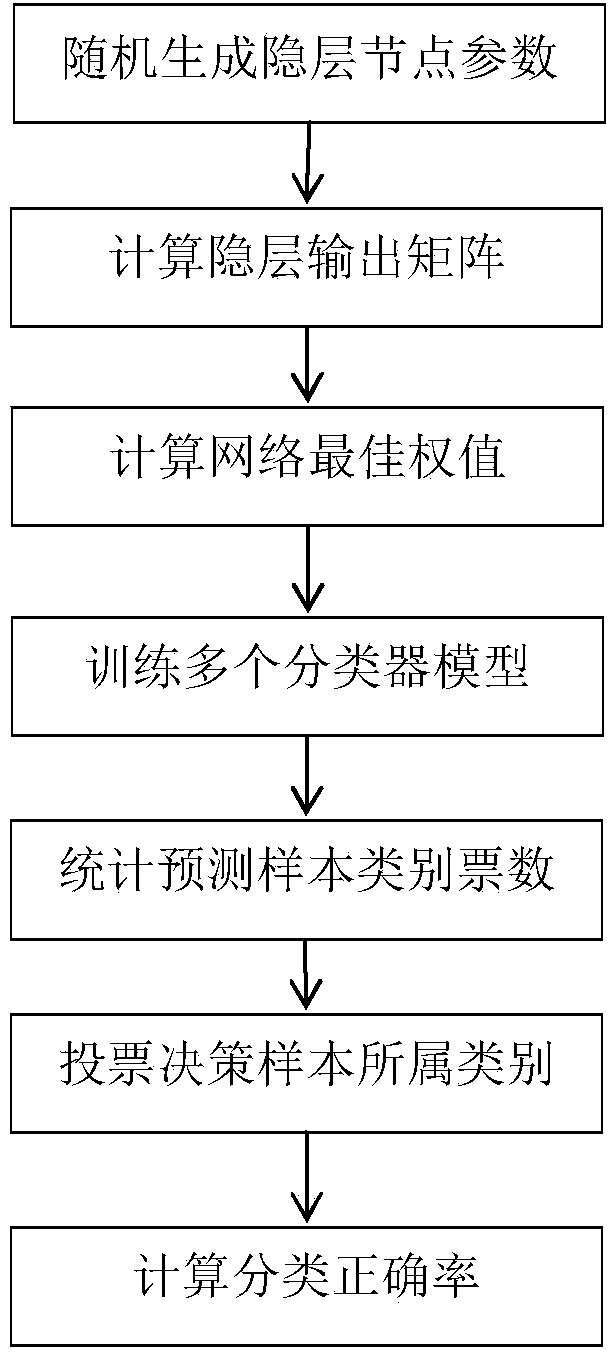
  • Figure 3
    Figure 3
Patent Text Reader

Abstract

The invention belongs to the field of mode recognition and a brain-machine interface and discloses a motor imagery electroencephalogram voting strategy sorting method based on extreme learning machines. The motor imagery electroencephalogram voting strategy sorting method comprises the following steps: dividing an original motor imagery electroencephalogram into S sections of sub-signals; carrying out dimensionality reduction on each section of sub-signal by a principal component analysis method; carrying out secondary dimensionality reduction on a feature vector subjected to the dimensionality reduction by a linear discrimination analysis method; carrying out the same processing on the S sections of sub-signals to finally obtain S (K-1)-dimensional feature vectors, and combining the S (K-1)-dimensional feature vectors to finally obtain an S*(K-1)-dimensional feature; and transmitting the S*(K-1)-dimensional feature into a plurality of ELM (Extreme Learning Machine) sorting devices so as to obtain a final sorting result by utilizing a voting sorting strategy. The invention provides a voting sorting strategy based on the ELMs; compared with a traditional multi-time ELM average accuracy scheme, the method provided by the invention has the advantages that the sorting accuracy is improved under the condition of not influencing the training sorting low consumption.
Need to check novelty before this filing date? Find Prior Art

Description

technical field

[0001] The invention belongs to the fields of pattern recognition and Brain-Computer Interface (Brain-Computer Interface, BCI), and relates to a method for classifying motor imagery EEG signals in a Brain-Computer Interface system device, specifically, extracting feature vectors A method for classification with extremely fast learning machine-based voting strategies. Background technique

[0002] There are many diseases that affect the communication between the brain and the external environment, such as paralysis. These diseases will cause patients to lose part or all of their autonomic control, which will bring a very heavy burden to the family and society. With the development of computer science and the deepening of scientists' research on brain function, people began to try to establish a new way to transmit information and commands between the brain and the external environment, and do not rely on the communication and control pathways of muscle and ne...

Examples

Embodiment Construction

[0019] The present invention will be further described below in combination with specific embodiments.

[0020] Suppose there is a training data set TrainData and a set of test data sets TestData, the sample size of TrainData is N, and the dimension is D; the sample size of TestData is M, and the dimension is also D. Among them, the samples in TrainData and TestData belong to K categories.

[0021] Voting strategy classification method for motor imagery EEG signals based on extremely fast learning machine, the flow chart is as follows figure 2 shown.

[0022] Step 1: Divide the TrainData and TestData into S-segment EEG signals by means of fixed time window division. TrainData i Represents the i-th sub-signal in the training data set, and the dimension of each sub-signal is D i (i=1,2,...,S). TestData i Represents the i-th sub-signal in the test data set, and the dimension of each sub-signal is D i (i=1,2,...,S). Because a fixed time window is used, the window size is ...