Noise-detection-based high density impulse noise self-adaptive filtering algorithm
An adaptive filtering and impulse noise technology, applied in computing, image data processing, instruments, etc., can solve the problems of limited filtering ability, adaptive and real-time limitations, and high time cost of high-density noise images
- Summary
- Abstract
- Description
- Claims
- Application Information
AI Technical Summary
Problems solved by technology
Method used
Image



Examples
Embodiment
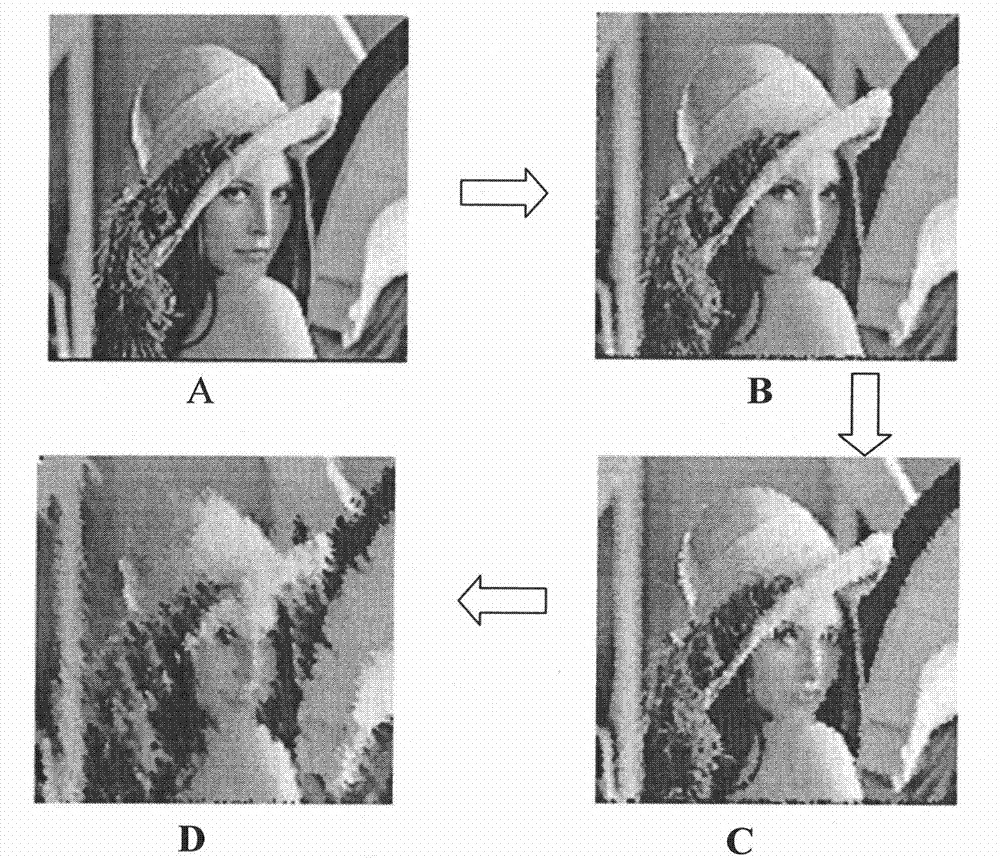
[0056] Introduction of salt and pepper impulse noise: Impulse noise is divided into fixed value impulse noise (salt and pepper noise) and random value impulse noise. For a 256-level grayscale image, the salt and pepper noise is the pixel point with the minimum value (grayscale is 0) and maximum value (grayscale is 255) of the noise point grayscale. Assume that I represents a 256-level grayscale image with a resolution of M×N. If salt and pepper noise with a noise density of p% (p represents the percentage of added noise, 0≤p≤100) is added to the image I, then the probability density function f(X) of the noise image X at coordinates (i, j) can be expressed for:
[0057]
[0058] High-density pulse noise adaptive filtering algorithm (PA) based on noise detection, based on the characteristics of salt and pepper noise, the first step is to detect noise points, the second step is only to filter and restore the detected noise points, and the detected signal The point gray value...
PUM
 Login to View More
 Abstract
Description
Claims
Application Information
 Login to View More
 - R&D
- Intellectual Property
- Life Sciences
- Materials
- Tech Scout
- Unparalleled Data Quality
- Higher Quality Content
- 60% Fewer Hallucinations
Browse by: Latest US Patents, China's latest patents, Technical Efficacy Thesaurus, Application Domain, Technology Topic, Popular Technical Reports.
© 2025 PatSnap. All rights reserved.Legal|Privacy policy|Modern Slavery Act Transparency Statement|Sitemap|About US| Contact US: help@patsnap.com