Check patentability & draft patents in minutes with Patsnap Eureka AI!

Test Method for Characterizing the Effect of Cement-Based Materials-Aggregate-Substrate Interface on Carbonation Rate

A technology of cement-based materials and test methods, applied in the field of cement materials, can solve the problems of failure to consider the influence of aggregate transmission performance, failure to consider carbonization prediction models, etc., and achieve the effect of avoiding mutual influence

Inactive Publication Date: 2016-06-29
SOUTHEAST UNIV
View PDF2 Cites 0 Cited by
  • Summary
  • Abstract
  • Description
  • Claims
  • Application Information

AI Technical Summary

Problems solved by technology

[0002] At present, on the influence of aggregates on the carbonation rate of concrete, there are mainly related studies on the volume content, gradation and variety of aggregates, but there is no research from the perspective of the aggregate-substrate interface.
Existing materials have shown that the interface has a very significant impact on the transport performance, so this factor needs to be considered in the establishment of the carbonization depth prediction model, but so far there is no carbonization prediction model that considers the influence of the aggregate substrate interface
The existing carbonation prediction models involving microstructure factors reported that when the microstructure transitions to mortar or concrete models, only the influence of aggregate content is considered, and the influence of aggregates on the microstructure and its transport properties is not considered.

Method used

the structure of the environmentally friendly knitted fabric provided by the present invention; figure 2 Flow chart of the yarn wrapping machine for environmentally friendly knitted fabrics and storage devices; image 3 Is the parameter map of the yarn covering machine
View more

Image

Smart Image Click on the blue labels to locate them in the text.
Viewing Examples
Smart Image
  • Test Method for Characterizing the Effect of Cement-Based Materials-Aggregate-Substrate Interface on Carbonation Rate
  • Test Method for Characterizing the Effect of Cement-Based Materials-Aggregate-Substrate Interface on Carbonation Rate
  • Test Method for Characterizing the Effect of Cement-Based Materials-Aggregate-Substrate Interface on Carbonation Rate

Examples

Experimental program
Comparison scheme
Effect test

Embodiment 1

[0021] Embodiment 1: A kind of test method that characterizes the influence of cement-based material aggregate base material interface on carbonization rate, the mixing ratio of the cement slurry that adopts is

[0022] Water cement ratio

water / g

Cement / g

0.53

636

1200

[0023] The specific implementation steps are:

[0024] 1) Add 795g of distilled water and 1500g of cement successively to the slurry mixer, and stir evenly;

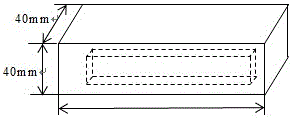
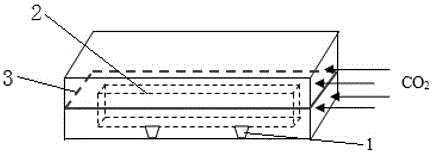
[0025] 2) Pour the stirred clean slurry into a 160mm×40mm×40mm (length×width×height) cement experiment forming mold, and put two small stones 1 with a height of 5mm along the length direction of the bottom in the mold;

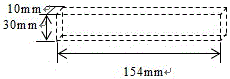
[0026] 3) Prefabricated regular limestone flakes 2 (such as figure 1 Shown) the surface is coated with a layer of grout, and then as figure 2 As shown, slowly put it into the middle of the mold where the slurry has been poured, and place the small stone 1 on the bottom of the stone flake 2, so that...

Embodiment 2

[0031] Roughly the same as Example 1, the difference is that the proportion of the cement paste used is

[0032] Water cement ratio

water / g

Cement / g

0.35

420

1200

[0033] Add 345g of distilled water and 1500g of cement successively to the slurry mixer, and stir evenly. Put two pebbles 1 with a height of 10 mm in the mold along the length direction of the bottom, and apply a layer of cement slurry on the surface of the prefabricated regular granite slice 2 with a size of 5 mm × 20 mm × 150 mm, which has been washed and dried for 24 hours. Then slowly put it into the middle of the mold where the slurry has been poured, and place the small stone 1 on the bottom of the stone flake 2, so that the stone flake 2 is completely submerged in the slurry and keeps a distance of 10mm from the upper and lower slurry surfaces. Keep a distance of 5 mm between the left and right sides of the slurry as a laitance layer.

[0034] The measured carbonization ...

Embodiment 3

[0036] Roughly the same as Example 1, the difference is that the proportion of the cement paste used is

[0037] Water cement ratio

water / g

Cement / g

[0038] 0.23

276

1200

[0039] Step 1) Add 276g of distilled water and 1200g of cement successively to the slurry mixer, and stir evenly. Put two small stones 1 with a height of 8mm along the length direction of the bottom in the mold, and smear a layer of cement slurry on the surface of the prefabricated regular marble slice 2 with a size of 7mm×25mm×152mm that has been washed and dried for 24 hours in advance, Then slowly put it into the middle of the mold where the slurry has been poured, and place the small stone 1 on the bottom of the stone flake 2, so that the stone flake 2 is completely submerged in the slurry and keeps a distance of 8 mm from the upper and lower slurry surfaces. Keep a distance of 4mm between the left and right sides of the slurry as a laitance layer.

[0040]...

the structure of the environmentally friendly knitted fabric provided by the present invention; figure 2 Flow chart of the yarn wrapping machine for environmentally friendly knitted fabrics and storage devices; image 3 Is the parameter map of the yarn covering machine
Login to View More

PUM

No PUM Login to View More

Abstract

The invention discloses a test method for characterizing the influence of the cement-based material aggregate base material interface on the carbonization speed. Cement slurry or mortar is poured into a cement forming mold of 160mm×40mm×40mm (length×width×height). Place a stone flake of fixed size in place, leave one side for carbonization, and seal the other surfaces with paraffin. After carbonization reaches the set time, cut the specimen along the carbonization direction to expose the internal stone flake. Finally, use phenolphthalein method and thermal analysis method. or XCT and other methods to measure the depth of carbonization at the interface; the present invention intuitively reflects the 2 How does the aggregate-substrate interface in the transport direction affect the carbonization rate of the substrate itself, and avoid the mutual influence between the interfaces, explaining the mechanism of the influence of the interface on the carbonization rate of the substrate, in order to further study the range of interface effects and their superposition on the carbonization rate The influence of carbonization laid the foundation and provided a basis for the interface theory of carbonization.

Description

technical field [0001] The invention relates to the field of cement materials, in particular to a method for testing the influence of carbonization speed. Background technique [0002] At present, there are mainly related studies on the influence of aggregates on the carbonation rate of concrete from the volume content, gradation and variety of aggregates, but there is no research from the perspective of the aggregate-substrate interface. Existing materials have shown that the interface has a significant influence on the transport performance, so this factor needs to be considered in the establishment of the carbonization depth prediction model, but so far there is no carbonization prediction model that considers the influence of the aggregate-substrate interface. The existing carbonation prediction models involving microstructure factors reported that when the microstructure transitions to mortar or concrete models, only the influence of aggregate content is considered, and...

Claims

the structure of the environmentally friendly knitted fabric provided by the present invention; figure 2 Flow chart of the yarn wrapping machine for environmentally friendly knitted fabrics and storage devices; image 3 Is the parameter map of the yarn covering machine
Login to View More

Application Information

Patent Timeline
no application Login to View More
Patent Type & Authority Patents(China)
IPC IPC(8): G01N13/00G01N13/04
Inventor 潘钢华占华刚潘文佳
Owner SOUTHEAST UNIV
Features
  • R&D
  • Intellectual Property
  • Life Sciences
  • Materials
  • Tech Scout
Why Patsnap Eureka
  • Unparalleled Data Quality
  • Higher Quality Content
  • 60% Fewer Hallucinations
Social media
Patsnap Eureka Blog
Learn More