

Indoor evacuation simulating optimization method based on potential energy driving cellular ant colony algorithm
A technology of ant colony algorithm and optimization method, which is applied in the fields of calculation, calculation model, special data processing application, etc., and can solve the problem of local minimization of artificial potential energy field.
Patent Information
- Authority / Receiving Office
- CN · China
- Current Assignee / Owner
- Publication Date
- 2015-02-18
- Estimated Expiration
- Not applicable · inactive patent
Smart Images
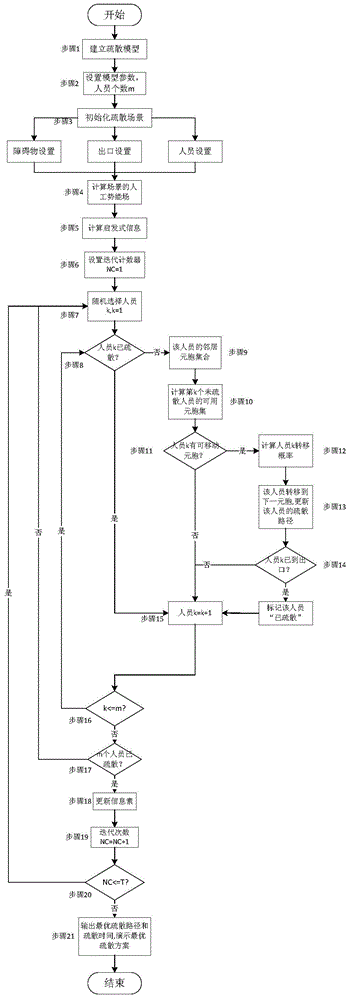
Figure 1 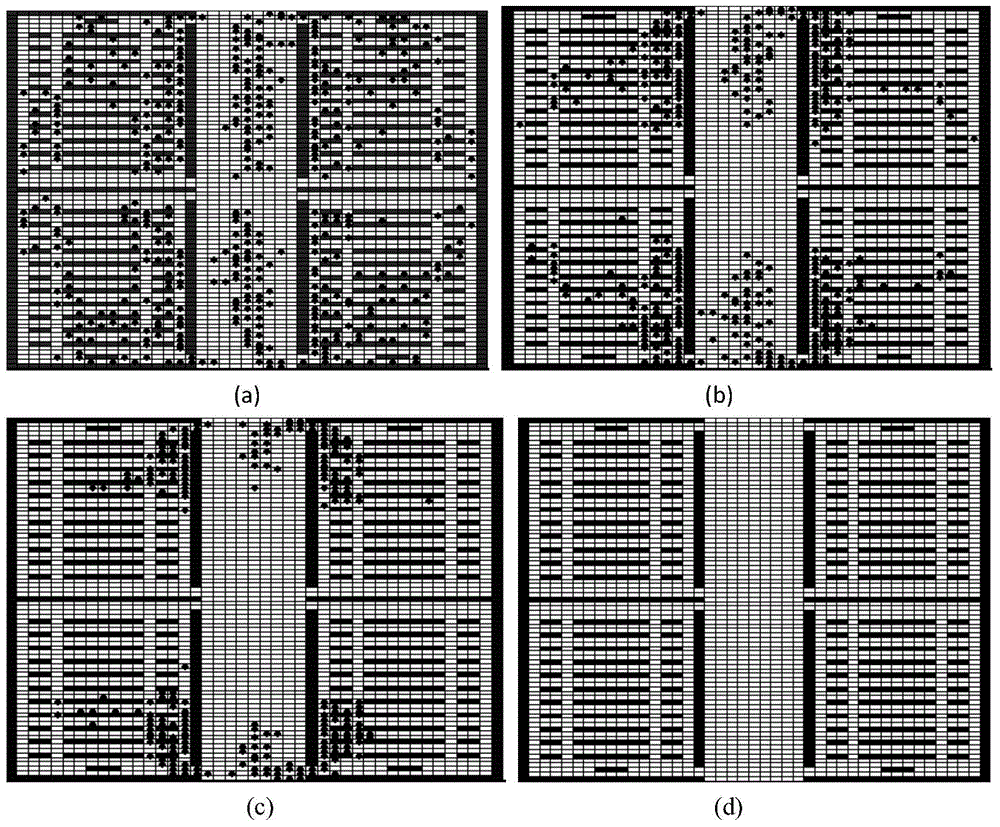
Figure 2 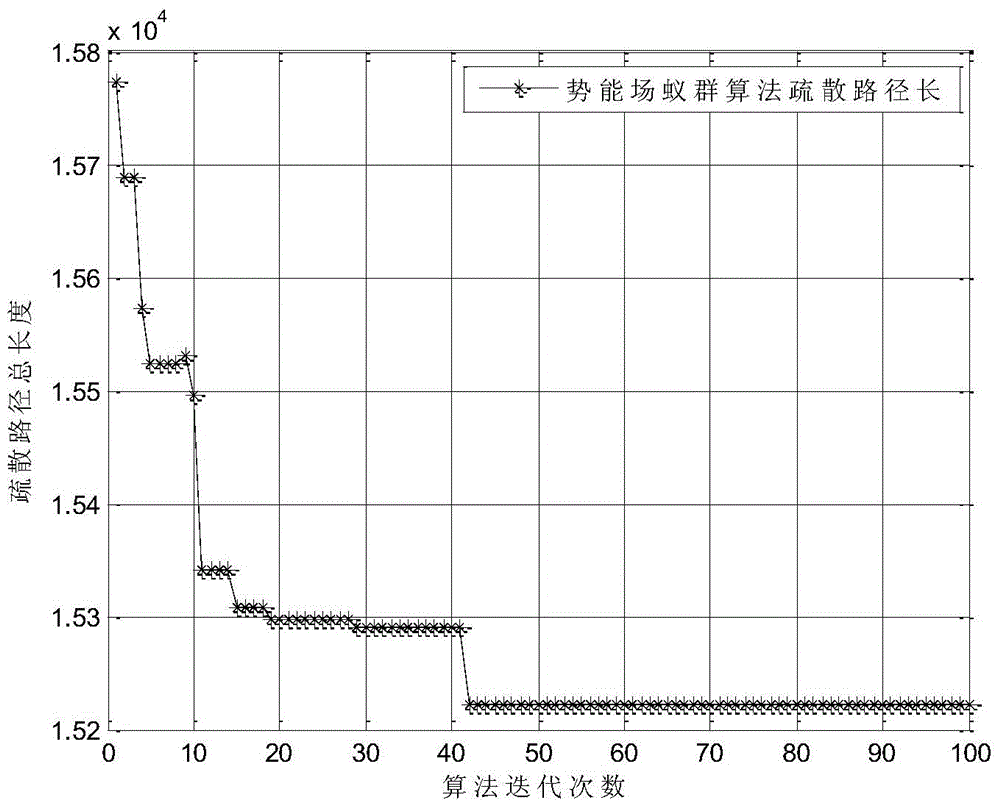
Figure 3
Abstract
Description
technical field
[0001] The invention belongs to the field of intelligent system modeling and optimization, in particular to an indoor evacuation simulation optimization method based on a potential energy-driven cellular ant colony algorithm. Background technique
[0002] The evacuation problem can be abstracted into a complex large-scale dynamic network according to the evacuation scene. The simplest and direct method is to use the traditional shortest path algorithm to solve it, but this algorithm is suitable for path optimization of small-scale static road networks, while for large-scale In a dynamic network, when the network scale increases, the complexity of the algorithm will increase rapidly. This traditional shortest path algorithm cannot meet the needs of the system due to the lack of computing power. Since the calculation time of the intelligent algorithm does not increase significantly with the increase of the network size, it is more suitable for solving the path ...
Examples
Embodiment Construction
[0073] 1. Establish a two-dimensional cellular automaton model for building evacuation:
[0074] A cellular automaton can be defined as a quadruple:
[0075] C=(D 2 ,S,N,f)
[0076] where D 2 is a 2-dimensional cell space; S is a set of finite state machines, and the state of a cell located on grid position r at time t can be expressed as:
[0077] S={S 1 (r,t),S 2 (r,t),...,S k (r,t)}
[0078] where S k (r, t) represents the kth state of the cell on the grid position r at time t; N is the neighborhood with r as the center cell, N={N 1 ,N 2 ,...,N n} is D 2 A limited subset of sequences.
[0079] f is the movement rule between the central cell r and its neighbors. Here, the definition of Moore-type neighbors is used, that is, the cells in the eight directions of the central cell’s upper, lower, left, right, upper left, lower left, upper right, and lower right are Its neighbors, at this time, the neighbor radius is also r=l, and this neighbor model is usually calle...