
Cold rolling process capable of preventing broken edge wave defect of ultrathin steel strip
A technology of ultra-thin strips and broken edges, which is applied in the field of steel rolling, can solve the problems of reducing market competitive advantages and rising production costs, and achieves the effects of reducing harmful contact stress, uniform pressure, and improving friction conditions
- Summary
- Abstract
- Description
- Claims
- Application Information
AI Technical Summary
Problems solved by technology
Method used
Image

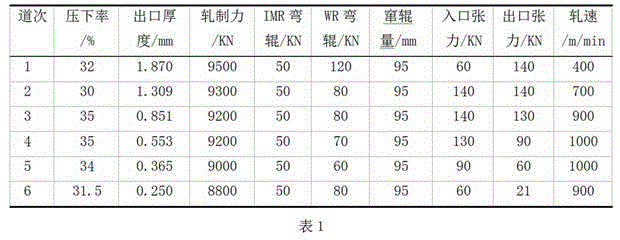
Examples
Embodiment Construction
[0013] The present invention will be further described below.
[0014] The cold-rolling process for preventing the chipped edge defect of the ultra-thin strip includes the following steps:
[0015] a) Set the temperature of the emulsion lubricated by the rolling mill to 55-58°C, the concentration to 2.5-4.0%, and the saponification value to 160-180mgKOH / g. Increase the temperature of the emulsion from 50-55°C to 55-58°C, the aggravation of the thermal movement of the rolling oil molecules and the clean emulsion sucked into the roll gap can increase the process lubrication effect at the limit pressure and improve the internal friction conditions of the roll gap , significantly reduce the rolling force of the pass; the appropriate increase in the temperature of the emulsion can reduce the cooling effect on the roll gap, increase the thermal crown of the roll, reduce the amount of flattening at both ends of the roll, reduce edge thinning, and prevent edge chipping wave defects. ...
PUM
 Login to View More
 Abstract
Description
Claims
Application Information
 Login to View More