Check patentability & draft patents in minutes with Patsnap Eureka AI!

Cloning method and application of preferential expression promoters in peanut seed

A promoter and seed technology, applied in the fields of molecular genetics and plant transgenics, can solve problems affecting the normal development of plants and energy waste

Inactive Publication Date: 2015-09-09
BIOTECH RES CENT SHANDONG ACADEMY OF AGRI SCI +1
View PDF2 Cites 1 Cited by
  • Summary
  • Abstract
  • Description
  • Claims
  • Application Information

AI Technical Summary

Problems solved by technology

However, the overexpression of many genes with specific spatiotemporal expression often leads to energy waste, and the constitutive high expression of some exogenous genes also affects the normal development of plants.

Method used

the structure of the environmentally friendly knitted fabric provided by the present invention; figure 2 Flow chart of the yarn wrapping machine for environmentally friendly knitted fabrics and storage devices; image 3 Is the parameter map of the yarn covering machine
View more

Image

Smart Image Click on the blue labels to locate them in the text.
Viewing Examples
Smart Image
  • Cloning method and application of preferential expression promoters in peanut seed
  • Cloning method and application of preferential expression promoters in peanut seed
  • Cloning method and application of preferential expression promoters in peanut seed

Examples

Experimental program
Comparison scheme
Effect test

Embodiment 1

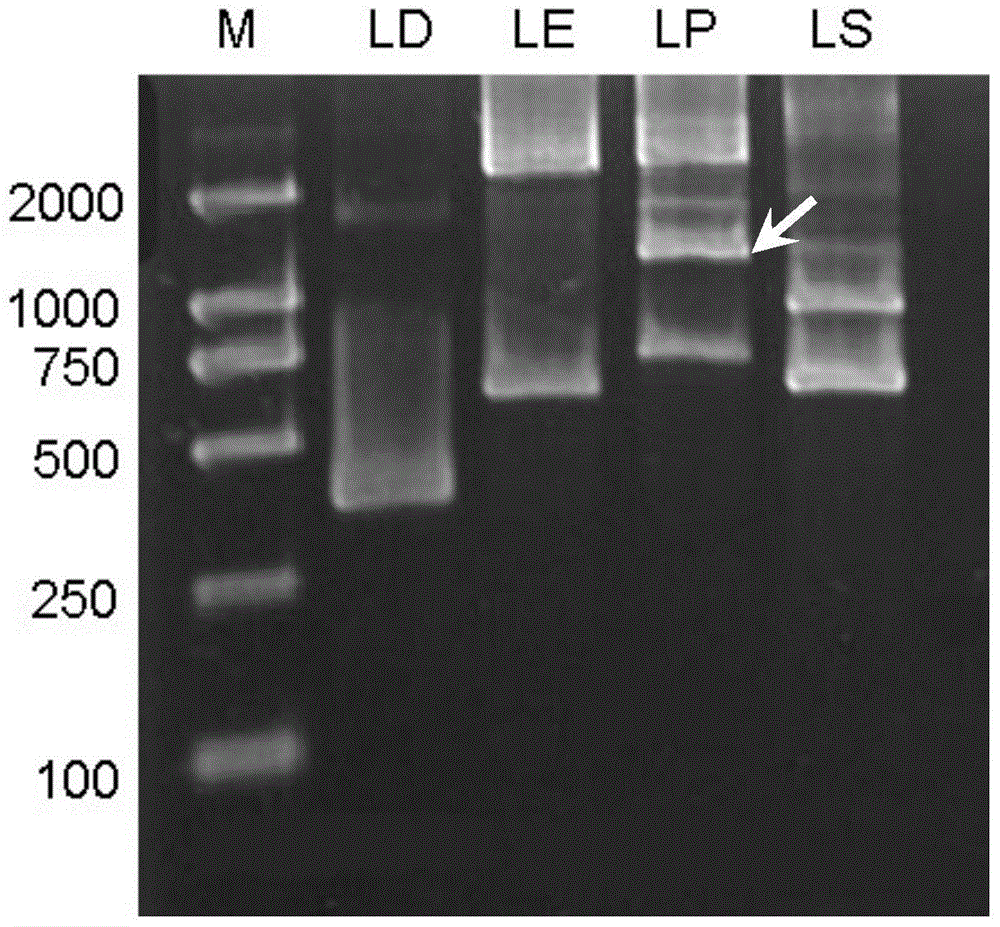
[0023] Example 1 Cloning of Peanut AhLEC1B Gene Promoter

[0024] 1.1 Extraction of peanut genomic DNA

[0025] Use the method provided by the plant DNA extraction kit (product of Beijing Tiangen Biochemical Technology Co., Ltd.) to extract the DNA of young peanut leaves, and dissolve it in an appropriate amount of TE (pH8.0) buffer;

[0026] 1.2 Cloning of peanut AhLEC1B gene promoter

[0027] 2.5 μg of peanut genomic DNA was digested with DraI, EcoRV, PvuII, and StuI endonucleases, extracted and purified with phenol, and dissolved in 20 μl of TE (pH 7.5) buffer. Take 4 μl of digested complete DNA, connect to Adaptor according to the requirements of BD GenomeWalker Universal Kit (sequence: 5'GTAATACGACTCACTATAGGGCACGCGTGGTCGACGGCCCGGGCTGGT 3', as shown in Seq ID No:5), and construct 4 peanut genomic DNA libraries (LD, LE, LP, LS). According to the obtained genome sequence of the peanut AhLEC1B gene, two nested 3' end-specific primers LEC1BGSP2-1 (5'CCTTGTTCCCATGTAAAACCATGA...

Embodiment 2

[0041] Construction and Transformation of Embodiment 2 Plant Expression Vector

[0042] 2.1 Fusion of peanut AhLEC1B gene promoter sequence and GUS reporter gene

[0043]Select pCAMBIA3301 as the plant expression vector, digest the cloning vector with the target fragment correctly sequenced, and recover the target fragment by electrophoresis and gel. At the same time, the expression vector was digested with restriction endonucleases HindⅢ and NcoI, and the vector fragment was recovered. The promoter fragment and the vector fragment were connected, and pCAMBIA3301-AhLEC1B promoter recombinant vectors containing promoters of different lengths were screened by plasmid restriction map identification. The specific process can refer to Figure 4 Shown:

[0044] 1. Use primers F1 and R1 and R2 with restriction sites to amplify the promoter segments of different lengths of the AhLEC1B gene, separate and recover the target fragments by gel electrophoresis, clone them into the pEASY-...

the structure of the environmentally friendly knitted fabric provided by the present invention; figure 2 Flow chart of the yarn wrapping machine for environmentally friendly knitted fabrics and storage devices; image 3 Is the parameter map of the yarn covering machine
Login to View More

PUM

No PUM Login to View More

Abstract

The invention discloses a cloning method and application of preferential expression promoters in a peanut seed, belonging to the technical field of biology. The cloning method comprises the step of cloning peanuts to obtain promoters of two peanut AhLEC1B genes, wherein the nucleotide sequences of the promoters are as shown in Seq ID No:1 or Seq ID No:2, and the two promoters are proven by GUS histochemical staining to drive the genes to mainly express in seeds, but have extremely-low expression quantity in roots, stems, leaves and flowers of plants. Inventors establish plant expression vectors of GUS reporter genes driven by the promoters on the basis of the functions of the promoters, the plant expression vectors are converted into arabidopsis, and the promoters are proven to be used for researching seed development and reserve material accumulation as well as carrying out genetic improvement on gene engineering.

Description

technical field [0001] The invention relates to the field of molecular genetics, in particular to the field of plant transgenic technology, in particular to the cloning and application of a new promoter capable of predominantly expressing in peanut seeds. Background technique [0002] Seeds play an important role in agricultural production and national economy. Statistics show that 80% of human food is directly taken from the seeds of plants. Rice, wheat and other seeds are rich in starch, which is the staple food for human survival; soybeans, peanuts, rapeseed, sesame and other seeds have high oil content and are edible. main source of oil. The amount and composition of stored substances in seeds directly affect the yield and quality of crops. Therefore, the root of improving the yield and quality of food crops and oil crops is to increase and improve the accumulation and composition of storage substances in their seeds. Although the excellent crop varieties cultivated b...

Claims

the structure of the environmentally friendly knitted fabric provided by the present invention; figure 2 Flow chart of the yarn wrapping machine for environmentally friendly knitted fabrics and storage devices; image 3 Is the parameter map of the yarn covering machine
Login to View More

Application Information

Patent Timeline
no application Login to View More
Patent Type & Authority Applications(China)
IPC IPC(8): C12N15/11C12N15/82A01H5/00
Inventor 单雷唐桂英徐平丽柳展基
Owner BIOTECH RES CENT SHANDONG ACADEMY OF AGRI SCI
Features
  • R&D
  • Intellectual Property
  • Life Sciences
  • Materials
  • Tech Scout
Why Patsnap Eureka
  • Unparalleled Data Quality
  • Higher Quality Content
  • 60% Fewer Hallucinations
Social media
Patsnap Eureka Blog
Learn More