Peanut seed embryo specificity promoter and cloning and application thereof
A promoter and specific technology, applied in the field of plant transgenic and molecular genetics, can solve the problems affecting the normal development of plants and energy waste
- Summary
- Abstract
- Description
- Claims
- Application Information
AI Technical Summary
Problems solved by technology
Method used
Image

Examples
Embodiment 1
[0027] Example 1 Cloning of Peanut AhLEC1A Gene Promoter
[0028] 1.1 Extraction of peanut genomic DNA
[0029] The DNA of young peanut leaves was extracted with the method provided by the plant DNA extraction kit (product of Beijing Tiangen Biochemical Technology Co., Ltd.), and dissolved in an appropriate amount of TE (pH 8.0) buffer.
[0030] 1.2 Cloning of peanut AhLEC1A gene promoter
[0031] 2.5 μg of peanut genomic DNA was digested with DraI, EcoRV, PvuII, StuI endonucleases, extracted and purified with phenol, and dissolved in 20 μl of TE (pH7.5) buffer. Take 4 μl of digested complete DNA, connect to Adaptor according to the requirements of BD Genome Walker Universal Kit (sequence: 5′GTAATACGACTCACTATAGGGCACGCGTGGTCGACGGCCCGGGCTGGT 3′, as shown in Seq ID No:5), and construct 4 peanut genomic DNA libraries (LD, LE , LP, LS). According to the obtained genome sequence of the peanut AhLEC1A gene, two nested 3′ end-specific primers LEC1AGSP1-3 (5′TGGGGATGGATAGAGAAACCAACG...
Embodiment 2
[0046] Example 2 Construction and Transformation of Plant Expression Vectors
[0047] 2.1 Fusion of peanut AhLEC1A gene promoter sequence and GUS reporter gene
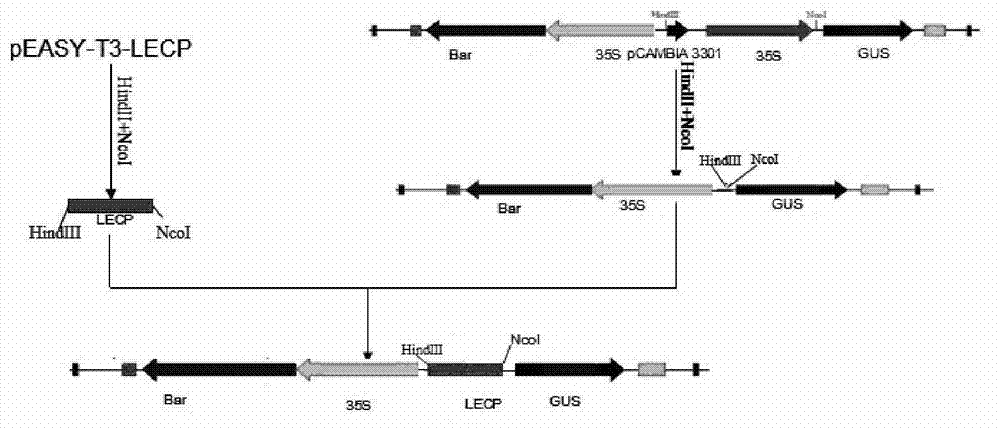
[0048] Select pCAMBIA3301 as the plant expression vector, digest the target fragment obtained by PCR amplification, electrophoresis and gel recovery. At the same time, the expression vector was digested with restriction endonucleases HindⅢ and NcoI, and the vector fragment was recovered. The promoter fragment and the vector fragment were connected, and pCAMBIA3301-AhLEC1A promoter recombinant vectors containing promoters of different lengths were screened by plasmid restriction map identification. The specific process can refer to the attached image 3 :
[0049] 1. Use primers P1 with restriction sites and P2-P8 with different restriction sites to amplify the different length promoter sequences of peanut AhLEC1A gene, and separate and recover the target fragments by gel electrophoresis.
[0050] 2. Recover the targ...
Embodiment 3
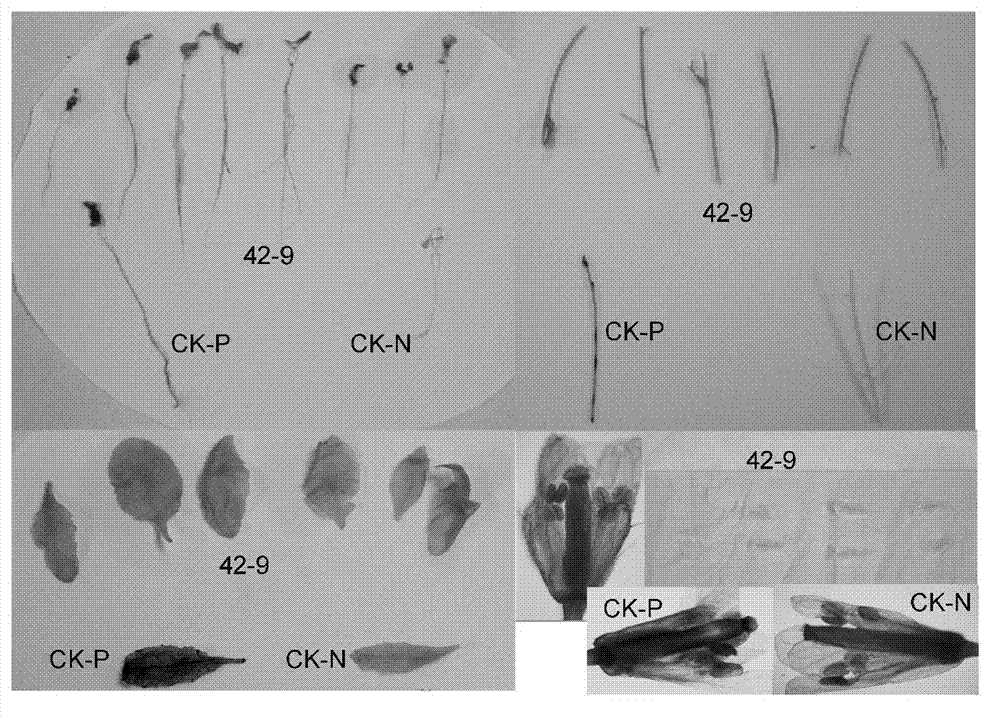
[0074] Example 3 Histochemical staining of GUS activity on seeds of different tissues and different developmental stages of transgenic plants
[0075] 3.1 GUS active histochemical staining method:
[0076] 1. Place the sample in an ice-water mixture for 2 minutes;
[0077] 2. Dry the sample with filter paper and put it into a centrifuge tube, add 90% acetone to soak the sample for 10 minutes;
[0078] 3. After washing the sample quickly with GUS staining buffer, add GUS staining solution and soak for 5 minutes, and pour off the dyeing solution;
[0079] 4. Add an appropriate amount of dye solution to immerse the sample, and pump air twice, 5 minutes each time;
[0080] Store overnight at 5.37°C constant temperature;
[0081] 6. Add absolute ethanol to decolorize, then transfer to water. Observe and take pictures with the naked eye or under an anatomical microscope.
[0082] 3.2 GUS staining buffer formula:
[0083] 100ml buffer
[0084]
[0085] wxya 2 O was adjuste...
PUM
 Login to View More
 Abstract
Description
Claims
Application Information
 Login to View More
 - R&D
- Intellectual Property
- Life Sciences
- Materials
- Tech Scout
- Unparalleled Data Quality
- Higher Quality Content
- 60% Fewer Hallucinations
Browse by: Latest US Patents, China's latest patents, Technical Efficacy Thesaurus, Application Domain, Technology Topic, Popular Technical Reports.
© 2025 PatSnap. All rights reserved.Legal|Privacy policy|Modern Slavery Act Transparency Statement|Sitemap|About US| Contact US: help@patsnap.com