High-efficient resource allocation method based on sensitivity in reconfigurable network
A resource allocation and sensitivity technology, applied in the field of network communication, can solve problems such as low time complexity and lower network request acceptance rate, and achieve the effects of reducing delay, increasing average request acceptance rate, and improving overall performance
- Summary
- Abstract
- Description
- Claims
- Application Information
AI Technical Summary
Problems solved by technology
Method used
Image



Examples
Embodiment 1
[0033] Such as figure 1 As shown, an efficient resource allocation method based on sensitivity in a reconfigurable network, the method includes the following steps:
[0034] A1. In a reconfigurable network with limited resources, first use the layered graph and capacity tracking algorithm to process end-to-end connection requests, and select the service path with the lowest delay among all effective service paths; then calculate the reconfigurable network Sensitivity Sen(i) of each node i in , at the same time calculate the average utilization of CPU resources of the node and link bandwidth resource average utilization The sensitivity Sen(i) of node i is the difference between the average request acceptance rate of the reconfigurable network and the average request acceptance rate when the node i and its associated links are absent.
[0035] A2. Calculate the difference ΔSen between the maximum value and the second maximum value of the sensitivity Sen(i), and calculate the...
Embodiment 2
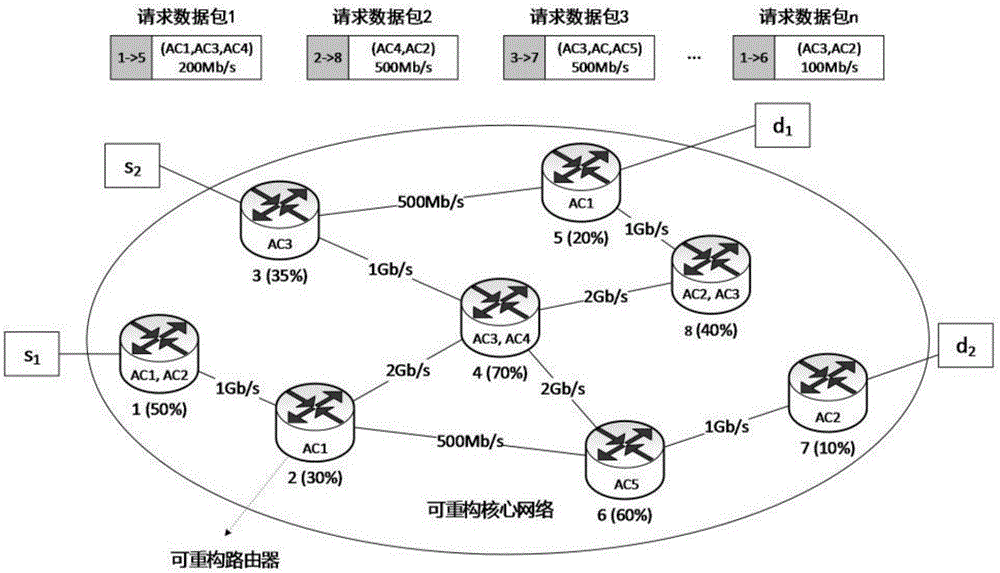
[0047] Such as figure 2 As shown, the reconfigurable core network includes 8 reconfigurable routers numbered 1-8 in sequence, and each router node can realize different types of meta-capabilities, for example: node 1 can realize meta-capability AC1 and meta-capability AC2, available CPU resources are at 50%. In the working environment, the reconfigurable core network will continuously receive end-to-end connection requests. The request packet contains the source node and destination node, functional requirements and performance requirements. For example, in the request packet 1, the source node is Node 1, the destination node is node 5, the functional requirements are the combination of meta-capabilities (AC1, AC3, AC4), the performance requirements are bandwidth requirements of 200Mb / s, and the computing resource requirements of the three meta-capabilities are determined by the CPU computing speed and data volume . In order to meet the requirements in the request packet 1,...
Embodiment 3
[0056] This embodiment specifically explains the process of allocating CPU resources to the node with the largest sensitivity value.
[0057] in such as Figure 4 In the topological structure of the reconfigurable network autonomous domain 1 shown, node 7 is the node with the largest sensitivity value, node 11 is the node with the second largest sensitivity value, ΔSen=Sen(7)-Sen(11), ΔSen> alpha, The candidate bottleneck node is node 7, the number is 1, and the resource type that needs to be allocated additionally is CPU resource. For the process of allocating CPU resources to node 7, see Image 6 , through the following steps:
[0058] 1) Additional allocated CPU resources t cpu initial value t cpu (0) is 100%, and its upper limit γ cpu is 500%;
[0059] 2) Start the iterative process:
[0060] 2-1) Compare the current value t cpu (j) and upper limit γ cpu the size of:
[0061] 2-2) If t cpu (j)≤γ cpu , and then increase the CPU resource of Δcpu, that is, t ...
PUM
 Login to View More
 Abstract
Description
Claims
Application Information
 Login to View More