
Stable underwater communication node awakening signal detection method
A wake-up signal and underwater communication technology, applied in wireless communication, sustainable communication technology, advanced technology, etc., can solve the problems of low frequency resolution, poor ability to adapt to environmental noise, and increase false alarms
- Summary
- Abstract
- Description
- Claims
- Application Information
AI Technical Summary
Problems solved by technology
Method used
Image

Examples
Embodiment Construction
[0032] The present invention will be described in further detail below in conjunction with the accompanying drawings.
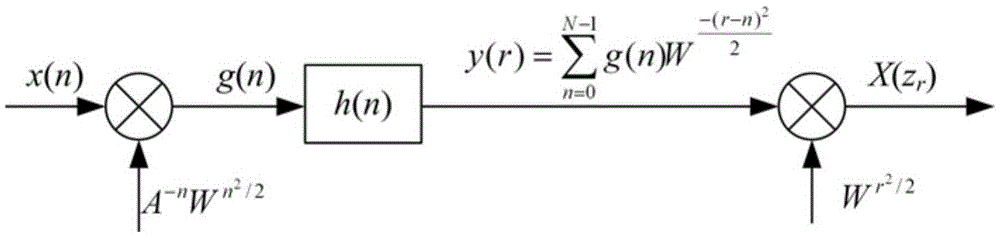
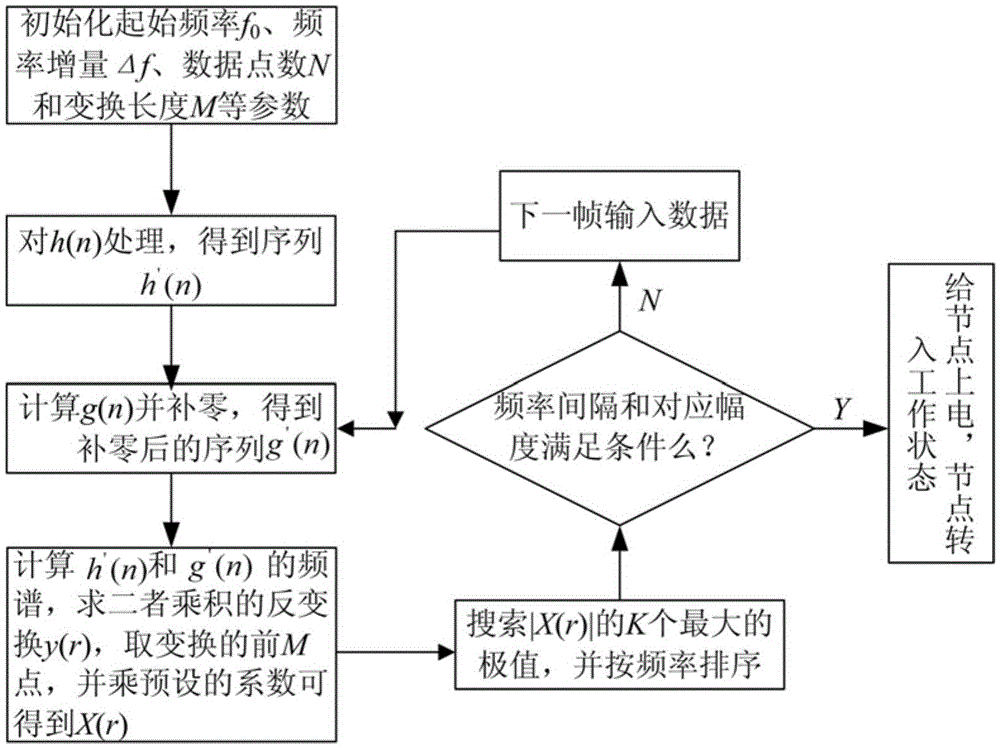
[0033] The main purpose of the present invention is to provide a wake-up signal detection algorithm for underwater wireless sensor network communication nodes, by designing dual-frequency or multi-frequency wake-up signals with similar frequencies, combined with chirp Z transform (ChirpZTransform, CZT) on the unit circle ) to refine the spectrum, and use the relatively constant characteristics of frequency interval and amplitude parameters to discriminate the signal, so as to solve the problems of poor anti-interference ability and high false alarm in existing methods. The specific technical scheme is as follows:
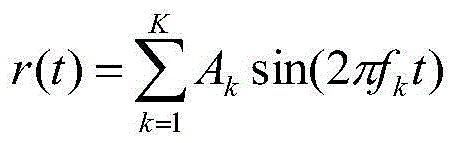
[0034] 1. The reference form of the transmitted wake-up signal is shown in formula (1):
[0035] r ( t ) = Σ k = ...
PUM
 Login to View More
 Abstract
Description
Claims
Application Information
 Login to View More