A low-thermal-conduction class A non-combustible sandwich insulation board and its manufacturing method

A technology of low thermal conductivity and thermal insulation boards, applied in thermal insulation, insulation improvement, building components, etc., can solve the problems of long production cycle, poor fire performance, and many safety hazards, and achieve improved waterproof and weather resistance, high impact strength, The effect of high bonding strength between layers

A technology of low thermal conductivity and thermal insulation boards, applied in thermal insulation, insulation improvement, building components, etc., can solve the problems of long production cycle, poor fire performance, and many safety hazards, and achieve improved waterproof and weather resistance, high impact strength, The effect of high bonding strength between layers

CN105544755BActive Publication Date: 2017-10-27徐振飞

Image

Smart Image Click on the blue labels to locate them in the text.
Viewing Examples
Smart Image
  • A low-thermal-conduction class A non-combustible sandwich insulation board and its manufacturing method
  • A low-thermal-conduction class A non-combustible sandwich insulation board and its manufacturing method
  • A low-thermal-conduction class A non-combustible sandwich insulation board and its manufacturing method

Examples

Experimental program
Comparison scheme
Effect test

Embodiment 1

[0038] The modified polyurethane rigid foam is prepared from the following raw material ratios by weight: 55 parts of polyol materials, 5 parts of ethylenediamine polyoxypropylene tetraol, 4 parts of melamine, 0.2 parts of triethylenediamine solution, 15 parts of ethyl chloride, 1 part of polyalkoxy ether copolymer, 5 parts of trichloroethyl phosphate, 44 parts of isocyanate;

Embodiment 2

[0040] The modified polyurethane rigid foam is prepared from the following raw material proportions by weight: 75 parts of polyol material, 30 parts of ethylenediamine polyoxypropylene tetraol, 6 parts of melamine, 0.5 part of triethylenediamine solution, 20 parts of ethyl chloride, 2 parts of polyalkoxy ether copolymer, 12 parts of trichloroethyl phosphate, 66 parts of isocyanate;

Embodiment 3

[0042] The modified polyurethane rigid foam is prepared from the following raw material proportions by weight: 95 parts of polyol material, 40 parts of ethylenediamine polyoxypropylene tetraol, 8 parts of melamine, 0.8 part of triethylenediamine solution, 25 parts of ethyl chloride, 3 parts of polyalkoxy ether copolymer, 20 parts of trichloroethyl phosphate, 88 parts of isocyanate;

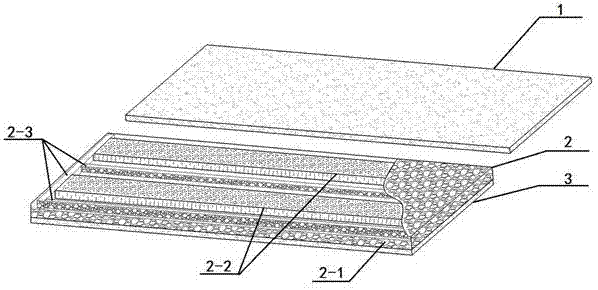
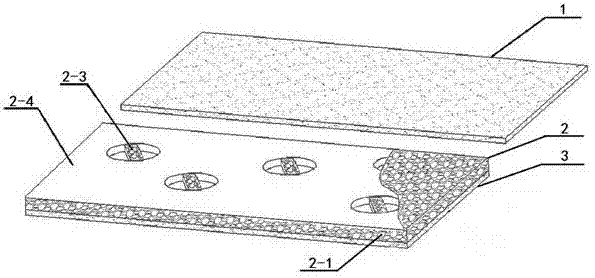
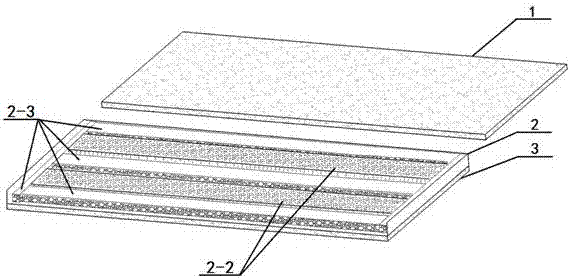
[0043] The low thermal conductivity class A non-combustible sandwich insulation board of the present invention is divided into three types of boards: A, B, and C, among which:

[0044] (1) The production method of A board is to carry out according to the following steps:

[0045] Step 1, place the upper board 1 and the lower board 3 respectively on the upper and lower crawlers of the conveying device of the insulation board production equipment, the upper and lower crawlers move synchronously, and the lower board 3 is transported to the gluing station by the lower crawler. The glue applicator spr...

the structure of the environmentally friendly knitted fabric provided by the present invention; figure 2 Flow chart of the yarn wrapping machine for environmentally friendly knitted fabrics and storage devices; image 3 Is the parameter map of the yarn covering machine
Login to View More

PUM

PropertyMeasurementUnit
thicknessaaaaaaaaaa
widthaaaaaaaaaa
thicknessaaaaaaaaaa
Login to View More

Abstract

The invention relates to a low-heat-conductivity A-grade non-ignitable sandwich insulation board and a manufacturing method thereof. The insulation board is formed by compounding a lower-layer board, a middle core layer and an upper-layer board. The upper-layer board and the lower-layer board are both high-strength fiber cement boards or high-strength calcium silicate boards or cement felt. A vacuum plate or a combined body of mineral wool sliver / mineral wool felt and modified rigid polyurethane foam is adopted as the middle core layer. The modified rigid polyurethane foam is prepared from, by weight, polyhydric alcohol materials, ethylenediamine poly propylene oxide tetraol, melamine, a triethylene diamine solution, dichloroethane, polyaldoxyl ether copolymer, tri(2-chloroethyl)phosphate and isocyanate. According to the insulation board, the advantages of organic and inorganic materials are complemented, superposition and efficiency increase can be achieved, the ideal technical effects of heat insulation and energy saving can be achieved, the fireproof grade of the insulation board can reach the grade A, and the practical technical effects of heat insulation and energy saving and fire prevention and flame retarding are achieved.

Description

technical field [0001] The invention belongs to the field of energy-saving building materials, and in particular relates to a low thermal conduction grade A non-combustible sandwich insulation board and a manufacturing method thereof. Background technique [0002] In China, building energy-saving wall insulation has become a mandatory standard in the construction industry. Usually, the thermal insulation technical measures of building walls basically adopt the method of powder spraying, pasting or externally hanging the thermal insulation layer on the outer wall of the building. Due to the influence of material characteristics, technology, climate and construction quality, the thermal insulation layer of most buildings is difficult to match. The main structure has the same life span. At the same time, some materials with good thermal insulation performance have poor fireproof performance, and materials with good fireproof performance have strong water absorption. After abso...

Claims

the structure of the environmentally friendly knitted fabric provided by the present invention; figure 2 Flow chart of the yarn wrapping machine for environmentally friendly knitted fabrics and storage devices; image 3 Is the parameter map of the yarn covering machine
Login to View More

Application Information

Patent Timeline
27 Oct 2017
Publication
CN105544755B
IPC
E04B1/80; E04B1/94; E04F13/075; C08G18/50
CPC
C08G18/5021; E04B1/80; E04B1/942; E04F13/0866; E04F2290/04; E04F2290/045; Y02A30/242; Y02B80/10
Inventors
徐振飞; 徐硕