Human motion local characteristic representation method and application in behavior identification thereof

A technology of local features and human movements, applied in the field of image recognition, can solve the problems of difficult movement change process, low recognition effect, qualitative interpretation of physical attributes of human movements, etc.

CN106066996AInactive Publication Date: 2016-11-02UNIV OF SHANGHAI FOR SCI & TECH
4 Cites 27 Cited by

Patent Information

Authority / Receiving Office
CN · China
Patent Type
Applications(China)
Current Assignee / Owner
Publication Date
2016-11-02
Estimated Expiration
Not applicable · inactive patent

Smart Images

  • Figure 1
    Figure 1
  • Figure 2
    Figure 2
  • Figure 3
    Figure 3
Patent Text Reader

Abstract

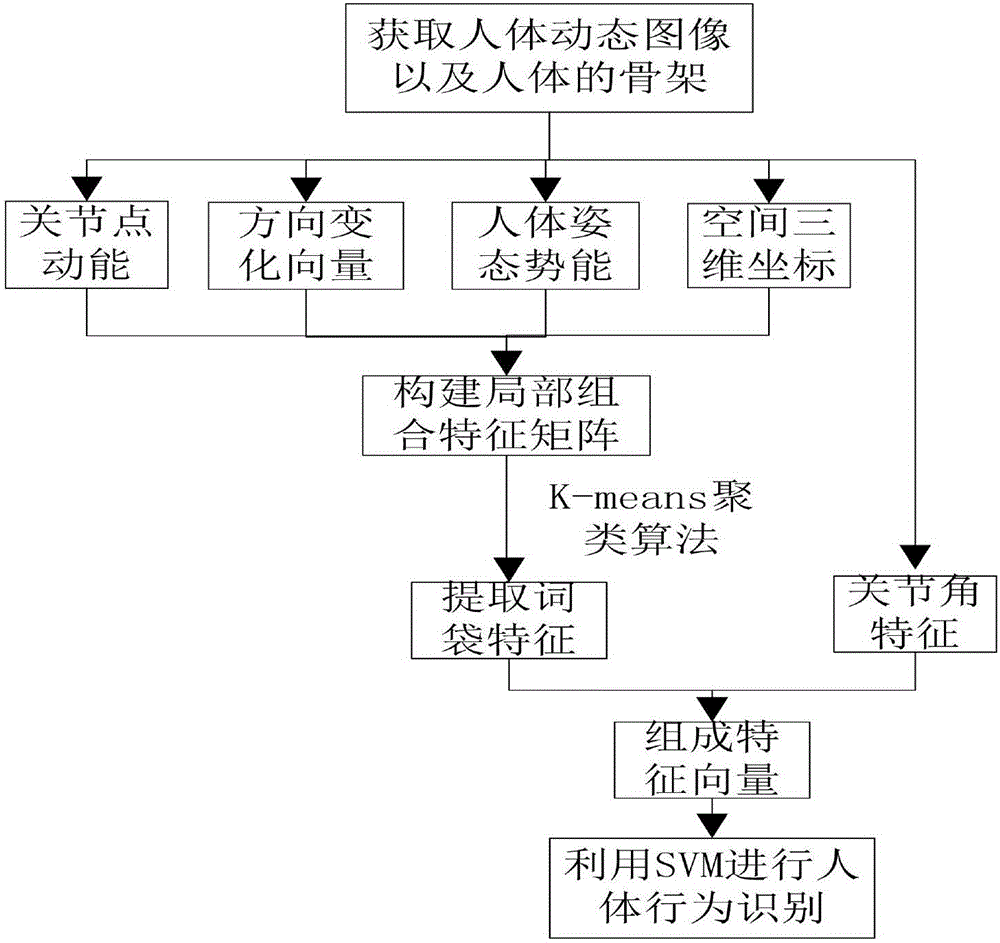
The invention relates to the field of image processing and image identification, and particularly relates to a human motion local characteristic representation method and an application in behavior identification thereof. The human motion local characteristic representation method comprises the following steps that firstly kinetic energy of human bone joints, the position coordinates of the human bone joints, the direction change vectors of the human bone joints and posture potential energy of the human bone joints are extracted from the perspective of energy according to human behavior biological and kinematic characteristics so that a local characteristic combination matrix is constructed; and then dimension reduction is performed on the local characteristic matrix by utilizing K-means clustering and bag of word (BOW) characteristics are extracted, characteristic vectors used for behavior identification are formed through combination of human joint angle characteristics, and the characteristic vectors are applied to the field of human behavior identification so that the method has great effect through experimental verification.
Need to check novelty before this filing date? Find Prior Art

Description

technical field

[0001] The invention relates to a local feature extraction method based on three-dimensional space information of a human body in the field of image processing and image recognition, belonging to the field of image recognition. Background technique

[0002] In recent years, with the widespread use of video equipment and 3D cameras, behavior recognition based on 3D information has received widespread attention and attention because of its small environmental impact. After searching the existing literature, it was found that Gu J. et al [Gu J, Ding X, Wang S, et al. Action and gait recognition from recovered3-D human joints [J]. Systems, Man, and Cybernetics, Part B: Cybernetics, IEEE Transactionson, 2010, 40(4): 1021-1033.] It is believed that the three-dimensional space position sequence of human joint points can well describe the human body movement process, Junxia G. et al. [Junxia G, Xiaoqing D, Shengjin W, et al. al.Full body tracking-based human action ...

Examples

Embodiment Construction

[0051] The specific implementation manners of the present invention will be described below in conjunction with the accompanying drawings.

[0052] figure 1 is a schematic flow chart of the method for representing local features of human body movements in this embodiment.

[0053] The first step is to use Microsoft's Kinect SDK (kinect sdk for windows hardware and software) to obtain human body dynamic images and human skeletons. The skeleton is composed of 20 joint points and 13 line segments connecting joints, such as hands and necks , torso, left shoulder, left elbow, left palm, right shoulder, etc. The database used in this embodiment is Dataset-1200 (CAD-60) of Cornell University. The human skeleton model in the database is composed of 15 human skeleton joint points, and the specific order and numbers are shown in Table 1. Thus, the three-dimensional coordinates (x i,t ,y i,t ,z i,t ) information and calculate as follows:

[0054] Table 1 Joint number

[0055]

...