Unlock instant, AI-driven research and patent intelligence for your innovation.

Detection method of MIMO-OFDM (multiple-input multiple-output-orthogonal frequency division multiplexing) system based on SIM (subcarrier index modulation)

A technology of MIMO-OFDM and carrier index modulation, applied in modulation carrier system, transmission system, multi-frequency code system, etc., can solve the problems of complexity increase, ML detection algorithm complexity limit application, etc.

Inactive Publication Date: 2017-01-25
UNIV OF ELECTRONIC SCI & TECH OF CHINA
View PDF4 Cites 26 Cited by
  • Summary
  • Abstract
  • Description
  • Claims
  • Application Information

AI Technical Summary

Problems solved by technology

The ML detection algorithm in the MIMO-SIM-OFDM system needs to jointly search the index space and the symbol space. It is a joint detection algorithm with the best bit error rate performance, but the algorithm needs to exhaustively search each combination space, which is complicated. The degree increases exponentially with the number of combinations, modulation order and number of antennas
The extremely high complexity of ML detection algorithms limits its application in practical communication systems

Method used

the structure of the environmentally friendly knitted fabric provided by the present invention; figure 2 Flow chart of the yarn wrapping machine for environmentally friendly knitted fabrics and storage devices; image 3 Is the parameter map of the yarn covering machine
View more

Image

Smart Image Click on the blue labels to locate them in the text.
Viewing Examples
Smart Image
  • Detection method of MIMO-OFDM (multiple-input multiple-output-orthogonal frequency division multiplexing) system based on SIM (subcarrier index modulation)
  • Detection method of MIMO-OFDM (multiple-input multiple-output-orthogonal frequency division multiplexing) system based on SIM (subcarrier index modulation)
  • Detection method of MIMO-OFDM (multiple-input multiple-output-orthogonal frequency division multiplexing) system based on SIM (subcarrier index modulation)

Examples

Experimental program
Comparison scheme
Effect test

Embodiment Construction

[0034] The present invention will be further described in detail below in conjunction with the accompanying drawings.

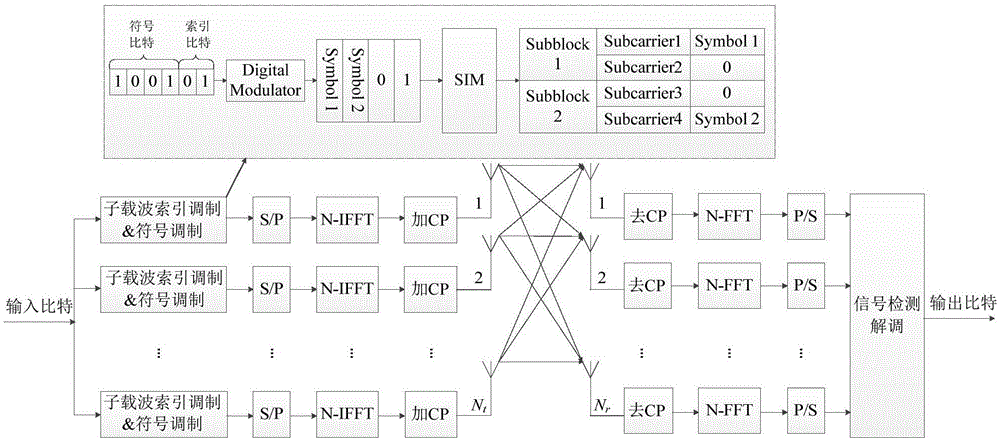
[0035] In this embodiment, the Matlab2012a simulation platform is used for experiments. The experimental simulation parameters are set as follows: the number of transmitting antennas N t =2, the number of receiving antennas N r =2, the total number of subcarriers N=512, the subcarrier configuration is L=2, K=1, the signal modulation is QPSK, and the channel in the simulation is Rayleigh fading and Gaussian white noise channel. The present invention utilizes above-mentioned parameters to carry out experimental simulation on Matlab, and this algorithm has more excellent comprehensive performance: under QPSK modulation, threshold value V th =N r Lσ 2 , when the system BER performance is 10 -5 , the bit signal-to-noise ratio E b / N 0 The loss is about 0.7dB, and the simulation statistics show that the complexity is reduced by about 90% relative to ML detec...

the structure of the environmentally friendly knitted fabric provided by the present invention; figure 2 Flow chart of the yarn wrapping machine for environmentally friendly knitted fabrics and storage devices; image 3 Is the parameter map of the yarn covering machine
Login to View More

PUM

No PUM Login to View More

Abstract

The invention belongs to the technical field of wireless communication, relates to MIMO (multiple-input multiple-output), OFDM (output-orthogonal frequency division multiplexing) and SIM (subcarrier index modulation) technologies and related signal detection technologies and provides a detection method of an MIMO-OFDM system based on SIM for an MIMO-SIM-OFDM system. The main idea of the method is as follows: (1) at the receiving end, MMSE detection is performed on a receiving symbol vector corresponding to each subcarrier, and hard decision is performed on detection symbols; (2) all index combinations are traversed, hard decision symbols corresponding to index positions in the index combinations are taken out, emission symbol vectors are obtained and multiply by corresponding channel matrixes, and then Euclidean distances between products and the receiving symbol vectors are calculated; (3) the Euclidean distances of the emission symbol vectors corresponding to all the index combinations are sequenced, and the shorter the Euclidean distances are, the higher the reliability is; (4) a threshold value is introduced, if the minimum of the Euclidean distances meets the threshold value, the corresponding index combinations and modulation symbols are directly output; otherwise, ML (maximum likelihood) detection is performed finally.

Description

technical field [0001] The invention belongs to the technical field of wireless communication, and relates to multiple-input multiple-output (Multiple-Input Multiple-Output, MIMO), orthogonal frequency division multiplexing (Orthogonal Frequency Division Multiplexing, OFDM) and carrier index modulation (Subcarrier Index Modulation, SIM) technologies and related signal detection techniques. Background technique [0002] The proposal of MIMO-OFDM system is a major breakthrough in the field of wireless mobile communication. The system combines the advantages of MIMO technology and OFDM technology, can effectively resist multipath fading and frequency selective fading, and has outstanding advantages such as large channel capacity and high transmission rate, and is one of the key technologies for the physical layer of the future wireless mobile communication system. [0003] In recent years, subcarrier index modulation (Subcarrier Index Modulation, SIM) has been proposed as a ne...

Claims

the structure of the environmentally friendly knitted fabric provided by the present invention; figure 2 Flow chart of the yarn wrapping machine for environmentally friendly knitted fabrics and storage devices; image 3 Is the parameter map of the yarn covering machine
Login to View More

Application Information

Patent Timeline
no application Login to View More
IPC IPC(8): H04B7/0413H04B7/08H04L27/26
CPCH04B7/0413H04B7/0854H04L27/2628H04L27/265H04L27/2697
Inventor 董方维肖悦雷霞李少谦
Owner UNIV OF ELECTRONIC SCI & TECH OF CHINA