
Device for optically generating radar pulse compression signals
A radar pulse and compressed signal technology, applied in microwave and photonic fields, can solve the problems of high system complexity and high cost, and achieve the effects of large frequency adjustable range, large time-bandwidth product, and stable performance
- Summary
- Abstract
- Description
- Claims
- Application Information
AI Technical Summary
Problems solved by technology
Method used
Image

Examples
Embodiment 1
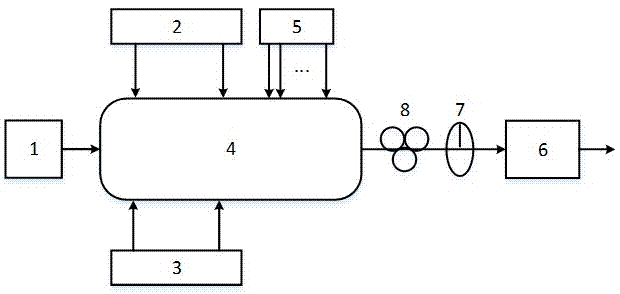
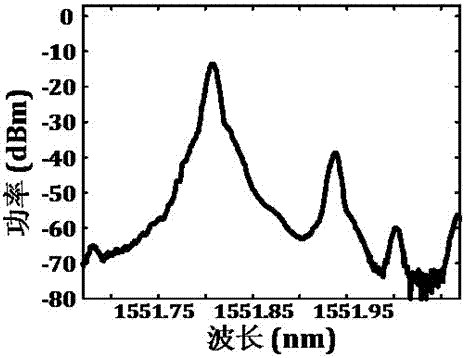
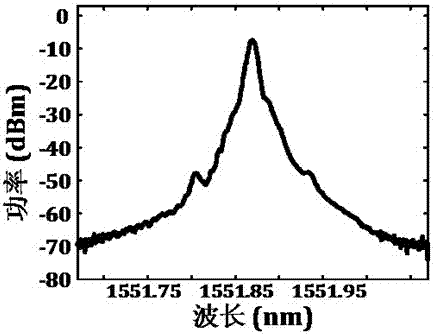
[0045] The frequency of the microwave signal output by the microwave signal source is 8GHz, which drives a sub-dual parallel Mach-Zehnder modulator of the polarization multiplexing dual-parallel Mach-Zehnder modulator. The output spectrum of the sub-dual parallel Mach-Zehnder modulator is shown in figure 2 . The coded signal generator generates a 500Mb / s binary square wave signal or a four-level ladder signal to drive another sub-parallel Mach-Zehnder modulator of the polarization multiplexing dual-parallel Mach-Zehnder modulator, and its output spectrum is shown in image 3 . The output optical signal after the polarizer is figure 2 and image 3 Coupling of optical signals shown, spectrogram see Figure 4 . The output of the photodetector is an 8GHz phase-encoded signal, and the phase information can be recovered by Hilbert transform, see Figure 5 . Change the signal generated by the encoded signal generator into a 128-bit 500Mb / s binary pseudo-random sequence or a q...
Embodiment 2
[0047] The frequency of the microwave signal output by the microwave signal source is 13 GHz, which drives a sub-dual parallel Mach-Zehnder modulator of the polarization multiplexing dual-parallel Mach-Zehnder modulator. The output spectrum of the sub-dual parallel Mach-Zehnder modulator can be found in Figure 7 . The coded signal generator generates a 500Mb / s binary square wave signal or a four-level ladder signal to drive another sub-parallel Mach-Zehnder modulator of the polarization multiplexing dual-parallel Mach-Zehnder modulator, and its output spectrum is shown in Figure 8 . The output optical signal after the polarizer is Figure 7 and Figure 8 Coupling of optical signals shown, spectrogram see Figure 9 . The output of the photodetector is a 13GHz phase-encoded signal, and the phase information can be recovered by Hilbert transform, see Figure 10 . Change the signal generated by the encoded signal generator into a 128-bit 500Mb / s binary pseudo-random sequen...
PUM
 Login to View More
 Abstract
Description
Claims
Application Information
 Login to View More