
Method of constructing recycled concrete three-dimensional random spherical aggregate model based on Python
A technology of recycled concrete and construction methods, applied in special data processing applications, instruments, electrical digital data processing, etc., can solve problems such as failure to consider multi-interface characteristics, complex mesoscopic structure of recycled aggregates, and increased workload
- Summary
- Abstract
- Description
- Claims
- Application Information
AI Technical Summary
Problems solved by technology
Method used
Image

Examples
Embodiment Construction
[0018] The present invention will be further elaborated below in conjunction with the accompanying drawings and specific embodiments.
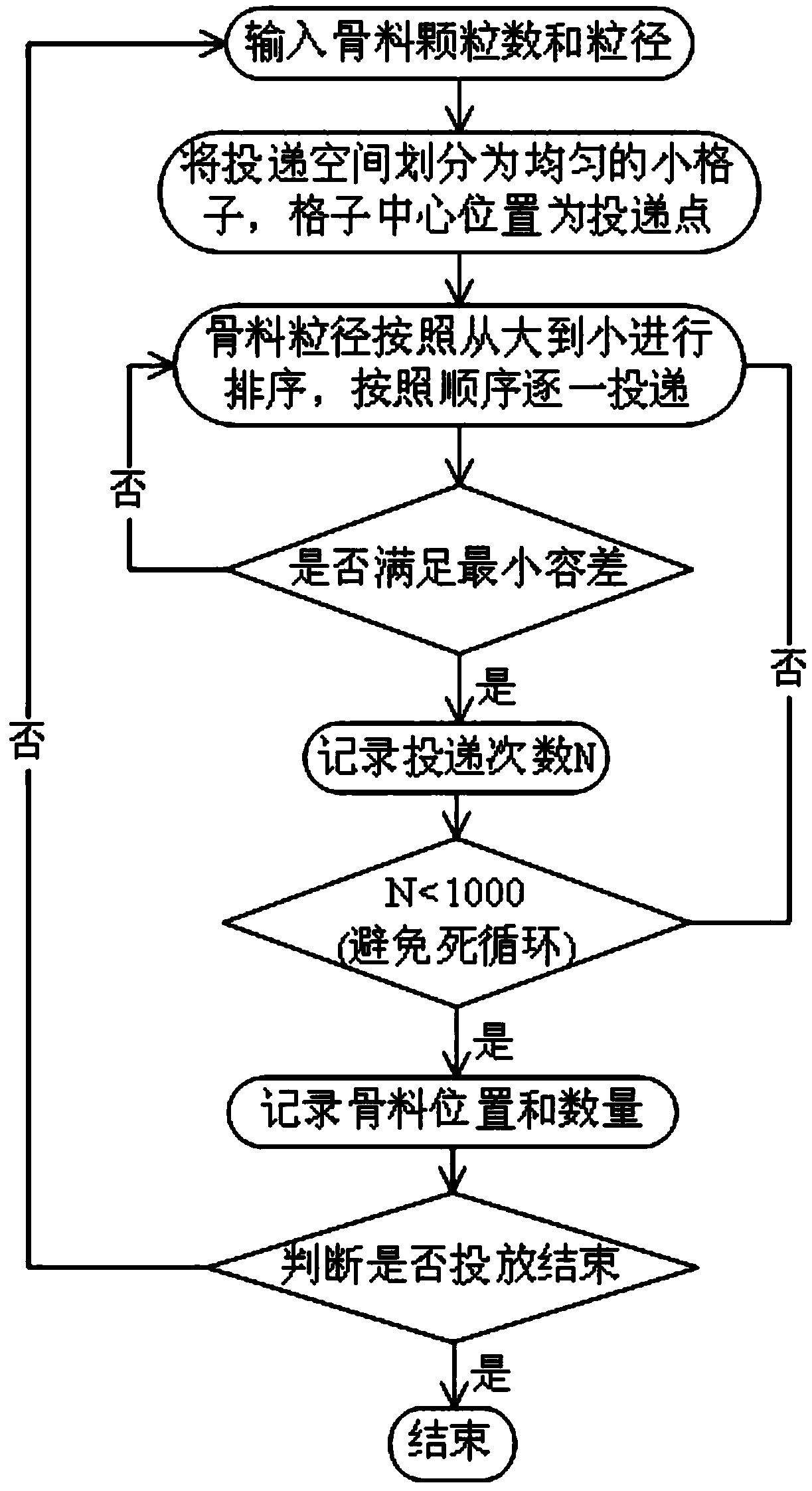
[0019] A method for constructing a three-dimensional random spherical aggregate model of recycled concrete based on python, including the following steps:
[0020] 1) Define an array for storing diameter, coordinates, and volume parameters; input basic parameters, including aggregate content, model size, and aggregate mesoscopic size;
[0021] 2), built-in particle size distribution function, built-in random function; randomly generate a floating point number from the particle size d1 to d2, and obtain a random number within the required range;
[0022] 3) Classify the particle size of the aggregate. When the sum of the accumulated aggregate volume of each level is less than the sum of the aggregate volume of the level, call the random particle size function, continue to increase the aggregate, and calculate the aggregate of each level separat...
PUM
 Login to View More
 Abstract
Description
Claims
Application Information
 Login to View More