
Mineral processing method of low-grade scheelite
A mineral processing method and scheelite technology, applied in flotation, solid separation, etc., can solve the problems of inability to disperse and suppress, inability to sort tungsten ore, and difficult sorting, so as to reduce the content of gangue, The effect of reducing the difficulty of drug removal and stabilizing the selection index
- Summary
- Abstract
- Description
- Claims
- Application Information
AI Technical Summary
Problems solved by technology
Method used
Image

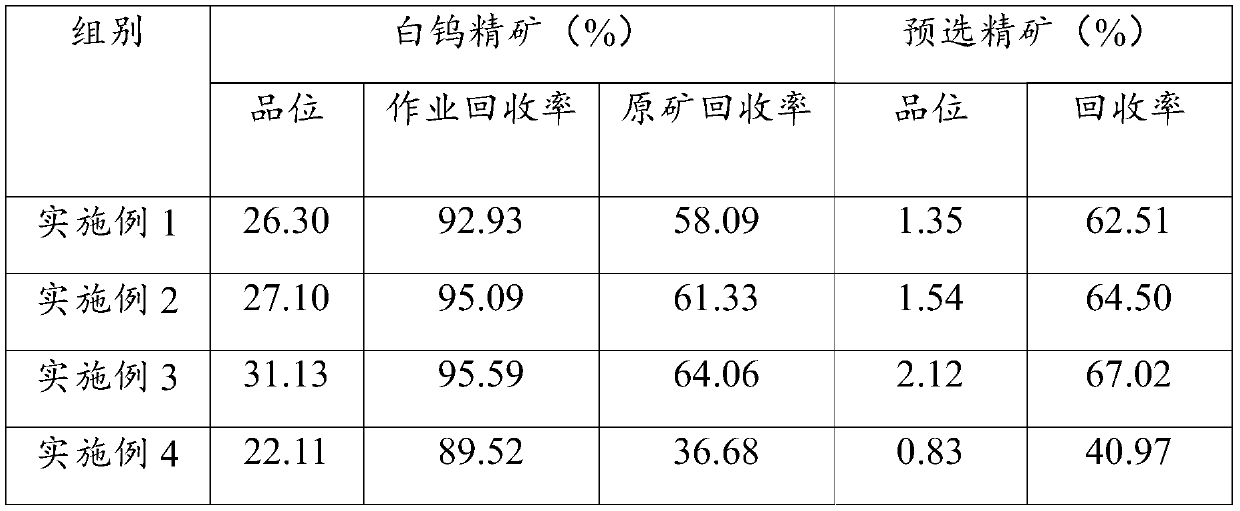

Examples
preparation example Construction
[0056] Preferably, the preparation method of the calcium and magnesium ion-resistant scheelite collector comprises the following steps:
[0057] (1) Heat the industrial oil residue to 60°C and stir for 30 minutes, then add sulfuric acid with a dilution concentration of 30%, and the dosage is 12%;
[0058] (2) Continue to stir and react for 50min, leave standstill, and remove the impurities in the lower layer after layering;
[0059] (3) Pass into reaction system 13% chlorine gas of industrial grease by-product quality and continue stirring reaction 70min, add lye solution to neutralize reaction system;
[0060] (4) Add the surfactant alkylphenol polyoxyethylene ether of 4% of the total mass of the system, stir evenly and then add 25% sodium hydroxide with a concentration of 14% of the total mass of the system to stir;
[0061] (5) Dilute the reaction system with water to a mass fraction of 5% to obtain a calcium and magnesium ion-resistant scheelite collector.
[0062] Where...
Embodiment 1
[0103] In this example, the low-grade scheelite contains 0.13% tungsten trioxide, 5.2% gypsum, 35% carbonate, 15% serpentine and 8% montmorillonite as main gangue minerals.
[0104] A method for beneficiating low-grade scheelite, the method specifically includes the following steps:
[0105] (a): adding sodium carbonate, water glass and tungsten collector to the low-grade scheelite with a particle size of 10 μm in sequence, stirring for 8 minutes, and then performing flotation to obtain roughing concentrate a and roughing tailings;
[0106] The add-on of described sodium carbonate is 2000g / t, and the add-on of water glass is 2000g / t, and the add-on of tungsten collector is 300g / t;
[0107] (b): The rougher tailings obtained in step (a) are subjected to 2 times of flotation with a calcium and magnesium ion-resistant scheelite collector to obtain the rougher concentrate b, and the rougher concentrate b and the step (a) are The rougher concentrate a is combined to obtain the rou...
Embodiment 2
[0118] In this embodiment, the low-grade scheelite contains 0.17% tungsten trioxide, 5% gypsum, 30% carbonate, 18% serpentine and 5% montmorillonite as main gangue minerals.
[0119] A method for beneficiating low-grade scheelite, the method specifically includes the following steps:
[0120] (a): adding sodium carbonate, water glass and tungsten collector to the low-grade scheelite with a particle size of 100 μm in sequence, stirring for 8 minutes, and then performing flotation to obtain roughing concentrate a and roughing tailings;
[0121] The add-on of described sodium carbonate is 1500g / t, and the add-on of water glass is 1500g / t, and the add-on of tungsten collector is 300g / t;
[0122] (b): The rougher tailings obtained in step (a) are subjected to 3 times of flotation with a calcium-magnesium ion-resistant scheelite collector to obtain the rougher concentrate b, and the rougher concentrate b and the step (a) are The rougher concentrate a is combined to obtain the rough...
PUM
| Property | Measurement | Unit |
|---|---|---|
| particle diameter | aaaaa | aaaaa |
| particle diameter | aaaaa | aaaaa |
| particle diameter | aaaaa | aaaaa |
Abstract
Description
Claims
Application Information
 Login to View More