Unlock instant, AI-driven research and patent intelligence for your innovation.
A method for comprehensive recovery of zinc, lead and tin from tin-rich lead-zinc soot by two-stage countercurrent sulfuric acid leaching
What is Al technical title?
Al technical title is built by PatSnap Al team. It summarizes the technical point description of the patent document.
A soot, tin-lead technology, applied in the field of zinc-lead-tin recovery, achieves the effects of reducing sulfuric acid consumption, being environmentally friendly, and having a simple process
Active Publication Date: 2020-06-16
KUNMING METALLURGY INST
View PDF6 Cites 1 Cited by
Summary
Abstract
Description
Claims
Application Information
AI Technical Summary
This helps you quickly interpret patents by identifying the three key elements:
Problems solved by technology
Method used
Benefits of technology
Problems solved by technology
There is no relevant patent report related to the soot produced by blast furnace smelting of electroplating sludge and fuming furnace smelting of smelting slag
Method used
the structure of the environmentally friendly knitted fabric provided by the present invention; figure 2 Flow chart of the yarn wrapping machine for environmentally friendly knitted fabrics and storage devices; image 3 Is the parameter map of the yarn covering machine
View more
Image
Smart Image Click on the blue labels to locate them in the text.
Viewing Examples
Smart Image
Click on the blue label to locate the original text in one second.
Reading with bidirectional positioning of images and text.
Smart Image
Examples
Experimental program
Comparison scheme
Effect test
Embodiment 1
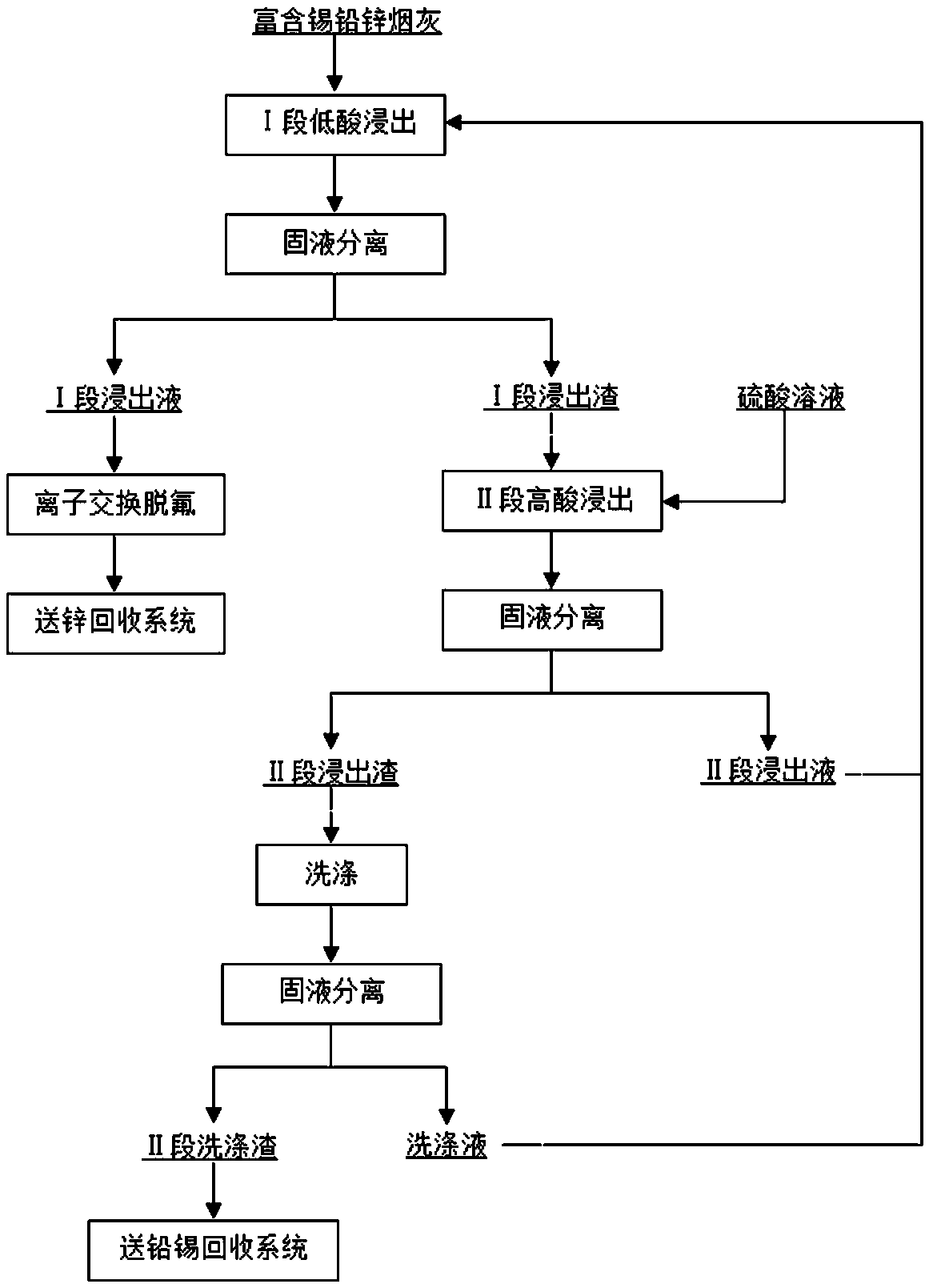
[0048] The main components of the lead-tin-zinc-rich soot in this embodiment are: Zn16.36%, Pb13.96%, Sn24.28%. Mix 1000g of lead-tin-zinc-rich soot with sulfuric acid solution, carry out sulfuric acid leaching reaction under the conditions of sulfuric acid mass concentration 30g / L, liquid-solid ratio 3:1, temperature 80°C, and time 60min. stage leaching solution and stage I leaching residue. The leaching residue of stage I contains Zn13.80%, Sn34.09%, Pb20.12%, and the zinc leaching rate of stage I is 41.64%.
[0049] Mix the leaching residue of stage I with sulfuric acid solution, and carry out sulfuric acid leaching reaction under the conditions of sulfuric acid mass concentration 110g / L, liquid-solid ratio 3:1, temperature 80°C, and time 60min. After the reaction is completed, the leachate of stage II and The leaching residue of the second stage is washed to obtain the washing water and the washing slag of the second stage. The leaching residue of stage II contains Zn0.6...
Embodiment 2
[0051] The main components of the lead-tin-zinc-rich soot in this embodiment are: Zn13.87%, Pb12.46%, Sn27.43%. Mix 1000g of lead-tin-zinc-rich soot with sulfuric acid solution, carry out sulfuric acid leaching reaction under the conditions of sulfuric acid concentration of 20g / L, liquid-solid ratio of 5:1, temperature of 90°C, and time of 120min. stage leaching solution and stage I leaching residue. The leaching slag of stage I contains Zn12.23%, Pb11.57%, Sn43.13%, and the zinc leaching rate of stage I is 44.01%.
[0052] Mix the leaching residue of stage I with sulfuric acid solution, and carry out the sulfuric acid leaching reaction under the conditions of sulfuric acid mass concentration 120g / L, liquid-solid ratio 5:1, temperature 90°C, and time 120min. After the reaction is completed, the leachate of stage II and Stage II leaching residue. The leaching residue of stage II contains Zn0.83%, Pb28.09%, Sn54.08%. After two stages of leaching, the zinc leaching rate reache...
the structure of the environmentally friendly knitted fabric provided by the present invention; figure 2 Flow chart of the yarn wrapping machine for environmentally friendly knitted fabrics and storage devices; image 3 Is the parameter map of the yarn covering machine
Login to View More
PUM
Property
Measurement
Unit
concentration
aaaaa
aaaaa
Login to View More
Abstract
The invention discloses a method for comprehensively recovering zinc, lead and tin from tin-rich lead-zinc soot by adopting two-stage countercurrent sulfuric acid leaching. The method concretely comprises the following steps: enabling the tin-rich lead-zinc soot and a sulfuric acid solution to be subjected to a sulfuric acid leaching reaction, and carrying out liquid-solid separation after the reaction is finished so as to obtain a first stage leaching solution and first stage acid-leaching slag, and recovering zinc from the first stage low-acid leaching solution; enabling the first stage acid-leaching slag and the sulfuric acid solution to be subjected to a high acid leaching reaction, and separating after the reaction is completed so as to obtain a second stage acid leaching solution andsecond stage acid-leaching slag; washing the second stage acid-leaching slag to obtain washing liquid and second stage washing residue; mixing the second stage acid leaching solution with the washingliquid and returning to the first step for carrying out first stage low-acid leaching on the tin-rich lead-zinc soot, and sending the second stage washing residue to a lead-tin recovery system for recovering lead and tin. The method provided by the invention is simple in process, and the two-stage countercurrent leaching solves the problem that the tin oxide in the tin-rich zinc soot is difficultto leach; the method improves the zinc leaching rate, reduces the consumption of sulfuric acid, is low in equipment investment and environmentally friendly, and is easily matched with the existing process so as to realize industrial production.
Description
technical field [0001] The invention belongs to the technical field of nonferrous metal smelting, and in particular relates to a method for recovering zinc, lead and tin from tin-rich lead-zinc soot by adopting two-stage countercurrent sulfuric acid leaching. Background technique [0002] Electroplating sludge is heavy metal sludge waste generated from wastewater treatment in the electroplating industry. Due to its high content of zinc, lead, tin, copper, chromium, iron and other heavy metals, it has great harm to the environment and has been included in the national list of hazardous waste. The seventh category of hazardous waste. Electroplating sludge is rich in high-grade valuable heavy metals, and it is also an important secondary metal resource. Therefore, it is of great significance to the harmless and resourceful comprehensive utilization of electroplating sludge. [0003] Electroplating sludge is smelted in a blast furnace, and the smelting slag is smelted in a fum...
Claims
the structure of the environmentally friendly knitted fabric provided by the present invention; figure 2 Flow chart of the yarn wrapping machine for environmentally friendly knitted fabrics and storage devices; image 3 Is the parameter map of the yarn covering machine
Login to View More
Application Information
Patent Timeline
Application Date:The date an application was filed.
Publication Date:The date a patent or application was officially published.
First Publication Date:The earliest publication date of a patent with the same application number.
Issue Date:Publication date of the patent grant document.
PCT Entry Date:The Entry date of PCT National Phase.
Estimated Expiry Date:The statutory expiry date of a patent right according to the Patent Law, and it is the longest term of protection that the patent right can achieve without the termination of the patent right due to other reasons(Term extension factor has been taken into account ).
Invalid Date:Actual expiry date is based on effective date or publication date of legal transaction data of invalid patent.

 Login to View More