
Seismic fluid prediction method based on VMD and TK energy operators
A technology of fluid prediction and energy operator, which is applied in seismology, seismic signal processing, measuring devices, etc., can solve the problems of Hilbert-Huang transformation endpoint effect and modal mixing, and achieve the removal of invalid energy anomalies, High time-frequency resolution, accurate prediction of fluid location and properties
- Summary
- Abstract
- Description
- Claims
- Application Information
AI Technical Summary
Problems solved by technology
Method used
Image

Examples
Embodiment Construction
[0038] The technical solution of the present invention will be further described in detail below in conjunction with the accompanying drawings, but the protection scope of the present invention is not limited to the following description.
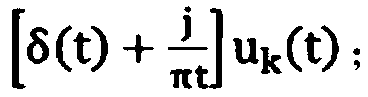
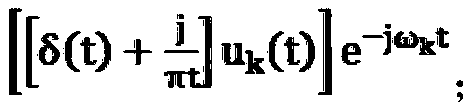
[0039] Variational Mode Decomposition (VMD) is a variational problem solving process based on classical Wiener filtering, Hilbert transform and frequency mixing. It realizes signal adaptive decomposition by searching for the optimal solution of the constrained variational model, and decomposes the input signal into a series of modal components with sparse characteristics; assuming that each mode has a finite bandwidth with a central frequency, the central frequency and bandwidth are constantly updated during the decomposition process, and the VMD decomposition is to seek the modal function uk with the smallest sum of K estimated bandwidths (t), the sum of the modes is the input signal f.
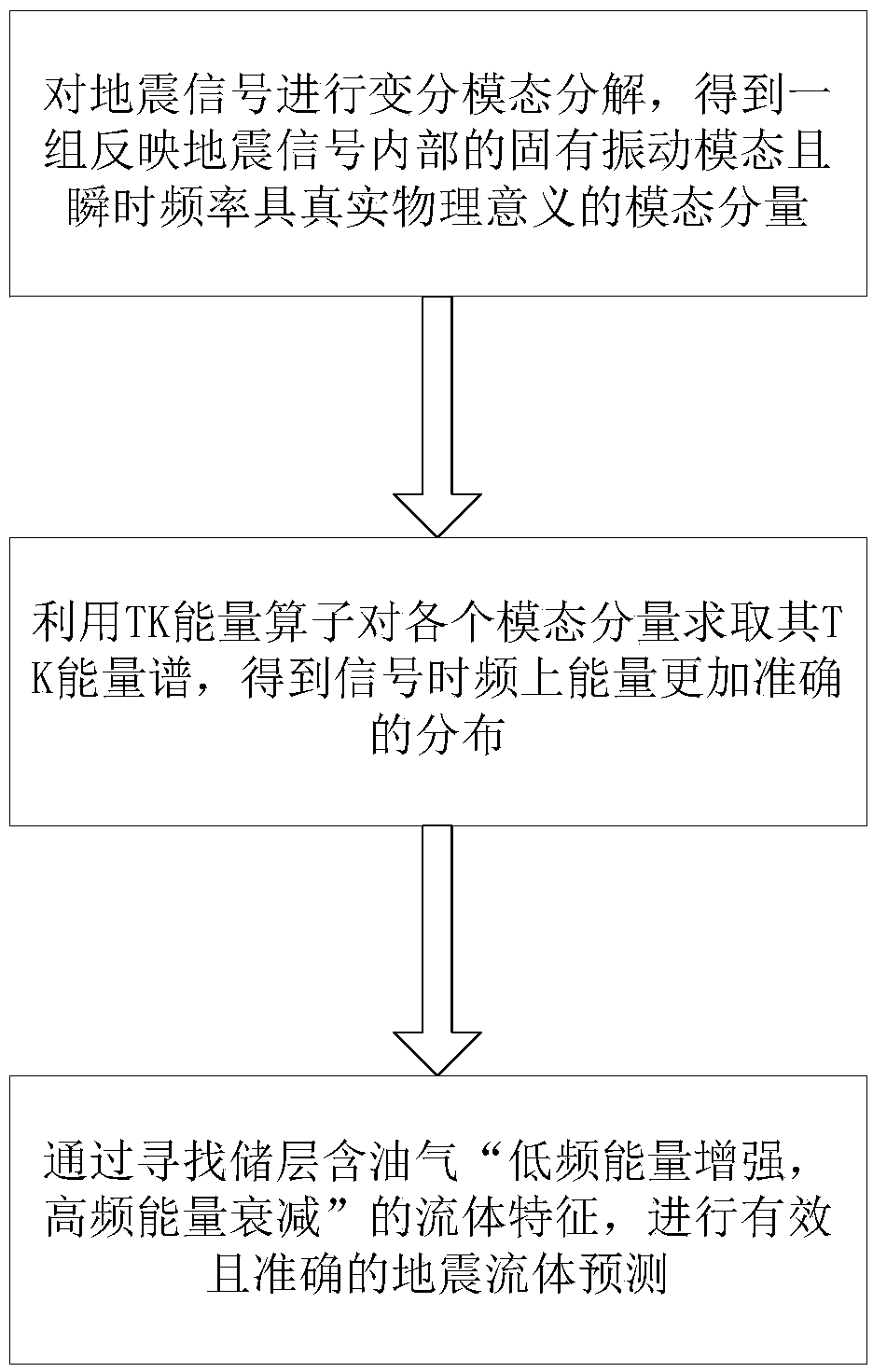
[0040] Such as figure 1 As shown, a seismic fluid ...
PUM
 Login to View More
 Abstract
Description
Claims
Application Information
 Login to View More