
Intelligent data blood relationship tracing method and device based on clustering analysis
A cluster analysis and data technology, applied in the field of big data, can solve problems such as inability to complete, data performance impact, and inability to process data lineage, etc., to achieve the effect of improving accuracy and efficiency
- Summary
- Abstract
- Description
- Claims
- Application Information
AI Technical Summary
Problems solved by technology
Method used
Image

Examples
Embodiment Construction
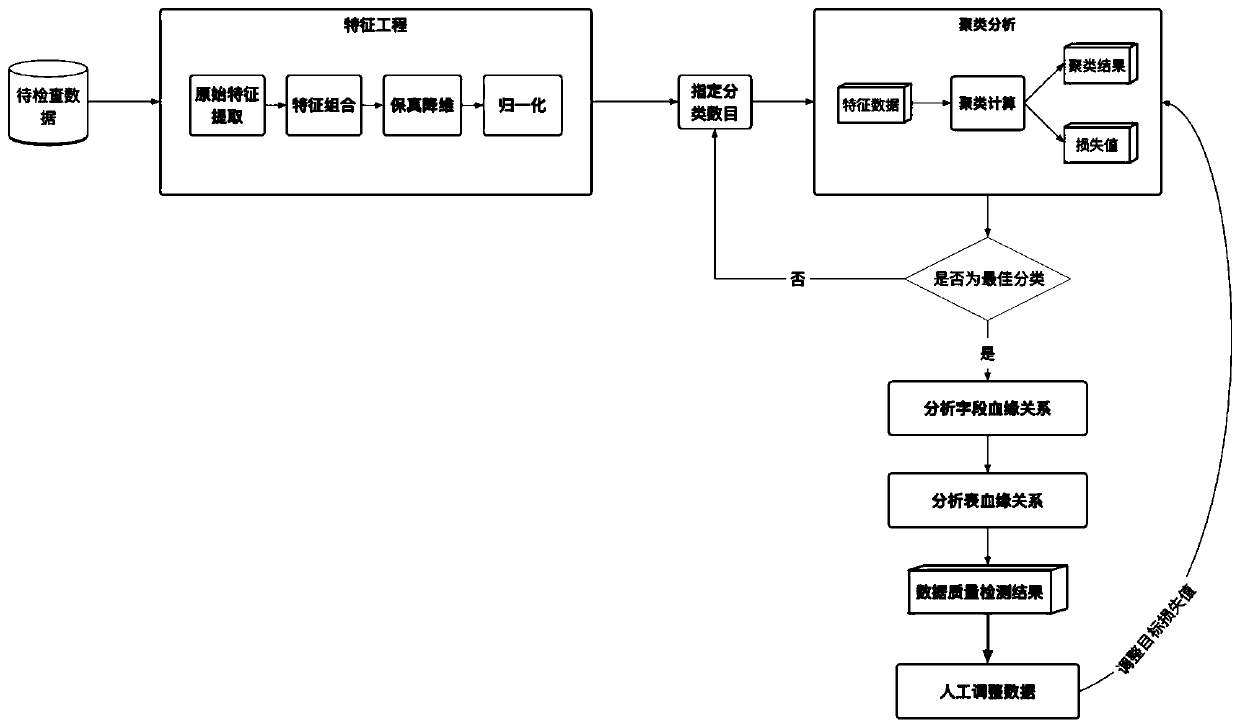
[0021] According to one or more embodiments, such as figure 1 As shown, a method for intelligent traceability of data kinship based on cluster analysis, including steps:
[0022] Step 1: Read the table structure and data, and form the data characteristics of each field through data engineering methods. The specific method is as follows:
[0023] Step 1.1: Analyze the data characteristics of the original data into structured sample data, including field type, field length, field content mode, etc.
[0024] Step 1.2: Combine the existing features in the sample data to form high-dimensional features;
[0025] Step 1.3: Analyze high-dimensional features, form new dimensions and sort the influence of new dimensions;
[0026] Step 1.4: Reduce the dimension of the sample data according to the new dimension, and use the minimum number of dimensions under the premise of ensuring that the distortion rate of the sample data is lower than the set value;
[0027] Step 1.5: Normalize the...
PUM
 Login to View More
 Abstract
Description
Claims
Application Information
 Login to View More