
Pedestrian re-identification method and system based on unsupervised cross visual angle metric learning
A pedestrian re-identification and cross-perspective technology, applied in character and pattern recognition, instruments, biological neural network models, etc., can solve the problems of difficult pedestrian accurate modeling, time-consuming and labor-intensive modeling process, saving manpower and material resources, and improving accuracy. , the effect of interference enhancement
- Summary
- Abstract
- Description
- Claims
- Application Information
AI Technical Summary
Problems solved by technology
Method used
Image



Examples
Embodiment Construction
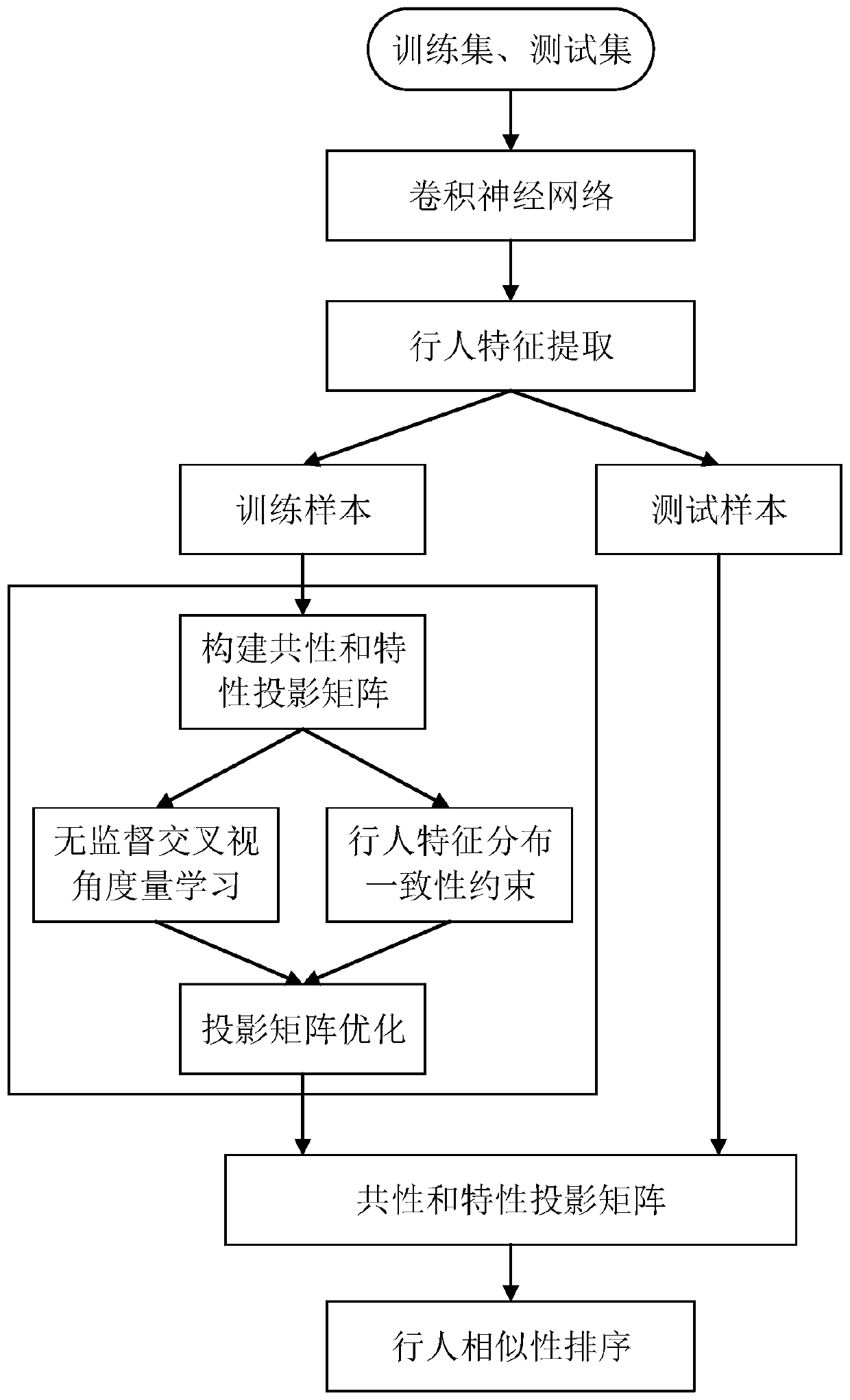
[0052] Below in conjunction with accompanying drawing and specific embodiment the step that the present invention realizes is described in further detail:
[0053] refer to figure 1 , the steps that the present invention realizes are as follows:
[0054] Step 1. Obtain image data from multiple cameras that do not overlap in space, and construct a training set.
[0055] Step 2, feature extraction of pedestrian images in the training set;
[0056] (2a), use the marked pedestrian data outside the training set to train the convolutional neural network.
[0057] (2b). On the training set, use the trained convolutional neural network to extract pedestrian feature expressions for each image.
[0058] Step 3. Construct a common and characteristic projection matrix to obtain the final pedestrian feature expression;
[0059] (3a), common projection matrix U 0 : The commonality projection matrix is used to extract common features between all cameras. For the i-th pedestrian image...
PUM
 Login to View More
 Abstract
Description
Claims
Application Information
 Login to View More