
Preparation method of high-performance self-cleaning curtain fabric
A self-cleaning, high-performance technology, used in dyeing, textile material processing, biochemical fiber processing, etc.
- Summary
- Abstract
- Description
- Claims
- Application Information
AI Technical Summary
Problems solved by technology
Method used
Image

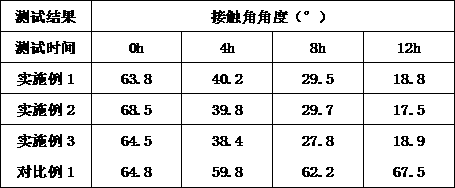
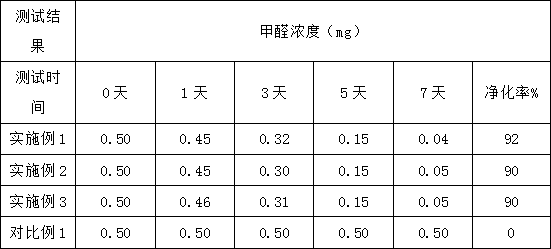
Examples
Embodiment 1
[0032] A method for preparing high-performance self-cleaning curtain fabrics includes the following steps:
[0033] S1. Pretreatment: Place the curtain grey fabric with 100% polyester to be treated in an overflow dyeing machine at 130°C for dyeing. The dyeing time is 1h, down to room temperature, washed and dehydrated to obtain pretreated fabric;
[0034] S2. Ingredients: Add water that matches the fabric to be treated in the overflow dyeing machine, and then add a photocatalyst finishing agent with a concentration of 5% and a particle size of 5nm to obtain a photocatalyst treatment liquid;
[0035] S3. Put the pretreated fabric obtained from S1 into the overflow dyeing machine of S2, and after treating for 1-2h at a temperature of 130-150℃, the fabric is dehydrated and finalized to obtain a dry photocatalyst treated fabric;
[0036] S4. Reprocessing: spray the dry fabric obtained in S3 with environmental spray, and then reprocess the fabric;
[0037] S5. Finished product: Take S4 to ge...
Embodiment 2
[0041] A method for preparing high-performance self-cleaning curtain fabrics includes the following steps:
[0042] S1. Pretreatment: Place the curtain grey fabric with polyester and linen as the main ingredient in an overflow dyeing machine at 140°C for dyeing. The dyeing time is 1.5h, down to room temperature, washed and dehydrated to obtain pretreated fabric;
[0043] S2. Ingredients: Add water that matches the fabric to be treated in the overflow dyeing machine, and then add a photocatalyst finishing agent with a concentration of 8% and a particle size of 8nm to obtain a photocatalyst treatment liquid;
[0044] S3. Put the pretreated fabric obtained from S1 into the overflow dyeing machine of S2, and treat it at 130°C for 1.5 hours, then dehydrate and finalize the shape to obtain a dry photocatalyst treated fabric;
[0045] S4. Reprocessing: spray the dry fabric obtained in S3 with environmental spray, and then reprocess the fabric;
[0046] S5. Finished product: Take S4 to get repr...
Embodiment 3
[0050] A method for preparing high-performance self-cleaning curtain fabrics includes the following steps:
[0051] S1. Pretreatment: Place the curtain grey fabric with polyester and linen as the main ingredient in an overflow dyeing machine at 150°C for dyeing. The dyeing time is 2h, and it is lowered to room temperature. After washing, it is dehydrated to obtain the pretreated fabric;
[0052] S2. Ingredients: Add water that matches the fabric to be treated in the overflow dyeing machine, and then add a photocatalyst finishing agent with a concentration of 10% and a particle size of 10nm to obtain a photocatalyst treatment liquid;
[0053] S3. Put the pretreated fabric obtained from S1 into the overflow dyeing machine of S2, and treat it at 130°C for 1.5 hours, then dehydrate and finalize the shape to obtain a dry photocatalyst treated fabric;
[0054] S4. Reprocessing: spray the dry fabric obtained in S3 with environmental spray, and then reprocess the fabric;
[0055] S5. Finished p...
PUM
 Login to View More
 Abstract
Description
Claims
Application Information
 Login to View More