Unlock instant, AI-driven research and patent intelligence for your innovation.
3D printing additive manufacturing method of kettle-shaped thin-wall part
What is Al technical title?
Al technical title is built by PatSnap Al team. It summarizes the technical point description of the patent document.
A 3D printing and additive manufacturing technology, applied in the field of 3D printing of pot-shaped thin-walled parts, can solve problems such as unfavorable development of the parts processing industry, part size deviation, and material springback, so as to improve 3D printing efficiency and compress printing Cycle, the effect of reducing difficulty
Active Publication Date: 2019-12-24
江西宝航新材料有限公司
View PDF19 Cites 8 Cited by
Summary
Abstract
Description
Claims
Application Information
AI Technical Summary
This helps you quickly interpret patents by identifying the three key elements:
Problems solved by technology
Method used
Benefits of technology
Problems solved by technology
[0002] With the rapid development of science and technology, the market has higher and higher requirements for the structure, performance, precision, production efficiency and product types of the parts processing industry, and there is an obvious trend of customization in the parts processing industry. The proportion of demand is increasing, and the traditional mechanical processing cannot meet the individualized product needs of the demand side. In order to meet the market demand and ensure the smooth transformation of enterprises, more and more parts processing enterprises are currently targeting the direction of research and development in additive manufacturing. Technology, that is, 3D printing technology, the use of 3D printing technology can effectively meet the high-quality, high-efficiency, multi-variety, and small-batch production methods required by the current market. For example, in the traditional production of pot-shaped thin-walled parts, stamping or sheet metal parts are generally used. Metal and welding are used to manufacture, but the above method cannot effectively manufacture pot-shaped thin-walled parts with special structures, and can only complete the manufacture of simple shapes, and in the manufacture of metal pot-shaped thin-walled parts, it will inevitably The phenomenon of material springback causes deviations in the size of the manufactured parts, which is time-consuming and laborious and is not conducive to the normal development of the parts processing industry. The use of 3D printing technology can effectively overcome the above problems
Method used
the structure of the environmentally friendly knitted fabric provided by the present invention; figure 2 Flow chart of the yarn wrapping machine for environmentally friendly knitted fabrics and storage devices; image 3 Is the parameter map of the yarn covering machine
View more
Image
Smart Image Click on the blue labels to locate them in the text.
Viewing Examples
Smart Image
Click on the blue label to locate the original text in one second.
Reading with bidirectional positioning of images and text.
Smart Image
Examples
Experimental program
Comparison scheme
Effect test
Embodiment 1
[0051] In order to better understand the above-mentioned technical solution, the above-mentioned technical solution will be described in detail below in conjunction with the accompanying drawings and specific implementation methods.
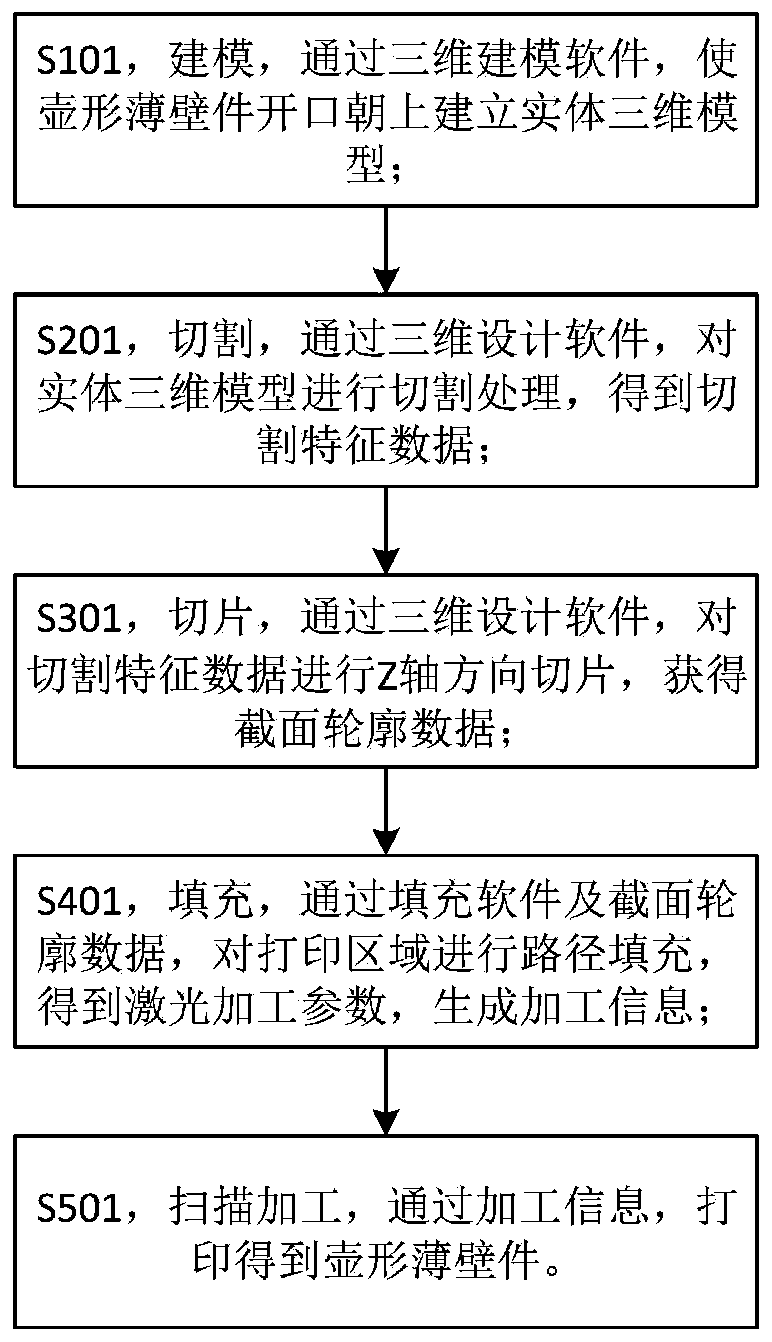
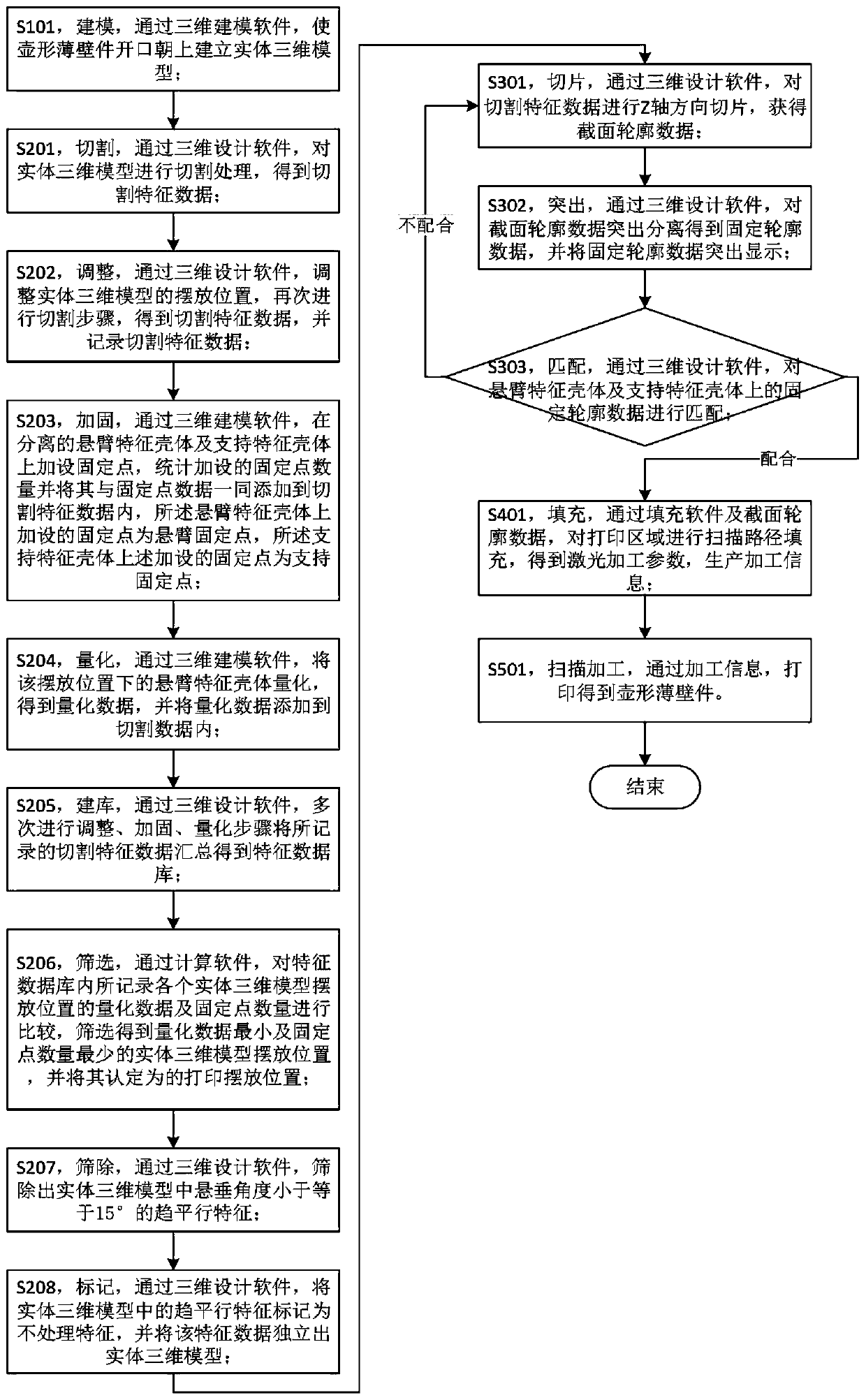
[0052] Such as figure 1 and figure 2 As shown, the present invention provides a 3D printing additive manufacturing method of a pot-shaped thin-walled part, comprising the following steps:
[0053] S101, modeling, building a solid three-dimensional model by making the opening of the pot-shaped thin-walled part upward through three-dimensional modeling software;
[0054] In the specific implementation process, in step S101, three-dimensional modeling is carried out according to the design requirements of the demand side through the three-dimensional modeling software, and the solid three-dimensional model with the opening of the pot-shaped thin-walled part is obtained, and the three-dimensional modeling data is exported.
[0055] S201, cutting, ...
Embodiment 2
[0078] This example is a preferred implementation of the 3D printing additive manufacturing method for pot-shaped thin-walled parts. The wall thickness of the pot-shaped thin-walled part shown in this example is 1.06mm, and the cantilever characteristic angle is 27°. Specifically, the steps are as follows :
[0079] Modeling: D101, through 3D modeling software, establish a solid 3D model of a pot-shaped thin-walled part with the opening facing upwards, and output *.stl format files;
[0080]Cutting: D201, use the 3D design software to cut the solid 3D model of the pot-shaped thin-walled parts and design the supporting structure; D202, import the model of the *.stl format file into Magic software; D203, use Magics software to perform Data repair, eliminate data conversion problems such as broken edges and gaps; D204, call up the printing platform in Magics software, and load the model data to the appropriate position on the platform; D205, use Magics software to physically stre...
the structure of the environmentally friendly knitted fabric provided by the present invention; figure 2 Flow chart of the yarn wrapping machine for environmentally friendly knitted fabrics and storage devices; image 3 Is the parameter map of the yarn covering machine
Login to View More
PUM
Login to View More
Abstract
The invention provides a 3D printing additive manufacturing method of a kettle-shaped thin-wall part. The 3D printing additive manufacturing method of the kettle-shaped thin-wall part comprises the following steps of modeling, specifically, through three-dimensional modeling software, a solid three-dimensional model is established to enable an opening of the kettle-shaped thin-wall part to face upwards; cutting, specifically, through three-dimensional design software, cutting treatment is performed on the solid three-dimensional model to obtain cutting characteristic data; slicing, specifically, through the three-dimensional design software, the cutting characteristic data are spliced in the Z-axis direction to obtain section contour data; filling, specifically, through filling software and the section contour data, path filling is performed on a printing area to obtain laser processing parameters and generate processing information; and scanning and processing, specifically, the kettle-shaped thin-wall part is obtained by printing through the processing information. The 3D printing additive manufacturing method of the kettle-shaped thin-wall part can be used for 3D printing of a thin-wall kettle body with a complex structure, the 3D printing efficiency is improved, the number of supporting structures in the 3D printing is reduced, the generated material waste is reduced, and the later processing work is reduced.
Description
Technical field: [0001] The invention relates to a 3D printing method for a pot-shaped thin-walled part, in particular to a 3D printing additive manufacturing method for a pot-shaped thin-walled part. Background technique: [0002] With the rapid development of science and technology, the market has higher and higher requirements for the structure, performance, precision, production efficiency and product types of the parts processing industry, and there is an obvious trend of customization in the parts processing industry. The proportion of demand is increasing, and the traditional mechanical processing cannot meet the individualized product needs of the demand side. In order to meet the market demand and ensure the smooth transformation of enterprises, more and more parts processing enterprises are currently targeting the direction of research and development in additive manufacturing. Technology, that is, 3D printing technology, the use of 3D printing technology can effec...
Claims
the structure of the environmentally friendly knitted fabric provided by the present invention; figure 2 Flow chart of the yarn wrapping machine for environmentally friendly knitted fabrics and storage devices; image 3 Is the parameter map of the yarn covering machine
Login to View More
Application Information
Patent Timeline
Application Date:The date an application was filed.
Publication Date:The date a patent or application was officially published.
First Publication Date:The earliest publication date of a patent with the same application number.
Issue Date:Publication date of the patent grant document.
PCT Entry Date:The Entry date of PCT National Phase.
Estimated Expiry Date:The statutory expiry date of a patent right according to the Patent Law, and it is the longest term of protection that the patent right can achieve without the termination of the patent right due to other reasons(Term extension factor has been taken into account ).
Invalid Date:Actual expiry date is based on effective date or publication date of legal transaction data of invalid patent.

 Login to View More
  Login to View More