
Calculation method of lattice distortion of high-entropy alloy based on atomic occupancy ordering behavior
A high-entropy alloy and atom-occupying technology, which is applied in computational theoretical chemistry, instrumentation, informatics, etc., can solve problems such as many guesses and lack of quantitative description, and achieve the effect of accelerating research and development
- Summary
- Abstract
- Description
- Claims
- Application Information
AI Technical Summary
Problems solved by technology
Method used
Image

Examples
Embodiment Construction
[0041] The present invention will be further described below with reference to the accompanying drawings and embodiments.
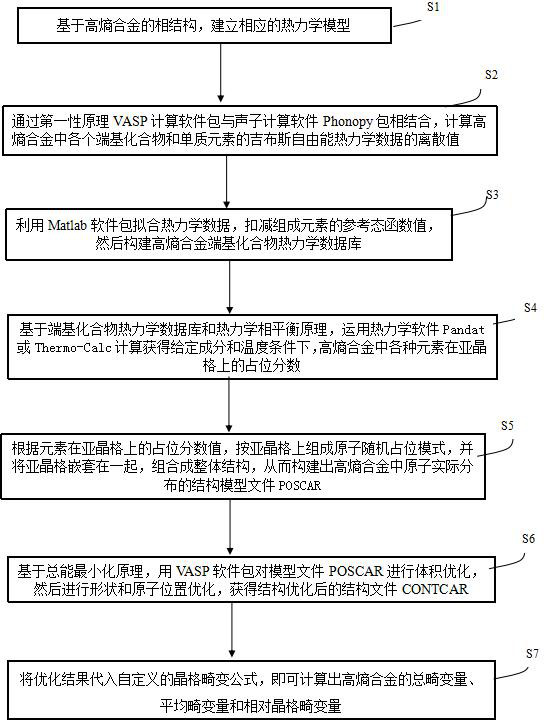
[0042] The present invention provides a method for calculating the lattice distortion value of high-entropy alloys based on atomic occupancy and ordering behavior. figure 1 , including the following steps:
[0043] Step S1: build a corresponding thermodynamic model based on the phase structure of the high-entropy alloy;
[0044] Step S2:-by calculating the phonon spectrum of density functional perturbation theory, obtain discrete values of Gibbs free energy thermodynamic data of each end group compound and elemental element in the high-entropy alloy;
[0045] Step S3: based on the preset function model, fitting thermodynamic data, deducting the reference state function value of the constituent element, thereby constructing a high-entropy alloy end-group compound thermodynamic database;
[0046] Step S4: based on the terminal compound thermodynamic datab...
PUM
 Login to View More
 Abstract
Description
Claims
Application Information
 Login to View More