Pretreatment method of hydrolytic acidification detoxification industrial wastewater
A technology of hydrolysis and acidification of industrial wastewater, applied in biological water/sewage treatment, water/sludge/sewage treatment, anaerobic digestion treatment, etc., can solve the problem of low capacity of industrial wastewater containing toxic organic substances, and achieve shortened start-up time, Strengthen the hydrolysis ability and improve the effect of precise pollution control
- Summary
- Abstract
- Description
- Claims
- Application Information
AI Technical Summary
Problems solved by technology
Method used
Image

Examples
Embodiment 1
[0027] A pretreatment method for hydrolytic acidification and detoxification industrial wastewater,
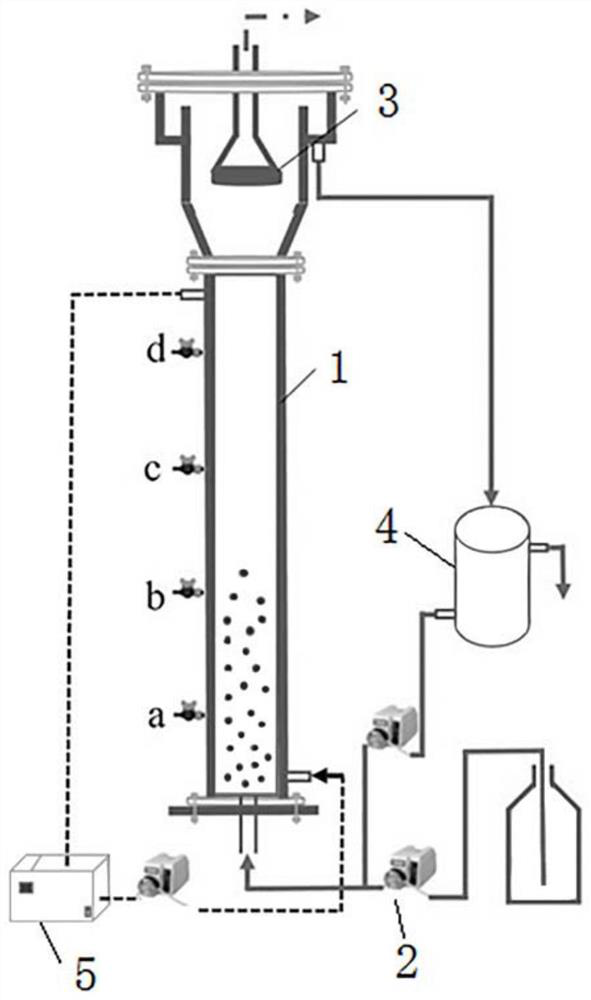
[0028] This example is carried out in an anaerobic granular sludge expanded bed reactor (EGSB). The inoculated anaerobic granular sludge is taken from a methanogenic reactor. The EGSB operates continuously, and the concentration of the anaerobic granular sludge is 15g / L. . The structure of the EGSB reactor is as follows figure 1 As shown, it includes a reactor 1 made of plexiglass material. The reactor 1 is provided with sampling ports a, b, c, and d along different heights. The effective volume of the reactor 1 is 1.72L. Wherein, the height of the reaction zone of the reactor 1 is 1500 mm, and the inner diameter of the reaction zone is 30 mm. The crotonaldehyde waste water is injected from the bottom of the reactor 1 by the first peristaltic pump 2, and an adjustable three-phase separator 3 is installed on the top of the reactor 1, and the mud-water mixture and gas are effe...
Embodiment 2
[0036] The difference between this example and Example 1 is that this example uses an upflow anaerobic sludge bed reactor (UASB), and the concentration of anaerobic granular sludge is 6g / L. Surfactants and nutrients are added to the crotonaldehyde production wastewater, wherein the nutrients are ammonium chloride and dihydrogen phosphate. After the nutrients are added, the COD:N:P ratio in the crotonaldehyde production wastewater is 500:5:1, and at the same time , the surfactant is rhamnolipid, and the addition amount of the surfactant is 0.07g / g dry anaerobic granular sludge; the pH is adjusted to 8.
[0037] The inflow velocity of the upflow anaerobic sludge bed reactor is 1.73m / h, the reflux ratio is 0, the residence time is 24h, and the temperature is 35°C.
[0038] The start-up time of the test sample in this embodiment is about 52d, and the load that can be borne after start-up is 3.9kgCOD / m 3 d; Under the maximum load that can be tolerated, the specific methanogenic acti...
Embodiment 3
[0040] The difference between this example and Example 1 is that this example uses an internal circulation anaerobic reactor (IC), and the concentration of anaerobic granular sludge is 30 g / L. Surfactants and nutrients are added to the crotonaldehyde production wastewater, wherein the nutrients are ammonium chloride and dihydrogen phosphate. After the nutrients are added, the COD:N:P ratio in the crotonaldehyde production wastewater is 100:5:1, and at the same time , the surfactant is an alkyl polyglycoside, and the addition amount of the surfactant is 0.005g / g dry anaerobic granular sludge; the pH is adjusted to 6.
[0041] The inflow velocity of the upflow anaerobic sludge bed reactor is 1.73m / h, the reflux ratio is 30, the residence time is 24h, and the temperature is 20°C.
[0042] The start-up time of the test sample in this embodiment is about 38 days, and the load that can be borne after start-up is 5.1kgCOD / m 3 d; Under the maximum load that can be tolerated, the spec...
PUM
 Login to View More
 Abstract
Description
Claims
Application Information
 Login to View More