High-toughness high-temperature-resistant RAFM steel and design method thereof based on machine learning
What is AI technical title?
AI technical title is built by Patsnap AI team. It summarizes the technical point description of the patent document.
A technology of machine learning and design method, applied in the field of steel materials, which can solve time-consuming and complex problems
Active Publication Date: 2021-07-06
HEFEI INSTITUTES OF PHYSICAL SCIENCE - CHINESE ACAD OF SCI
View PDF5 Cites 3 Cited by
Summary
Abstract
Description
Claims
Application Information
AI Technical Summary
This helps you quickly interpret patents by identifying the three key elements:
Problems solved by technology
Method used
Benefits of technology
Problems solved by technology
However, this multidimensional exhaustive search process is very complex and time-consuming
Method used
the structure of the environmentally friendly knitted fabric provided by the present invention; figure 2 Flow chart of the yarn wrapping machine for environmentally friendly knitted fabrics and storage devices; image 3 Is the parameter map of the yarn covering machine
View more
Image
Smart Image Click on the blue labels to locate them in the text.
Viewing Examples
Smart Image
Click on the blue label to locate the original text in one second.
Reading with bidirectional positioning of images and text.
Smart Image
Examples
Experimental program
Comparison scheme
Effect test
Embodiment 1
[0053] A high-strength, toughness and high-temperature-resistant RAFM steel in this embodiment is designed by using the method of the present invention, and the smelting and subsequent heat treatment are carried out in strict accordance with the composition and heat treatment parameters designed in the present invention.
[0054] The RAFM steel includes the following chemical components in mass percent: 0.12%C, 10.5%Cr, 1.6%W, 0.52%Si, 0.6%Mn, 0.27%V, 0.26%Ta, 0.001%Zr, 0.01%Y, 0.002% %Ti, 0.04% N, and the rest are Fe elements and other unavoidable impurity elements. The heat treatment parameters of the RAFM steel are: normalizing temperature (NT) 1050°C, normalizing time (Nt) 20min, tempering temperature (TT) 600°C, tempering time (Tt) 90min.
Embodiment 2
[0056] A high-strength, toughness and high-temperature-resistant RAFM steel in this embodiment is designed by using the method of the present invention, and the smelting and subsequent heat treatment are carried out in strict accordance with the composition and heat treatment parameters designed in the present invention.
[0057] The RAFM steel includes the following chemical components in mass percent: 0.16%C, 9.5%Cr, 1.8%W, 0.48%Si, 0.7%Mn, 0.23%V, 0.10%Ta, 0.005%Zr, 0.05%Y, 0.012% %Ti, 0.02% N, the rest is Fe and other unavoidable impurity elements. The heat treatment parameters of the RAFM steel are: normalizing temperature (NT) 1010°C, normalizing time (Nt) 55min, tempering temperature (TT) 720°C, tempering time (Tt) 50min.
Embodiment 3
[0059] A high-strength, toughness and high-temperature-resistant RAFM steel in this embodiment is designed by using the method of the present invention, and the smelting and subsequent heat treatment are carried out in strict accordance with the composition and heat treatment parameters designed in the present invention.
[0060] The RAFM steel includes the following chemical components in mass percent: 0.13%C, 9.5%Cr, 1.7%W, 0.49%Si, 0.67%Mn, 0.25%V, 0.20%Ta, 0.002%Zr, 0.03%Y, 0.005% %Ti, 0.021% N, and the rest are Fe and other unavoidable impurity elements. The heat treatment parameters of the RAFM steel are: normalizing temperature (NT) 1010°C, normalizing time (Nt) 36min, tempering temperature (TT) 660°C, tempering time (Tt) 76min.
[0061] In the above-mentioned Examples 1-3, other unavoidable impurity elements are Al, Ni, Mo, Nb, Cu, B, S, P, O, and the proportion of each impurity element is: Al: 0-0.010%, Ni: 0~0.005%, Mo: 0~0.005%, Nb: 0~0.010%, Cu: 0~0.010%, B: 0~0.0...
the structure of the environmentally friendly knitted fabric provided by the present invention; figure 2 Flow chart of the yarn wrapping machine for environmentally friendly knitted fabrics and storage devices; image 3 Is the parameter map of the yarn covering machine
Login to View More
PUM
Property
Measurement
Unit
Ultimate tensile strength
aaaaa
aaaaa
Ultimate tensile strength
aaaaa
aaaaa
Login to View More
Abstract
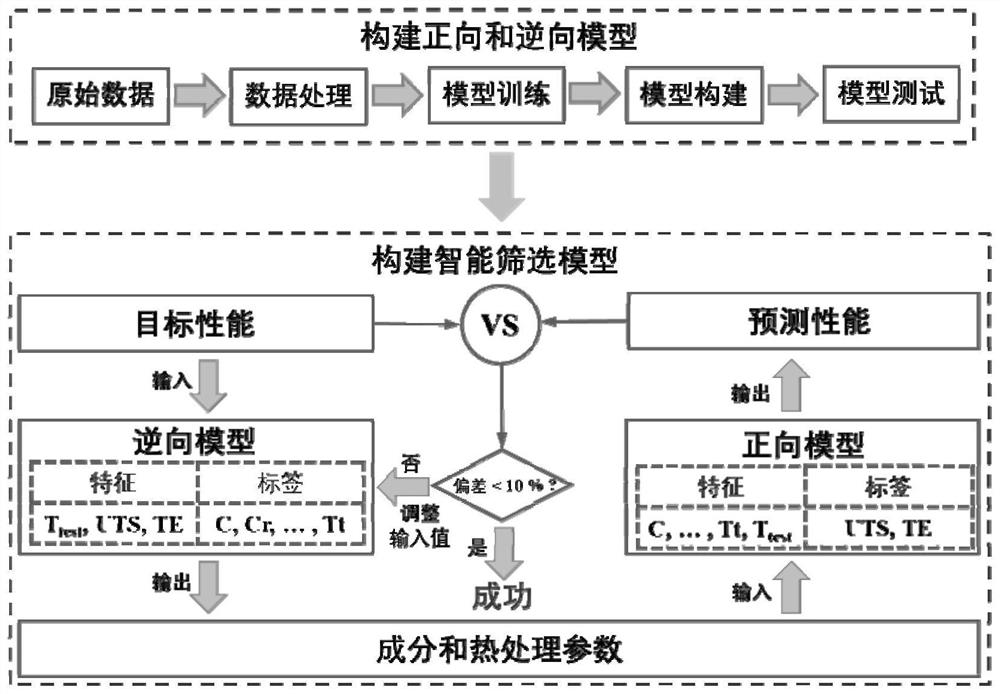
The invention provides high-toughness high-temperature-resistant RAFM steel which comprises the following chemical components: 0.12 to 0.16 percent of C, 9.5 to 10.5 percent of Cr, 1.6 to 1.8 percent of W, 0.48 to 0.52 percent of Si, 0.6 to 0.7 percent of Mn, 0.23 to 0.27 percent of V, 0.10 to 0.26 percent of Ta, 0.001 to 0.005 percent of Zr and the like. The heat treatment parameters are as follows: the normalizing temperature is 1010-1050 DEG C, the normalizing time is 20-55 minutes, the tempering temperature is 600-720 DEG C, and the tempering time is 50-90 minutes. The invention further provides a machine learning-based design method of the steel. The RAFM steel disclosed by the invention has a relatively high use temperature upper limit and also has a relatively good tensile property at a high temperature; and meanwhile, the machine learning method constructed by the invention is high in generalization ability, and reasonable components and heat treatment parameters can be quickly and efficiently designed.
Description
technical field [0001] The invention relates to the technical field of iron and steel materials, in particular to a high-strength, high-temperature-resistant RAFM steel and a design method based on machine learning. Background technique [0002] Low-activation ferritic / martensitic (RAFM) steels developed from conventional 9Cr-1Mo steels are considered to be very promising structures for fusion reactors due to their good thermophysical, thermomechanical, and radiation resistance properties Material. As a metallic structural material, tensile properties are the most important fundamental factor in the design and application evaluation of RAFM steel. In fusion reactors, the improvement of high-temperature mechanical properties of structural materials is conducive to improving the utilization efficiency of nuclear energy. At present, the upper limit of the service temperature of RAFM steel is 550°C. In order to optimize the high temperature tensile properties of RAFM steels, ...
Claims
the structure of the environmentally friendly knitted fabric provided by the present invention; figure 2 Flow chart of the yarn wrapping machine for environmentally friendly knitted fabrics and storage devices; image 3 Is the parameter map of the yarn covering machine
Login to View More
Application Information
Patent Timeline
Application Date:The date an application was filed.
Publication Date:The date a patent or application was officially published.
First Publication Date:The earliest publication date of a patent with the same application number.
Issue Date:Publication date of the patent grant document.
PCT Entry Date:The Entry date of PCT National Phase.
Estimated Expiry Date:The statutory expiry date of a patent right according to the Patent Law, and it is the longest term of protection that the patent right can achieve without the termination of the patent right due to other reasons(Term extension factor has been taken into account ).
Invalid Date:Actual expiry date is based on effective date or publication date of legal transaction data of invalid patent.


 Login to View More