

Odorless algorithm for non-analytic complex nonlinear system
A nonlinear system and algorithm technology, applied in the field of tasteless algorithm, can solve the problem of less complex signal research and achieve good accuracy
Image



Examples
Embodiment 1
[0048] This embodiment provides a tasteless algorithm for non-analytic complex nonlinear systems, including the following steps:
[0049] Step 101, forming the complex signal and its conjugate signal into an augmented form x =[x T , x H ] T
[0050] Step 102, calculate the second order statistics, the covariance is:
[0051]
[0052] The pseudocovariance is:
[0053]
[0054] Both the augmented covariance matrix and the augmented pseudo-covariance include the covariance R of the original x x and pseudo-covariance P x information.
[0055] Step 103, calculate the sigma point:
[0056]
[0057]
[0058]
[0059]
[0060] Can be abbreviated as:
[0061]
[0062] where σ i Indicates the i-th column mean square root of the augmented covariance or augmented pseudocovariance.
[0063] Among them, the non-analytic complex number system, its system function is related to x and its conjugate, for the non-analytic complex number nonlinear system, its Taylo...
Embodiment 2
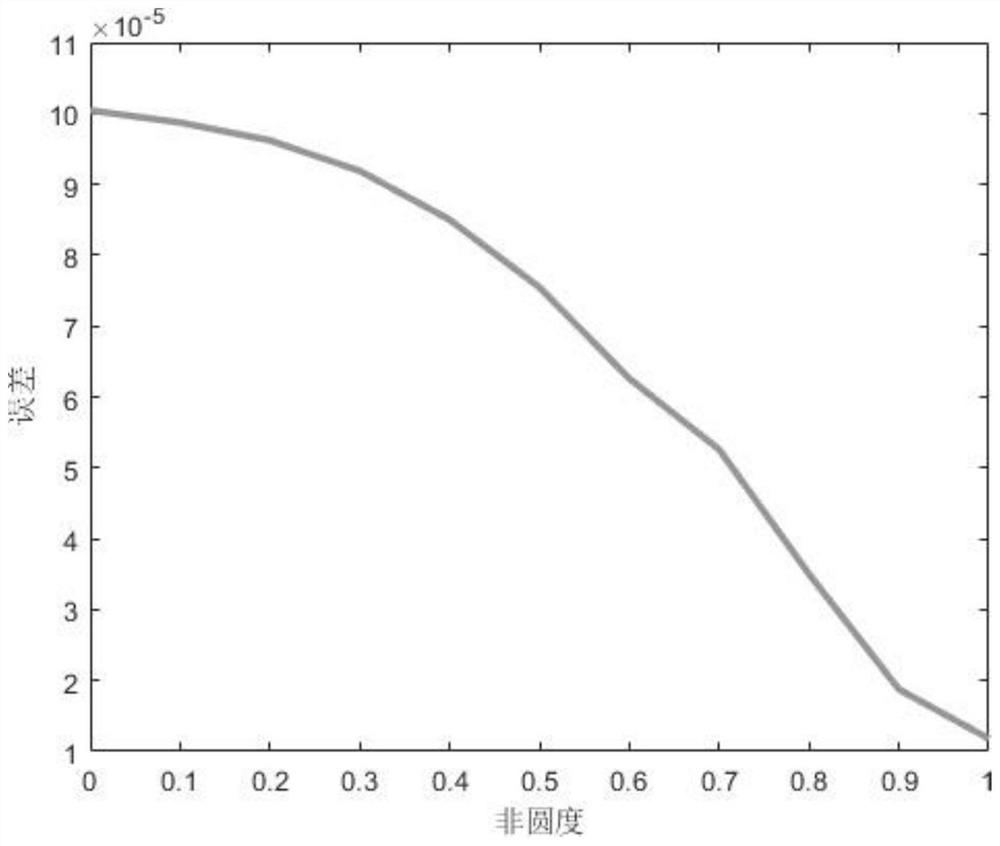
[0112] see Figure 1-Figure 4 , this embodiment also provides a tasteless algorithm for non-analytic complex nonlinear systems. The algorithm provided by this embodiment can be used but not limited to the analysis of the mean and second-order statistics after complex nonlinear analytical transformation, and is also suitable for Transformation of real numbers and analytic functions. For non-analytic functions, this embodiment uses f=|x| 2 =xx * As an example, the influence of the input non-circularity on the system error is analyzed, and the calculation accuracy of the algorithm after optimizing the parameters is shown. For the analytic function, for the convenience of comparison, this example uses complex numbers to undergo analytic transformation f=x 2 As an example, the superiority of the algorithm of the present invention is demonstrated through error results.
[0113] Such as Figure 4 Shown, algorithm described in the present invention comprises the following steps: ...
PUM
 Login to View More
 Abstract
Description
Claims
Application Information
- IPC
- G06F17/18; G06F17/16
- CPC
- G06F17/18; G06F17/16
- Inventors
- 夏亦犁; 石琬婷