Check patentability & draft patents in minutes with Patsnap Eureka AI!

Bilateral slope DTW distance load spectrum clustering method based on LTTB dimension reduction

A spectral clustering and slope technology, applied in the fields of instrument, character and pattern recognition, data processing applications, etc., can solve the problem of easy loss of power load data change information and shape characteristics, can not better reflect the power load curve change characteristics, clustering Ineffective, etc., to achieve the effect of improving data processing speed, improving clustering recognition effect, and saving computing time

Pending Publication Date: 2021-12-10
SHANGHAI UNIVERSITY OF ELECTRIC POWER
View PDF0 Cites 0 Cited by
  • Summary
  • Abstract
  • Description
  • Claims
  • Application Information

AI Technical Summary

Problems solved by technology

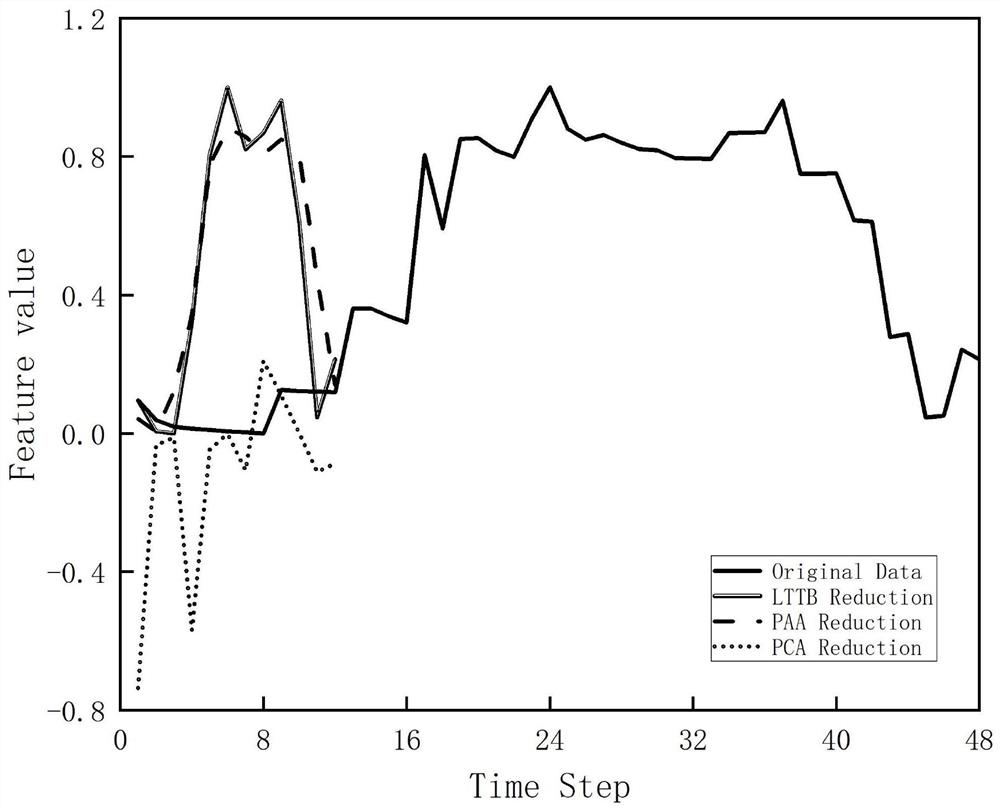
However, the traditional PAA and PCA dimension reduction methods cannot better reflect the change characteristics of the power load curve because they are easy to lose the change information and shape characteristics of the power load data during the dimension reduction process.
[0004] Although the traditional DTW (Dynamic Time Warping) method can retain the original change characteristics of the power load data, in the process of calculating the minimum cumulative distance for similarity identification, because the power load data is high-dimensional data, the traditional DTW method does not use the reduction method. dimensional method, so the traditional DTW method has too much calculation, and the clustering effect is not good on some data sets

Method used

the structure of the environmentally friendly knitted fabric provided by the present invention; figure 2 Flow chart of the yarn wrapping machine for environmentally friendly knitted fabrics and storage devices; image 3 Is the parameter map of the yarn covering machine
View more

Image

Smart Image Click on the blue labels to locate them in the text.
Viewing Examples
Smart Image
  • Bilateral slope DTW distance load spectrum clustering method based on LTTB dimension reduction
  • Bilateral slope DTW distance load spectrum clustering method based on LTTB dimension reduction
  • Bilateral slope DTW distance load spectrum clustering method based on LTTB dimension reduction

Examples

Experimental program
Comparison scheme
Effect test

Embodiment Construction

[0023] In order to make the technical means, creative features, goals and effects of the present invention easy to understand, a kind of bilateral slope DTW distance load spectrum clustering method based on LTTB dimensionality reduction of the present invention will be described in detail below in conjunction with the embodiments and accompanying drawings.

[0024]

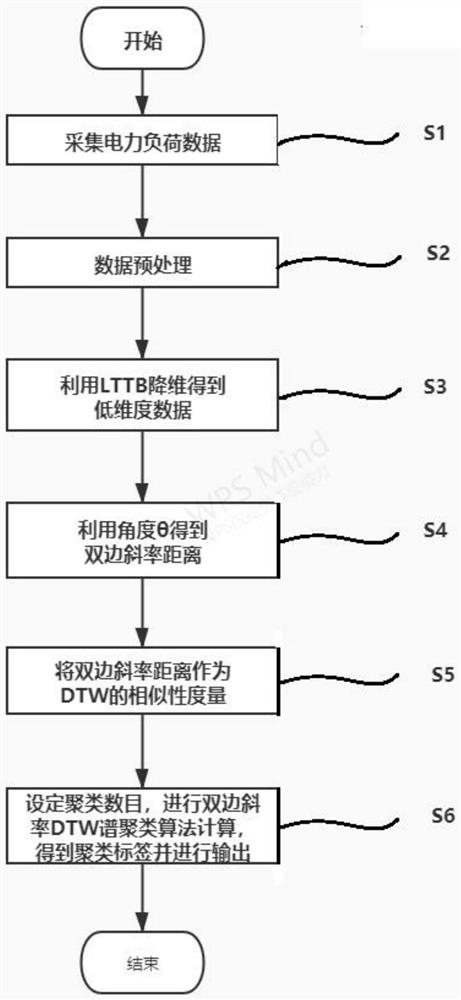
[0025] figure 1 It is a flowchart of a bilateral slope DTW distance load spectrum clustering algorithm based on LTTB dimensionality reduction in an embodiment of the present invention.

[0026] Such as figure 1 As shown, this embodiment provides a bilateral slope DTW distance load spectrum clustering algorithm based on LTTB dimensionality reduction, which is used for cluster analysis on the collected raw data of electric load.

[0027] Step S1, collecting power load data.

[0028] Step S2, preprocessing the electric load data to obtain preprocessing data. In this embodiment, step S2 specifically includes step...

the structure of the environmentally friendly knitted fabric provided by the present invention; figure 2 Flow chart of the yarn wrapping machine for environmentally friendly knitted fabrics and storage devices; image 3 Is the parameter map of the yarn covering machine
Login to View More

PUM

No PUM Login to View More

Abstract

The invention provides a bilateral slope DTW distance load spectrum clustering method based on LTTB dimension reduction; the method comprises the following steps: S1, collecting power load data; s2, preprocessing the power load data to obtain preprocessed data; s3, carrying out LTTB dimension reduction by utilizing the preprocessed data to obtain low-dimension data; s4, obtaining a bilateral slope distance of the low-dimension data through an angle theta between each data point and the positive and negative directions of the x axis; s5, taking the bilateral slope distance as the similarity measurement of the DTW; s6, setting a clustering number, carrying out bilateral slope DTW spectral clustering algorithm calculation on the processed load data set, obtaining a clustering label corresponding to each power load data, and outputting the clustering label. According to the method, the data storage space is reduced, the calculation time of model training is saved, and the recognition effect of clustering is improved.

Description

technical field [0001] The invention relates to a bilateral slope DTW distance load spectrum clustering algorithm based on LTTB dimension reduction. Background technique [0002] With the development of social economy and the continuous construction of smart grid, the data volume of electric load is increasing and the types are becoming more and more diverse. A large amount of power load data contains differentiated power consumption information. Power system load clustering is based on the similarity between loads, and the loads with high similarity are classified into the same category, so as to obtain different types of power usage and typical power consumption patterns, and then effectively identify different power consumption patterns and loads. characteristic. Power load clustering can be applied to various occasions such as power price division and formulation, load forecasting, load model establishment, power quality detection, etc., which is of great significance ...

Claims

the structure of the environmentally friendly knitted fabric provided by the present invention; figure 2 Flow chart of the yarn wrapping machine for environmentally friendly knitted fabrics and storage devices; image 3 Is the parameter map of the yarn covering machine
Login to View More

Application Information

Patent Timeline
no application Login to View More
IPC IPC(8): G06K9/62G06Q50/06
CPCG06Q50/06G06F18/23G06F18/22
Inventor 黄冬梅葛书阳胡安铎孙园孙锦中时帅
Owner SHANGHAI UNIVERSITY OF ELECTRIC POWER
Features
  • R&D
  • Intellectual Property
  • Life Sciences
  • Materials
  • Tech Scout
Why Patsnap Eureka
  • Unparalleled Data Quality
  • Higher Quality Content
  • 60% Fewer Hallucinations
Social media
Patsnap Eureka Blog
Learn More