
Method and apparatus in node for wireless communication
A technology for wireless communication and node equipment, applied in wireless communication, baseband systems, digital transmission systems, etc., to achieve the effect of improving frequency diversity gain, ensuring receiving performance, and reducing complexity
- Summary
- Abstract
- Description
- Claims
- Application Information
AI Technical Summary
Problems solved by technology
Method used
Image


Examples
Embodiment 1
[0072] Embodiment 1 illustrates the flowchart of the first synchronization signal and the first broadcast signal according to an embodiment of the present application, as shown in the attached figure 1 shown. in the attached figure 1 In the figure, each block represents a step, and it should be emphasized that the order of the blocks in the figure does not represent the chronological relationship between the steps represented.
[0073] In Embodiment 1, the first node device in this application receives the first synchronization signal in step 101; receives the first broadcast signal in step 102, the first broadcast signal carries a target index, and the target index is a non-negative Integer; wherein, the first synchronization signal occupies the first time-frequency resource set, the second time-frequency resource set is occupied by the first broadcast signal, and the target time-frequency resource subset is orthogonal to the second time-frequency resource set , the target ...
Embodiment 2
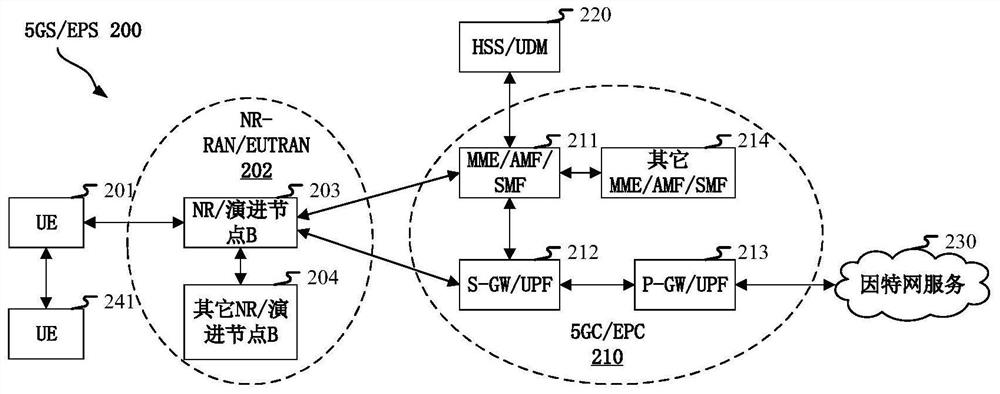
[0237] Embodiment 2 illustrates a schematic diagram of a network architecture according to the present application, as attached figure 2 shown. attached figure 2A diagram illustrating a network architecture 200 of 5G NR, LTE (Long-Term Evolution, long-term evolution) and LTE-A (Long-Term Evolution Advanced, enhanced long-term evolution) systems. The 5G NR or LTE network architecture 200 may be referred to as 5GS (5G System) / EPS (Evolved Packet System, Evolved Packet System) 200 or some other suitable terminology. 5GS / EPS 200 may include one or more UE (User Equipment, user equipment) 201, NG-RAN (next generation radio access network) 202, 5GC (5G Core Network, 5G core network) / EPC (Evolved Packet Core, evolution Packet Core) 210, HSS (Home Subscriber Server, Home Subscriber Server) / UDM (Unified Data Management, Unified Data Management) 220 and Internet Service 230. 5GS / EPS can be interconnected with other access networks, but these are not shown for simplicity entity / inte...
Embodiment 3
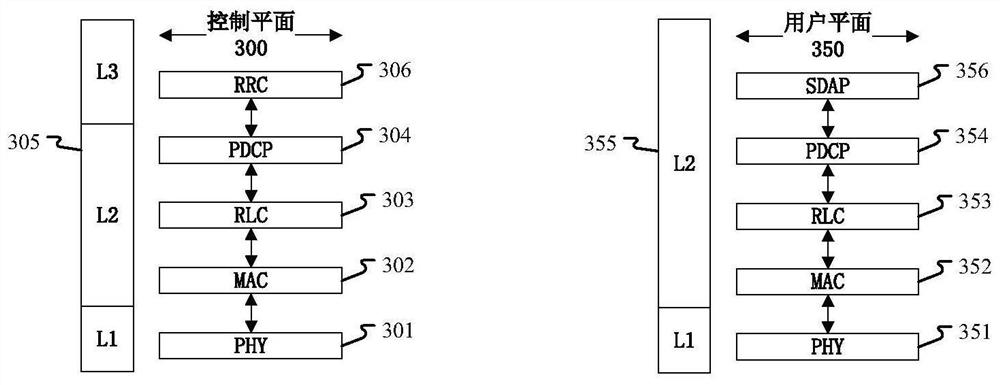
[0245] Embodiment 3 shows a schematic diagram of an embodiment of a wireless protocol architecture of a user plane and a control plane according to the present application, as shown in the attached image 3 shown. image 3 is a schematic diagram illustrating an embodiment of a radio protocol architecture for a user plane 350 and a control plane 300, image 3 The radio protocol architecture of the control plane 300 for the first node device (UE or gNB) and the second node device (gNB or UE) is shown in three layers: Layer 1 , Layer 2 and Layer 3 . Layer 1 (L1 layer) is the lowest layer and implements various PHY (Physical Layer) signal processing functions. The L1 layer will be referred to herein as PHY 301 . Layer 2 (L2 layer) 305 is above the PHY 301 and is responsible for the link between the first node device and the second node device through the PHY 301 . The L2 layer 305 includes a MAC (Medium Access Control, Media Access Control) sublayer 302, an RLC (Radio Link Cont...
PUM
 Login to View More
 Abstract
Description
Claims
Application Information
 Login to View More