
Dual-mode coronary vessel image three-dimensional fusion method and fusion system
A vascular image, three-dimensional fusion technology, applied in the direction of ultrasound/sonic/infrasonic image/data processing, catheter, ultrasound/sonic/infrasonic Permian technology, etc., can solve inaccurate results, do not consider catheter bending and twisting, etc. problem, to achieve the effect of high resolution and deep detection depth
- Summary
- Abstract
- Description
- Claims
- Application Information
AI Technical Summary
Problems solved by technology
Method used
Image

Examples
Embodiment Construction
[0051] The present invention will be further described in detail through the accompanying drawings and specific embodiments below.
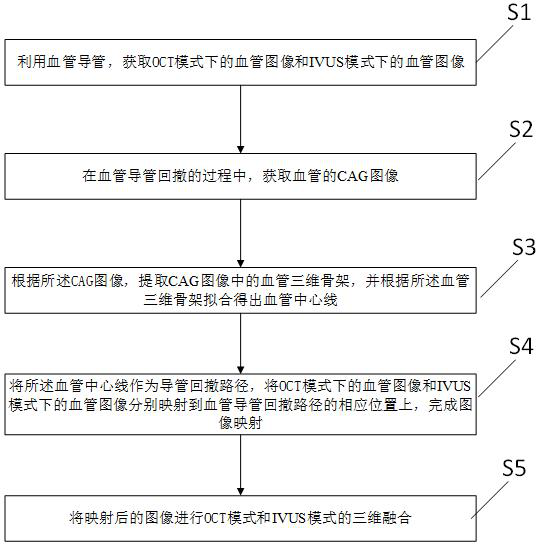
[0052] Such as figure 1 As shown, a method for three-dimensional fusion of a dual-mode coronary artery image provided by an embodiment of the present invention includes the following steps:
[0053] S1. Using a vascular catheter, obtain a vascular image in OCT mode (hereinafter referred to as OCT image) and a vascular image in IVUS mode (hereinafter referred to as IVUS image);
[0054] S2. During the process of withdrawing the vascular catheter, acquire a CAG image of the blood vessel;
[0055] Further preferably, in S1, when acquiring the vascular images of the vascular catheter in the OCT mode and the vascular images in the IVUS mode, it includes a synchronous acquisition mode and an asynchronous switching mode; the synchronous acquisition mode is the simultaneously acquired OCT mode The working mode of the blood vessel image in the IVUS mode...
PUM
 Login to View More
 Abstract
Description
Claims
Application Information
 Login to View More