
High-gain zero-ripple passive clamping type Boost converter and control method thereof
A passive-clamp, high-gain technology, which is applied to conversion equipment without intermediate conversion to AC, output power conversion devices, electrical components, etc., can solve the problems of large input current ripple and low boost ratio, and achieve higher The effect of voltage gain, small switching loss, and improved system efficiency
- Summary
- Abstract
- Description
- Claims
- Application Information
AI Technical Summary
Problems solved by technology
Method used
Image

Examples
Embodiment 1
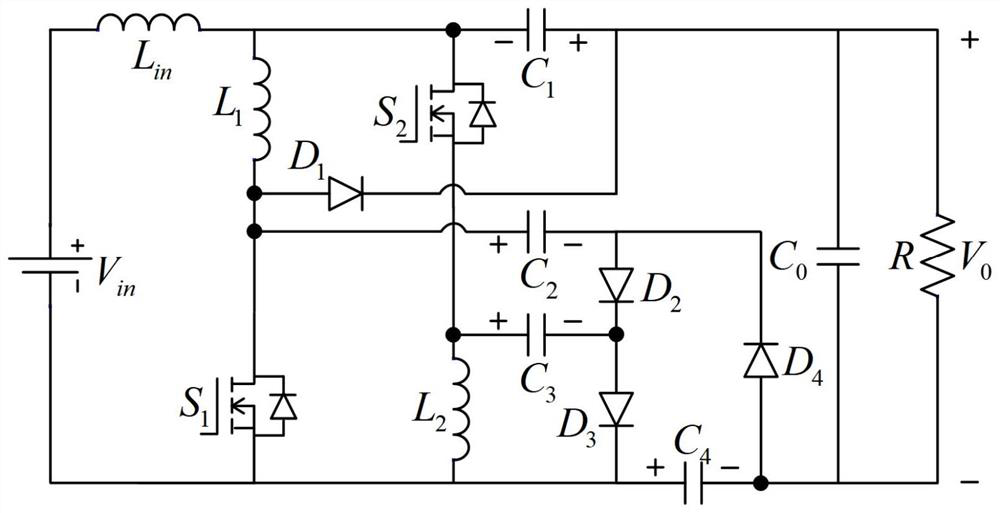
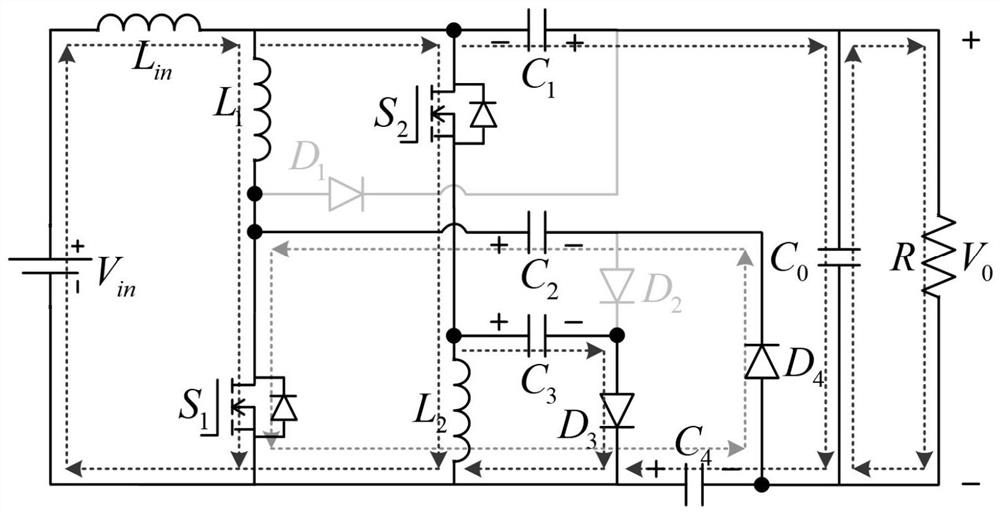
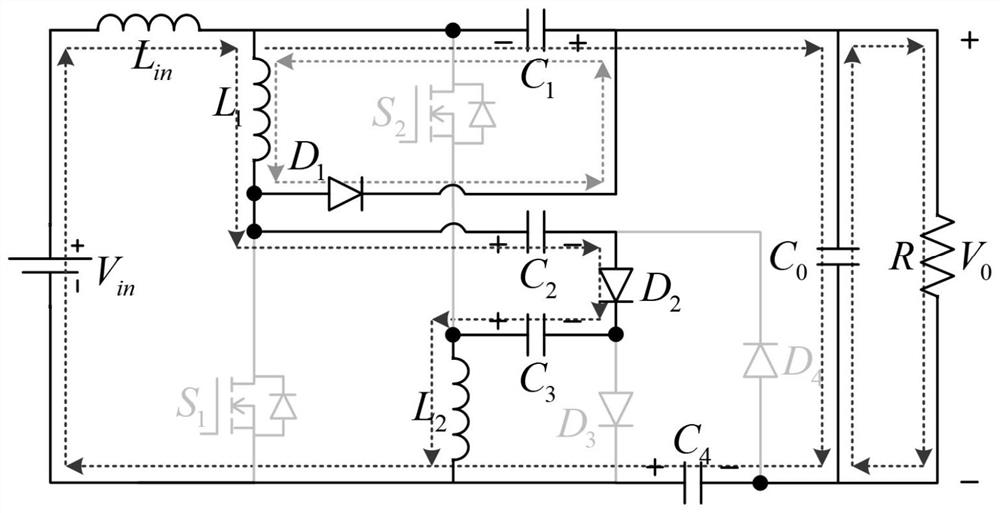
[0065] Such as figure 1 As shown, a high-gain zero-ripple passive clamp Boost converter of this embodiment, the inductance L in , L 1 , L 2 and capacitance C 1 、C 2 、C 3 、C 4 and C 0 . Inductance L in Connect one end to the input power supply V in Positive, the other end is connected to the inductor L 1 One end, power switch tube S 2 the drain as well as the capacitor C 1 One end; capacitor C 1 The other end is connected to the diode D 1 Cathode, output capacitor C 0 One end and one end of the load resistor; power switch tube S 2 The sources are respectively connected to the inductor L 2 One terminal and capacitor C 3 One end; inductance L 1 The other end is respectively connected to the power switch tube S 1 Drain, diode D 1 anode and capacitor C 2 One end; capacitor C 2 The other end is connected to the diode D 2 Anode, D 4 cathode; capacitance C 3 The other end is connected to the diode D 2 Cathode, D 3 anode; input power supply V in The negative...
Embodiment 2
[0099] Such as Figure 5 As shown, this embodiment provides a novel high-gain zero-ripple passive-clamp common-ground Boost converter, the inductance L in Connect one end to the input power supply V in Positive, the other end is connected to the inductor L 1 One end, diode D 1 Anode, power switch tube S 2 the drain as well as the capacitor C 4 One end; capacitor C 4 The other end is connected to the diode D 2 Cathode, output capacitor C 0 One end and one end of the load resistor R; the inductance L 1 The other end is respectively connected to the power switch tube S 1 the drain as well as the capacitor C 1 One end; capacitor C 1 The other end is connected to the diode D 1 Cathode, D 4 anode and capacitor C 2 One end; capacitor C 2 The other end is connected to the diode D 2 Anode, D 3 Cathode; power switch tube S 2 The sources are respectively connected to the inductor L 2 One end and the capacitor C 3 One end; capacitor C 3 The other end is connected to th...
PUM
 Login to View More
 Abstract
Description
Claims
Application Information
 Login to View More