

Heterogeneous multi-core system-based task scheduling method applied to power edge computing
An edge computing and heterogeneous multi-core technology, applied in computing, program control design, multi-program device, etc., can solve problems such as permanent fault tolerance, achieve the effect of reducing power consumption and realizing energy efficiency optimization
- Summary
- Abstract
- Description
- Claims
- Application Information
AI Technical Summary
Problems solved by technology
Method used
Image



Examples
Embodiment Construction
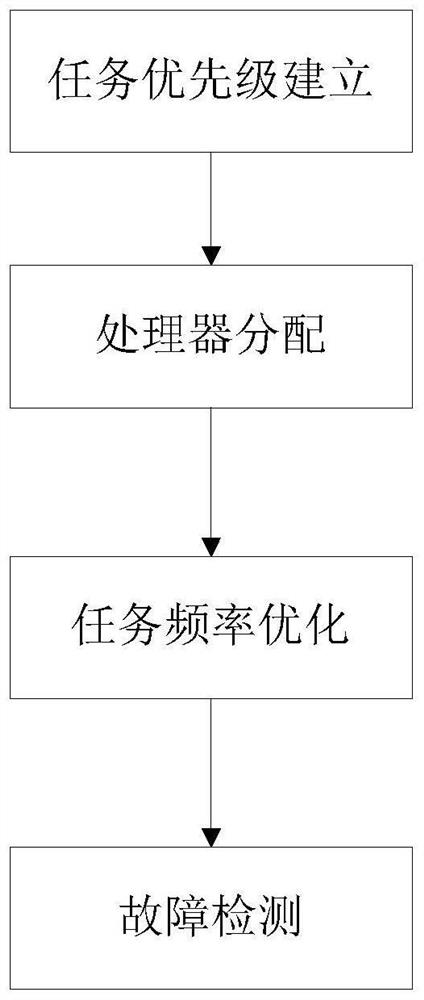
[0029] For the joint optimal scheduling of task energy efficiency and reliability in power edge computing, this invention selects a DAG graph with public deadline constraints and dependency constraints, and proposes a scheduling algorithm MRSS that meets the high reliability requirements of the system. With the primary task adding a backup task, the system can tolerate not only multiple transient failures, but also a single permanent failure. On this basis, MRSS-HEFT uses DVFS and DPM technology to reduce system energy consumption.
[0030] DAG task graph example figure 2 As shown, the DAG task model is defined as G={N, W, E, D}. N represents a set of periodic real-time tasks. W represents the worst case execution time (WCET) of a task running at the maximum frequency on the processor core, E represents the data dependency between tasks, and D represents the common deadline of all tasks.
[0031] by figure 2 As an example, show the scheduling results of the MRSS algorith...
PUM
 Login to View More
 Abstract
Description
Claims
Application Information
 Login to View More