

Machine vision based LCD spot flaw detection method and system
A liquid crystal display, machine vision technology, applied in optical testing flaws/defects, instruments, image data processing, etc., can solve problems such as difficulty in automatic detection of spot defects
- Summary
- Abstract
- Description
- Claims
- Application Information
AI Technical Summary
Problems solved by technology
Method used
Image

Examples
Embodiment Construction
[0025] The technical solution of the present invention will be further described below in conjunction with the accompanying drawings.
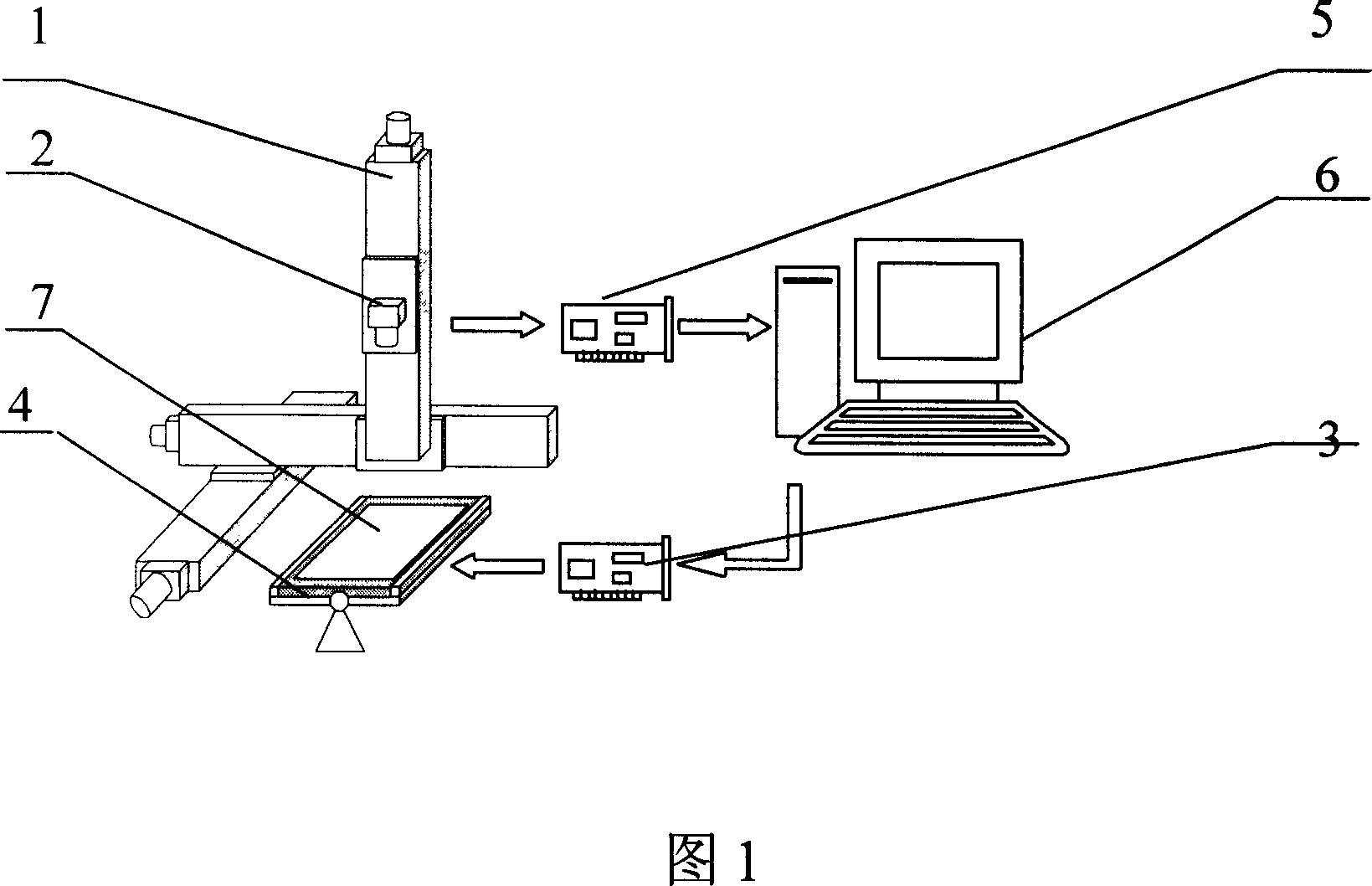
[0026] Referring to FIG. 1 , the liquid crystal display defect detection system in this specific embodiment is composed of a CCD camera 2 , an image acquisition card 5 , a computer 6 , a three-axis precision positioning platform 1 , a liquid crystal display drive module 3 and an object stage 4 . The stage 4 is fixedly connected to the three-axis precision positioning platform 1, and is connected to the interface of the dedicated display driver module 3 through a cable. On the stage 4, the CCD camera 2 is fixed on the three-axis precision positioning platform 1 as an image acquisition device, so that it can move to a corresponding position under the control of the computer 6 according to the model of the liquid crystal display 7 to be tested for image acquisition.
[0027] The image acquisition card 5 is a standard analog or digital image acqui...
PUM
 Login to View More
 Abstract
Description
Claims
Application Information
 Login to View More