Process for producing water-absorbent resin
a water-absorbing resin and resin technology, applied in the direction of other chemical processes, chemistry apparatus and processes, bandages, etc., can solve the problems of skin irritation, difficult to obtain a water-absorbing resin with high water-absorption performance, and increase in crosslinking density inside the resin, etc., to achieve high water-retention capacity, high water-absorption capacity, and high water-absorption capacity.
- Summary
- Abstract
- Description
- Claims
- Application Information
AI Technical Summary
Benefits of technology
Problems solved by technology
Method used
Image

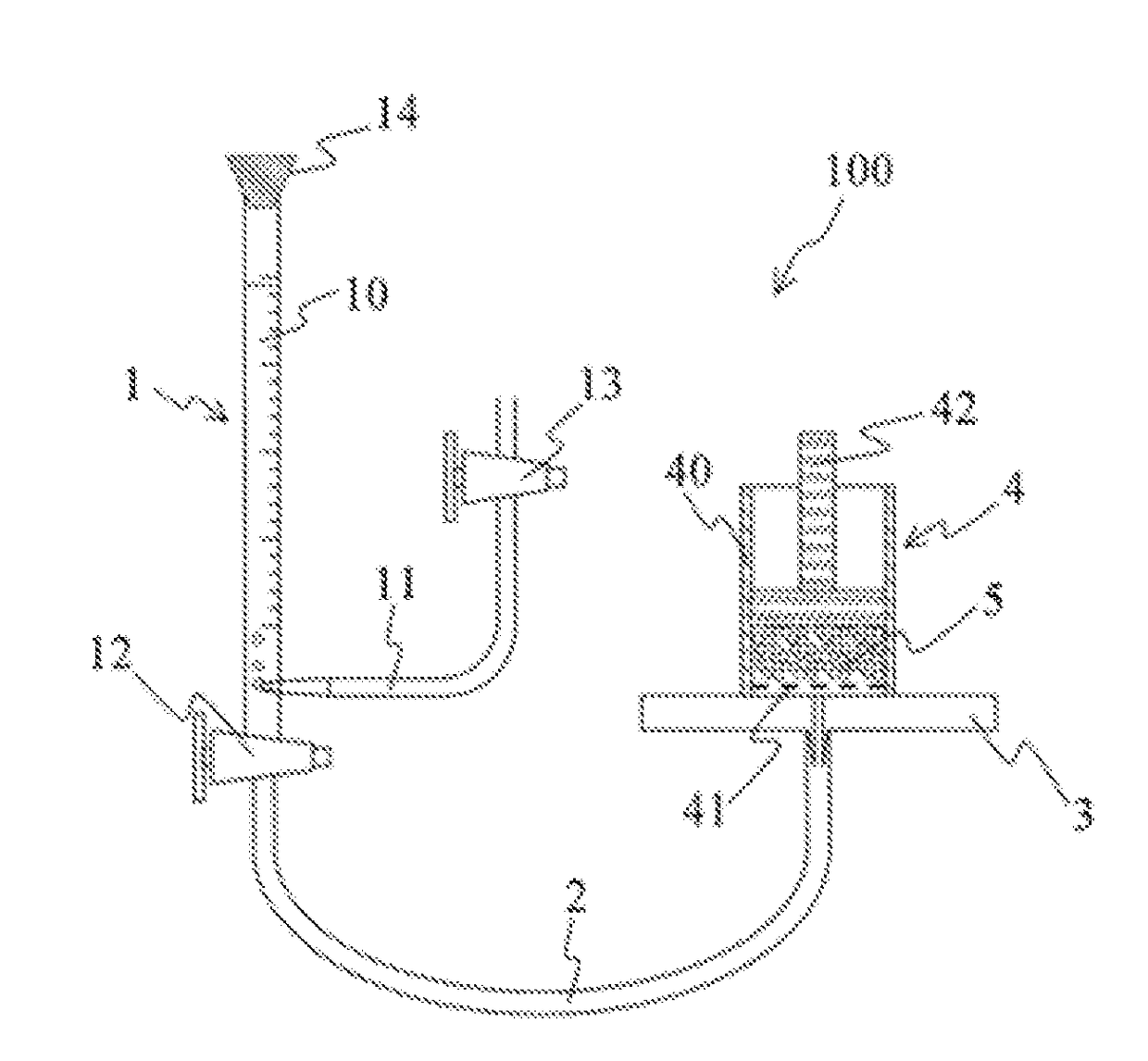
Examples
example 1
[0097]A cylindrical round-bottomed separable flask having an internal diameter of 100 mm was prepared, wherein the flask was equipped with a reflux condenser, a dropping funnel, a nitrogen gas introducing tube, and a stirrer having two steps of four-piece-inclined paddle blades with a blade diameter of 50 mm. In this flask, 300 g of n-heptane was introduced as a hydrocarbon dispersion medium, and 0.74 g of sucrose stearic acid ester (Mitsubishi-Kagaku Foods Corporation; Ryoto Sugar Ester S-370) as a surfactant, and 0.74 g of maleic anhydride-modified ethylene-propylene copolymer (Mitsui Chemicals, Inc.; High Wax 1105A) as a polymeric dispersion agent were added. Under stirring, the temperature was raised to 80° C. to dissolve the surfactant, and thereafter the solution was cooled to 55° C.
[0098]Separately, 92.0 g (1.021 mol) of 80 mass %-aqueous acrylic acid solution was weighed in a 500-ml Erlenmeyer flask, and 146.0 g of 21 mass %-aqueous sodium hydroxide solution was added dropwi...
example 2
[0102]A cylindrical round-bottomed separable flask having an internal diameter of 100 mm was prepared, wherein the flask was equipped with a reflux condenser, a dropping funnel, a nitrogen gas introducing tube, and a stirrer having two steps of four-piece-inclined paddle blades with a blade diameter of 50 mm. In this flask, 300 g of n-heptane was introduced as a hydrocarbon dispersion medium, and 0.74 g of sucrose stearic acid ester (Mitsubishi-Kagaku Foods Corporation, Ryoto Sugar Ester S-370) as a surfactant, and 0.74 g of maleic anhydride-modified ethylene-propylene copolymer (Mitsui Chemicals, Inc., High Wax 1105A) as a polymeric dispersion agent were added. Under stirring, the temperature was raised to 80° C. to dissolve the surfactant, and thereafter the solution was cooled to 55° C.
[0103]Separately, 92.0 g (1.021 mol) of 80 mass %-aqueous acrylic acid solution was weighed in a 500-ml Erlenmeyer flask, and 146.0 g of 21 mass %-aqueous sodium hydroxide solution was added dropwi...
example 3
[0109]228.6 g of a water-absorbent resin in the form of agglomerated spherical particles was obtained in the same method as in Example 2 except that the used amount of potassium persulfate as the peroxide in the aqueous monomer solution for the first stage was changed to 0.028 g (0.104 mmol), that the used amount of ethylene glycol diglycidyl ether as the internal-crosslinking agent in the aqueous monomer solution for the first stage was changed to 0.014 g (0.080 mmol), that the used amount of potassium persulfate as the peroxide in the aqueous monomer solution for the second stage was changed to 0.038 g (0.141 mmol), and that the amount of water removed out of the system by azeotropic distillation of water and n-heptane before the post-crosslinking reaction was changed to 243.5 g. The properties of the water-absorbent resin were measured by the above-mentioned methods, and the results were shown in Table 2.
PUM
| Property | Measurement | Unit |
|---|---|---|
| mass % | aaaaa | aaaaa |
| temperature | aaaaa | aaaaa |
| temperature | aaaaa | aaaaa |
Abstract
Description
Claims
Application Information
 Login to View More
 - R&D
- Intellectual Property
- Life Sciences
- Materials
- Tech Scout
- Unparalleled Data Quality
- Higher Quality Content
- 60% Fewer Hallucinations
Browse by: Latest US Patents, China's latest patents, Technical Efficacy Thesaurus, Application Domain, Technology Topic, Popular Technical Reports.
© 2025 PatSnap. All rights reserved.Legal|Privacy policy|Modern Slavery Act Transparency Statement|Sitemap|About US| Contact US: help@patsnap.com