Regioselective one-step process for synthesizing 2-hydroxyquinoxaline
Active Publication Date: 2019-11-26
DEV CENT FOR BIOTECHNOLOGY
View PDF4 Cites 0 Cited by
Summary
Abstract
Description
Claims
Application Information
AI Technical Summary
This helps you quickly interpret patents by identifying the three key elements:
Problems solved by technology
Method used
Benefits of technology
Benefits of technology
The present invention is about a new way to make certain chemicals called 2-hydroxyquinoxaline. This process is faster and more efficient than previous methods, and can make these chemicals with greater precision. It involves adding a specific chemical called glyoxylic acid to a mixture of other chemicals, which results in the formation of 2-hydroxyquinoxaline. This method can produce a higher yield of the desired chemicals, which makes it a more robust process for the production of these molecules.
Problems solved by technology
These reactions are of limited utility not only due to their lack of regioselectivity and impact on overall yield, but also due to separation of the resulting isomers being generally extremely difficult and possibly requiring preparative chromatography, an often undesirable step in process sequence.
The lack of regioselectivity requires the separation of the two regioisomers, considerably increasing production costs.
Method used
the structure of the environmentally friendly knitted fabric provided by the present invention; figure 2 Flow chart of the yarn wrapping machine for environmentally friendly knitted fabrics and storage devices; image 3 Is the parameter map of the yarn covering machine
View more
Image
Smart Image Click on the blue labels to locate them in the text.
Viewing Examples
Smart Image
Click on the blue label to locate the original text in one second.
Reading with bidirectional positioning of images and text.
Smart Image
Examples
Experimental program
Comparison scheme
Effect test
example 1
General Method: Preparation of 7-chloro-2-hydroxyquinoxaline-8-carbonitrile
[0042]To a stirred solution of glyoxylic acid monohydrate (2,473 mg, 26.87 mmol, 4.5 eq) in methanol (50 mL) was added dropwise a solution of 2,3-diamino-6-chlorobenzonitrile (1,000 mg, 5.97 mmol, 1.0 eq) in methanol (250 ml) at 0° C. After being stirred at the same temperature as above, the starting material was consumed as indicated by TLC analysis (CH2Cl2 / MeOH=20 / 1, Rf=0.4). The reaction mixture was then filtered, and the precipitate was washed with methanol to give 7-chloro-2-hydroxyquinoxaline-8-carbonitrile as a light yellow solid (1044 mg, yield: 85%, purity: 98.8%). The regioselectivity of the reaction is 98.7%. 1H NMR (600 MHz, DMSO-d6) δ 13.15 (s, 1H), 8.43 (s, 1H), 8.15 (d, J=7.5 Hz, 1H), 7.70 (s, 1H). LCMS (ESI) m / z [M]+ calcd for C9H4ClN3O: 205.00; found: 205.73.
[0043]Compounds of the following Examples were synthesized following the above General Method with a variety of other substituted 1,2-ph...
example 2
[0044]7,8-difluoroquinoxalin-2-ol (purity: 95.4%) 1H NMR (500 MHz, DMSO-d6) δ 12.83 (br, 1H), 8.18 (s, 1H), 7.85-7.52 (m, 1H), 7.37 (dd, J=18.1, 9.0 Hz, 1H). 13C NMR (150 MHz, DMSO-d6) δ 155.0, 152.2, 151.3, 149.7, 130.0, 125.6, 123.6, 111.7. LCMS (ESI) m / z [M]+ calcd for C8H4F2N2O: 182.03; found: 182.12. The regioselectivity of the reaction is 92.6%.
example 3
[0045]8-(trifluoromethyl)quinoxalin-2-ol (purity: 99.7%)1H NMR (500 MHz, CDCl3) δ 9.12 (s, 1H), 8.38 (s, 1H), 8.10 (d, J=8.1 Hz, 1H), 7.85 (d, J=7.8 Hz, 1H), 7.45 (t, J=7.9 Hz, 1H), 7.28 (s, 1H). 13C NMR (125 MHz, CDCl3) δ 153.9, 152.0, 134.2, 133.1, 128.4, 124.5, 123.3, 122.3, 115.6. LCMS (ESI) m / z [M+H]+ calcd for C9H6F3N2O: 215.04; found: 215.30. The regioselectivity of the reaction is 93.0%.
the structure of the environmentally friendly knitted fabric provided by the present invention; figure 2 Flow chart of the yarn wrapping machine for environmentally friendly knitted fabrics and storage devices; image 3 Is the parameter map of the yarn covering machine
Login to View More
PUM
Login to View More
Abstract
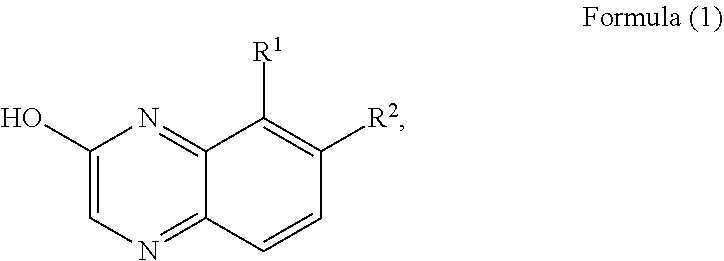
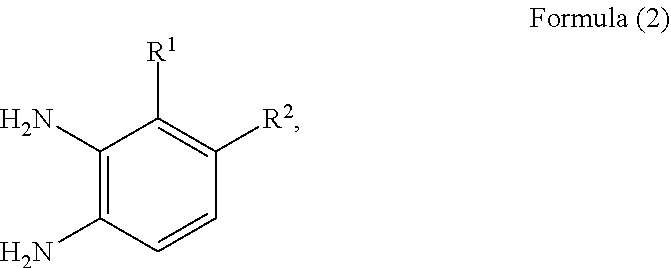
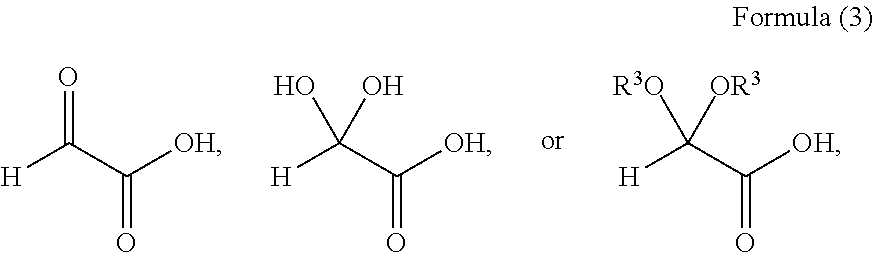
A regioselective one-step process for the synthesis of 2-hydroxyquinoxaline of Formula (1) or tautomers thereof:comprising reacting 1,2-phenylenediamine of Formula (2):with an excess amount of glyoxylic acid, glyoxylic acid monohydrate, or a 2,2-dialkoxyacetic acid of Formula (3):at a low temperature;wherein R1 and R2 are as defined in the specification.
Description
CROSS REFERENCE TO RELATED APPLICATIONS[0001]This application claims priority to U.S. Provisional Application No. 62 / 713,661, filed Aug. 2, 2018; the disclosure of which is incorporated herein by reference in its entirety.FIELD OF THE INVENTION[0002]The present invention provides a regioselective one-step process for the synthesis of 2-hydroxyquinoxaline of Formula (1) or tautomers thereof from 1,2-phenylenediamine of Formula (2).BACKGROUND OF THE INVENTION[0003]Quinoxalinemoiety is a common component in a variety of biologically active drug-like molecules and has been found to be useful in the treatment of abnormal cell growth, such as cancer, in mammals. Hydroxyquinoxaline derivatives can be used as intermediates for the preparation of quinoxalinemoiety and can be easily prepared from 1,2-phenylenediamine.[0004]However, reactions of 3,4-disubstituted-1,2-phenylenediamine derivatives with glyoxylate or glyoxylic acid usually provide non-selective mixtures of 2-hydroxy-7,8-disubst...
Claims
the structure of the environmentally friendly knitted fabric provided by the present invention; figure 2 Flow chart of the yarn wrapping machine for environmentally friendly knitted fabrics and storage devices; image 3 Is the parameter map of the yarn covering machine
Login to View More
Application Information
Patent Timeline
Application Date:The date an application was filed.
Publication Date:The date a patent or application was officially published.
First Publication Date:The earliest publication date of a patent with the same application number.
Issue Date:Publication date of the patent grant document.
PCT Entry Date:The Entry date of PCT National Phase.
Estimated Expiry Date:The statutory expiry date of a patent right according to the Patent Law, and it is the longest term of protection that the patent right can achieve without the termination of the patent right due to other reasons(Term extension factor has been taken into account ).
Invalid Date:Actual expiry date is based on effective date or publication date of legal transaction data of invalid patent.



 Login to View More
  Login to View More