Supercharge Your Innovation With Domain-Expert AI Agents!

Method for treating an allergic disease

a technology for allergic diseases and treatment methods, applied in the field of treating allergic diseases, can solve the problems of increasing the threat to our health, and the severity of allergic symptoms, and achieve the effect of reducing the risk of allergic reactions

Active Publication Date: 2020-06-23
ARJIL BIOTECH HLDG CO LTD
View PDF4 Cites 0 Cited by
  • Summary
  • Abstract
  • Description
  • Claims
  • Application Information

AI Technical Summary

Benefits of technology

The composition significantly reduces skin inflammation, ear swelling, and mast cell infiltration, improving symptoms of atopic dermatitis and psoriasis, while also showing potential in treating autoimmune hepatitis by suppressing inflammatory responses and liver injury.

Problems solved by technology

In recent years, it has gradually become a major threat to our health.
IL-4 helps B cells to produce sensilization antibodies of immunoglobulin E. IL-5 can attract eosinophilic white blood cells, which will release some of the inflammatory mediators, resulting in much severe allergic symptoms.

Method used

the structure of the environmentally friendly knitted fabric provided by the present invention; figure 2 Flow chart of the yarn wrapping machine for environmentally friendly knitted fabrics and storage devices; image 3 Is the parameter map of the yarn covering machine
View more

Image

Smart Image Click on the blue labels to locate them in the text.
Viewing Examples
Smart Image
  • Method for treating an allergic disease
  • Method for treating an allergic disease
  • Method for treating an allergic disease

Examples

Experimental program
Comparison scheme
Effect test

preparation examples

[0060]1. Contact Dermatitis Animal Experiment

[0061]Contact Dermatitis Animal Model:

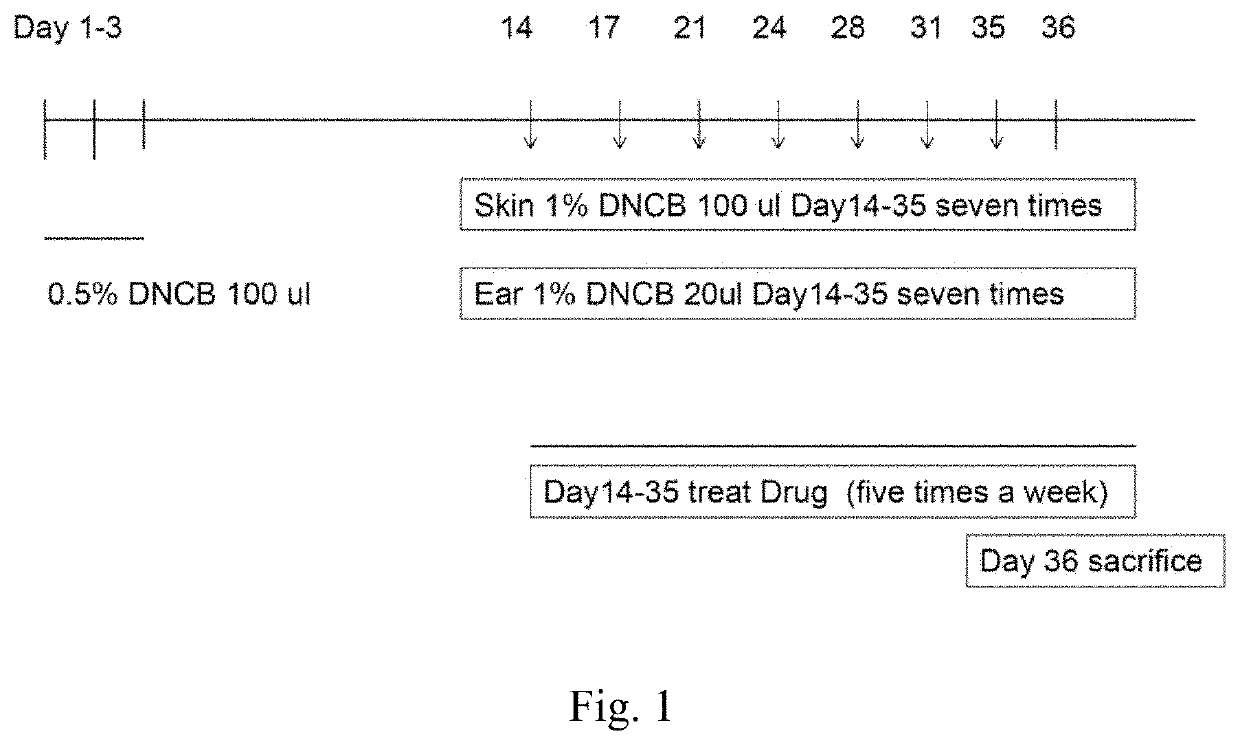
[0062]After 7 to 8 weeks from the birth of BALB / c mice, back shaving was conducted, and the allergy drug, 1-chloro-2,4-dinitrobenzene (DNCB), was used as a stimulant to induce the symptoms of contact dermatitis, such as atopic eczema. As shown in FIG. 1, the back was smeared with 100 μl of 0.5% DNCB on Day 1-3; the skins were challenged with 100 μl of 1% DNCB and the ears were challenged with 20 μl of 1% DNCB on Day 14. The smearing could also be conducted on Days 17, 21, 24, 28, 31, and 35. On the other hand, from Day 14, the test ointments were applied five times a week for three weeks. On Day 36, the mice were sacrificed.

[0063]Mice Grouping:

[0064]Mice were divided into five groups and each group had four mice. The names, drugs, and ointments are shown in Table 1:

[0065]

TABLE 1Agent for inducing atopicTreatmentGroup (short title)eczema(in an ointment)Remark1Normal group (N)acetone and olive oilaceton...

example 1

Animal Experiment for Inducing Atopic Dermatitis

[0102]1. Appearance Observations and Analyses

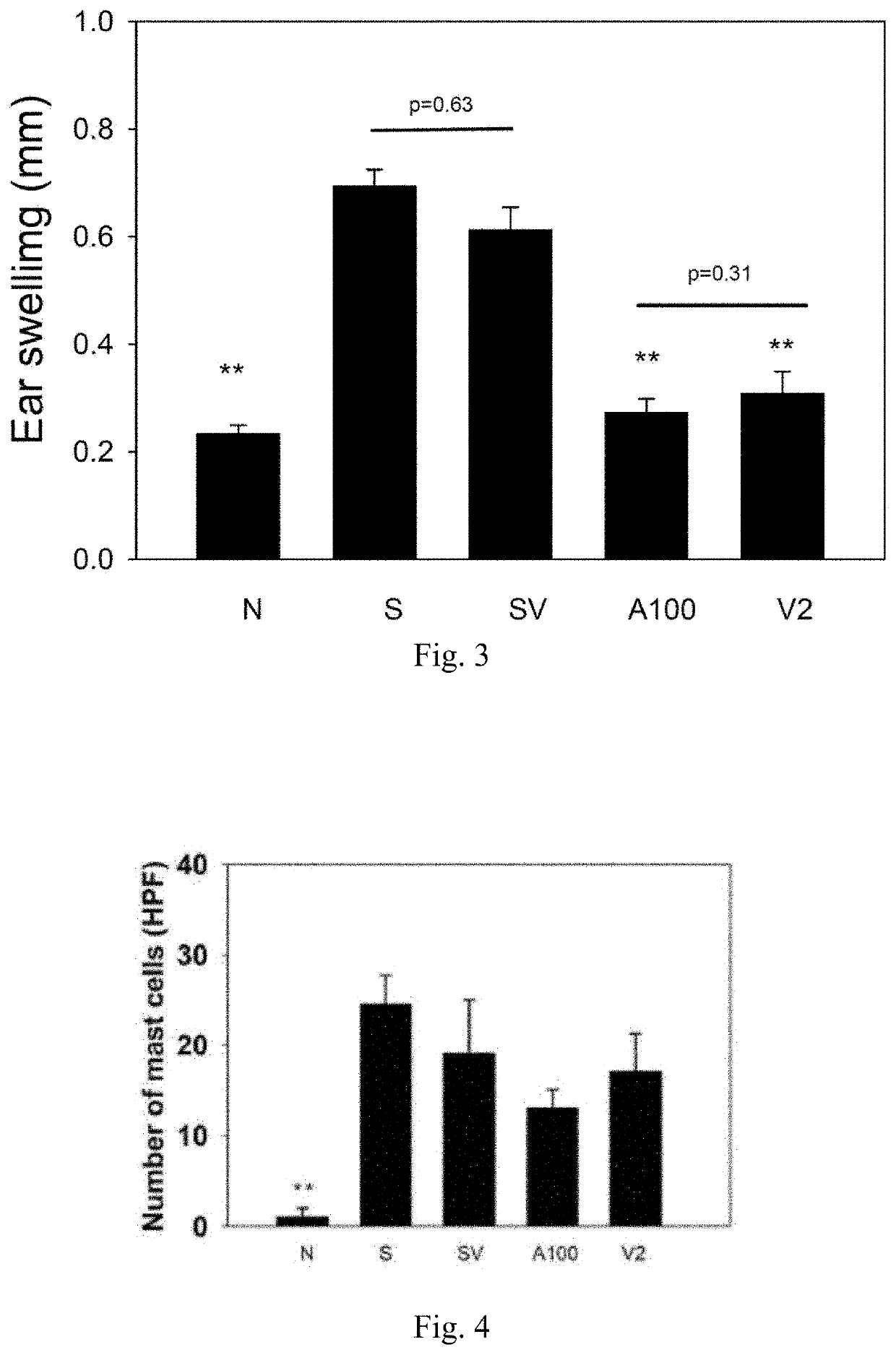
[0103]The appearances of mice skins were photographed after mice were sacrificed at the end of the experiment. The mice of the normal group (N) had intact skins; the skins of the mice of the sensitization group (S) were rough and inflamed, and the ears of which were swelling. The remodeling phenomenon in skin was found after about 3-4 weeks from the stimulation of DNCB. In the group SV, the symptoms of the skin were not improved. However, it was found in each of the groups A100 and V2 the effects on improvement of atopic eczema, wherein the skin redness and skin swelling were significantly improved. In addition, at the process of breaking necks of mice, the group A100 and the group V2 were found to have no phenomenon in skin crack, wherein the fragile skin caused by atopic eczema was improved. Therefore, it was concluded that the symptoms caused by atopic eczema could be improved by the trea...

example 2

Psoriasis Animal Experiment

[0116]1. Appearance Observations and Analyses

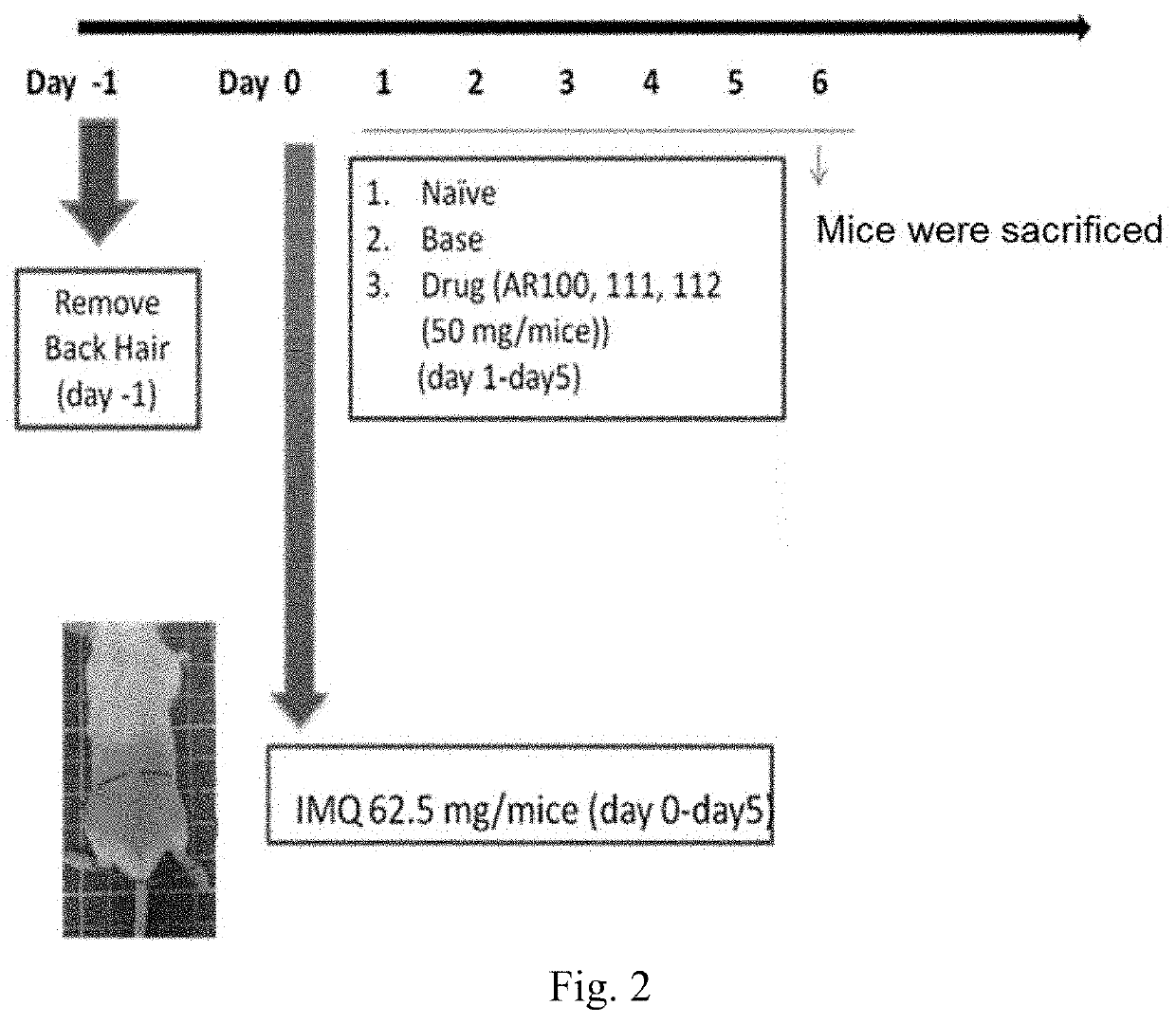
[0117]The appearances of mice skins were observed and it was found that in the groups AR100 and AR112 the scaling and redness on the affected areas with psoriasis were effectively reduced, wherein the composition of AR0001DS1 and AR0002DS3 provided a significant effect on reduction in the symptoms of psoriasis.

[0118]2. Scores on Redness

[0119]The scale of redness was scored according to daily observation and recordation of the mice. The degree of skin scaling is shown in FIG. 8A, and the redness is shown in FIG. 8B. The data in FIGS. 8A and 8B were based on the Psoriasis Area and Severity Index (PAST), and the degrees of psoriasis scaling ratio, redness, and scaling were scored to 0 point (none), 1 point (mild), 2 points (moderate), 3 points (severe) and 4 points (extremely severe), and were recorded daily during the course of the experiment. The results showed that the AR100 group, the AR111 group, and the AR112...

the structure of the environmentally friendly knitted fabric provided by the present invention; figure 2 Flow chart of the yarn wrapping machine for environmentally friendly knitted fabrics and storage devices; image 3 Is the parameter map of the yarn covering machine
Login to View More

PUM

PropertyMeasurementUnit
temperatureaaaaaaaaaa
concentrationaaaaaaaaaa
pHaaaaaaaaaa
Login to View More

Abstract

The invention relates to a use of a compound for manufacturing a medicament for treating an allergic disease, wherein the compound is selected from the group consisting of ovatodiolide, 1′-acetoxychavicol acetate, zerumbone and combination thereof. Also provided is a method and a composition for treating an allergic disease.

Description

CROSS REFERENCE TO RELATED APPLICATION[0001]This non-provisional application claims the benefit under 35 U.S.C. § 119(e) to U.S. Provisional Application No. 62 / 694,779, filed on Jul. 6, 2018, which is hereby expressly incorporated by reference into the present application.FIELD OF THE INVENTION[0002]The invention relates to a method for treating an allergic disease. In particular, the invention relates to a composition for treating an allergic disease.BACKGROUND OF THE INVENTION[0003]Allergies are due to immune system disorders of the body, which reacts excessively to allergens in the environment. Allergens entering the body and IgE antibodies will be combined to stimulate mast cells to release substances like histamine, whereby the inflammatory response are generated in body tissues, resulting in chronic inflammation of skin, mucosal tissues or blood vessels. In recent years, it has gradually become a major threat to our health. Allergies are related to the second type of helper T ...

Claims

the structure of the environmentally friendly knitted fabric provided by the present invention; figure 2 Flow chart of the yarn wrapping machine for environmentally friendly knitted fabrics and storage devices; image 3 Is the parameter map of the yarn covering machine
Login to View More

Application Information

Patent Timeline
no application Login to View More
Patent Type & Authority Patents(United States)
IPC IPC(8): A61K31/22A61K31/34A61K31/122A61K31/365A61K31/222A61P1/16A61K36/9062A61K36/9068A61P17/06A61K36/53
CPCA61K31/122A61K36/9068A61K36/9062A61K36/53A61K31/365A61P1/16A61K31/222A61P17/06A61P37/00A61P11/06A61P19/02A61P11/00A61P17/00A61P9/00A61P1/06A61K2300/00
Inventor WU, YEH BLO, JIR-MEHNGLIANG, HUI JULIN, PEI-HSIN
Owner ARJIL BIOTECH HLDG CO LTD
Features
  • R&D
  • Intellectual Property
  • Life Sciences
  • Materials
  • Tech Scout
Why Patsnap Eureka
  • Unparalleled Data Quality
  • Higher Quality Content
  • 60% Fewer Hallucinations
Social media
Patsnap Eureka Blog
Learn More