Supercharge Your Innovation With Domain-Expert AI Agents!

Methods of generating manganese (III) ions in mixed aqueous acid solutions using ozone

a technology of mixed aqueous acid and ozone, which is applied in the direction of manganates/permanentates, liquid/solution decomposition chemical coatings, instruments, etc., can solve the problems of high anode surface, hexavalent chromium or cr(vi) quality problems, and no commercial product which is free of hexavalent chromium or cr(vi) is currently available on the market to provide the efficiency desired by the metallization industry

Active Publication Date: 2021-01-12
ROHM & HAAS ELECTRONICS MATERIALS LLC
View PDF4 Cites 0 Cited by
  • Summary
  • Abstract
  • Description
  • Claims
  • Application Information

AI Technical Summary

Benefits of technology

[0011]The methods of the present invention using ozone as an oxidizing agent to oxidize Mn(II) ions to Mn(III) ions enable a high efficiency process for generating and regenerating the Mn(III) ion etch species. The methods of the present invention eliminate the need for electrodes and electrolysis to generate and regenerate the Mn(III) ion species and the inefficiencies of the electrolysis process. The method of generating Mn(III) using ozone of the present invention generates environmentally friendly waste products such as water and oxygen. The rapid oxidation of Mn(II) to Mn(III) using ozone also reduces or eliminates any undesirable side reactions which can compromise the efficiency of oxidizing Mn(II) to Mn(III).
[0012]The methods of the present invention etch the one or more polymers of substrates prior to metallization using chrome-free aqueous acid solutions, thus eliminating a hazardous and environmentally undesirable compound. The methods use dissolved Mn(III) ions as etching agents in place of Cr(VI) to roughen the one or more polymers. Mn(III) ions are more stable in the aqueous acid solution than Mn(VII) ionic species, do not readily form insoluble MnO2 as does Mn(VII). Mn(III) ions are generated and regenerated in the aqueous acid solution by oxidizing Mn(II) ions with ozone. The methods of the present invention can be continuous processes where the Mn(III) ions are generated from Mn(II) ions with ozone and Mn(III) ions which are reduced back to Mn(II) ions during the etch process are oxidized or regenerated to Mn(III) ions by ozone.
[0013]The mixture of the sulfuric acid and the one or more organic acids increases the solubility of the Mn(II) and Mn(III) ions such that the Mn(II) and Mn(III) ions are substantially completely dissolved in the aqueous acid solution to provide concentrations of at least 15 mmol / L of the Mn(III) oxidizing agent in the solution and to operate using standard solution circulation and filtration systems under production conditions. Furthermore, it is known that solutions with higher sulfuric acid content readily adsorb water from the atmosphere due to the hygroscopicity of sulfuric acid. By replacing part of the sulfuric acid with one or more organic acids, water adsorption can be reduced or prevented thus maintaining good etching performance.
[0014]In addition, metals plated on the etched polymers of the present invention have good peel strength. Such peel strengths range from 7 N / cm and greater, or such as 10 N / cm and greater.

Problems solved by technology

Although great efforts have been made over the years by many chemical suppliers and the plating industry to replace currently used toxic etching solutions, no commercial product which is free of hexavalent chromium or Cr(VI) is currently available on the market to provide the efficiency desired by the metallization industry.
Oxidizing agents are consumed either by the etching process or due to the instability of the oxidants.
However, either in an acidic or alkaline medium, Mn(VII) is unstable and tends to reduce to its lower oxidation states, especially to Mn(IV), consequently forming a large quantity of the insoluble MnO2 and causing quality issues on the treated polymer surfaces.
Operating in the low current density range has the disadvantage that this requires very high anode surfaces and the required space for those electrolysis tank equipment becomes inconvenient for industrial scale applications.
Also, due to the lower current efficiency, oxygen is evolved at the anode which decreases the anode life-time because of the corrosion of platinum.
However, the anode life time for a platinum thickness of 10 μm is expected to be approximately one year due to platinum corrosion of ca.
Due to the above reasons, the electrolytic regeneration process has the disadvantage of being inefficient, expensive and potentially hazardous, with the electrolysis tank consuming considerable factory space.
Therefore, there is a need for a chrome-free etch method using Mn(III) ions as an etch species which is efficient for generating the etch species during continuous operation and is unhazardous and environmentally friendly.

Method used

the structure of the environmentally friendly knitted fabric provided by the present invention; figure 2 Flow chart of the yarn wrapping machine for environmentally friendly knitted fabrics and storage devices; image 3 Is the parameter map of the yarn covering machine
View more

Image

Smart Image Click on the blue labels to locate them in the text.
Viewing Examples
Smart Image
  • Methods of generating manganese (III) ions in mixed aqueous acid solutions using ozone
  • Methods of generating manganese (III) ions in mixed aqueous acid solutions using ozone
  • Methods of generating manganese (III) ions in mixed aqueous acid solutions using ozone

Examples

Experimental program
Comparison scheme
Effect test

example 1

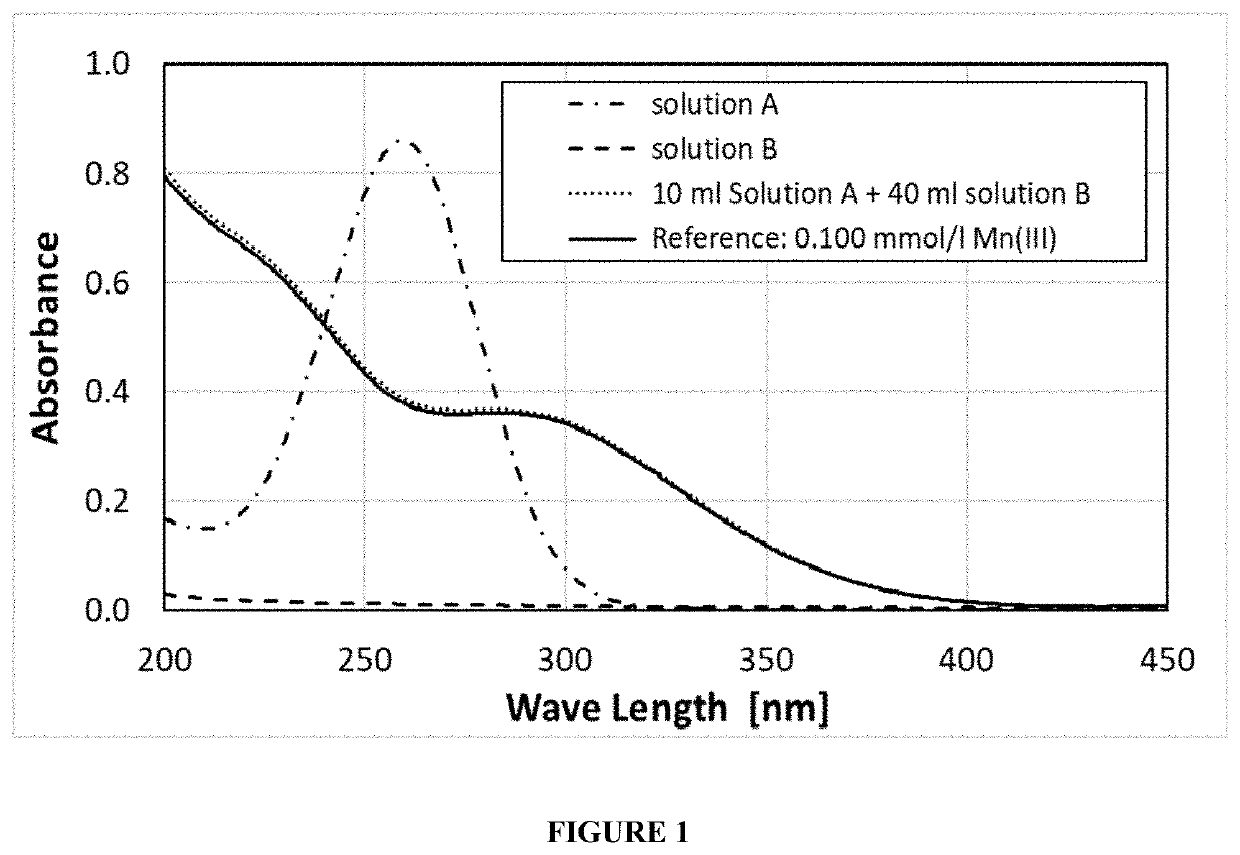
[0041]An ozone containing mixed acid solution (solution A) was prepared by passing ozone through a solution of 400 mL / L sulfuric acid 96 wt % (7.2 M sulfuric acid) and 550 mL / L methanesulfonic acid 70 wt % (5.4 M methanesulfonic acid). The ozone was produced with an OZONETECH ICT-10™ ozone generator (available from Ozone Tech Systems OTS AB) at an ozone production rate of 4.99 g / hour (5.87 g / L / hour) of ozone gas from pure oxygen. The ozone / oxygen gas mixture (11.2 wt % of ozone) was passed at a rate of 0.5 L / min for 10 min (0.83 g O3) through 0.85 L solution of the mixed acid solution. The pH of the aqueous acid solution was less than 1. The ozone was brought in contact with the aqueous acid solution via a PTFE gas distributer with 4 holes of 0.5 mm diameter in a 1 liter glass bottle such that the travel length of the ozone gas through the solution was 10 cm. After the ozone was passed through this solution, the concentration of ozone dissolved in the solution was determined via UV ...

example 2

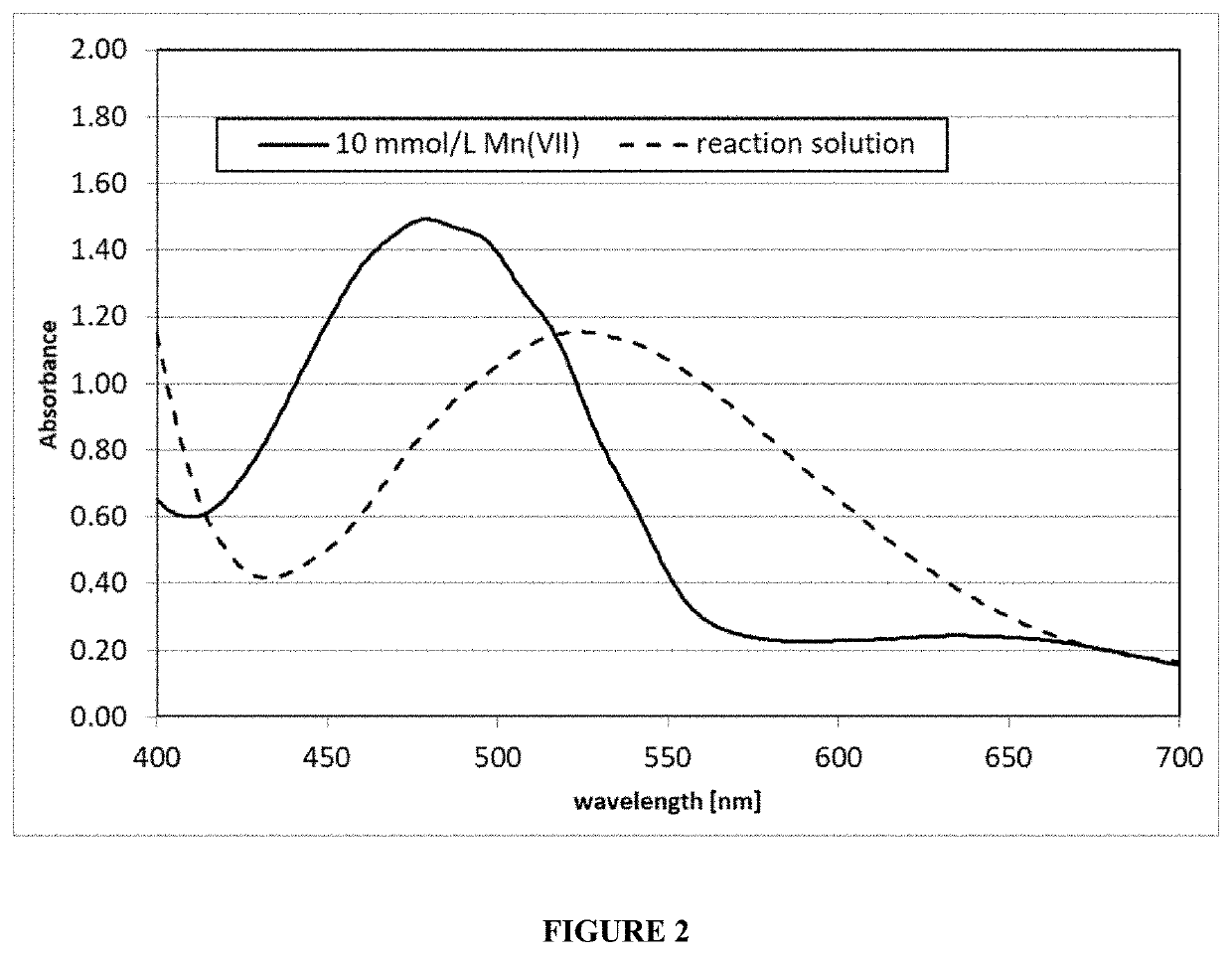
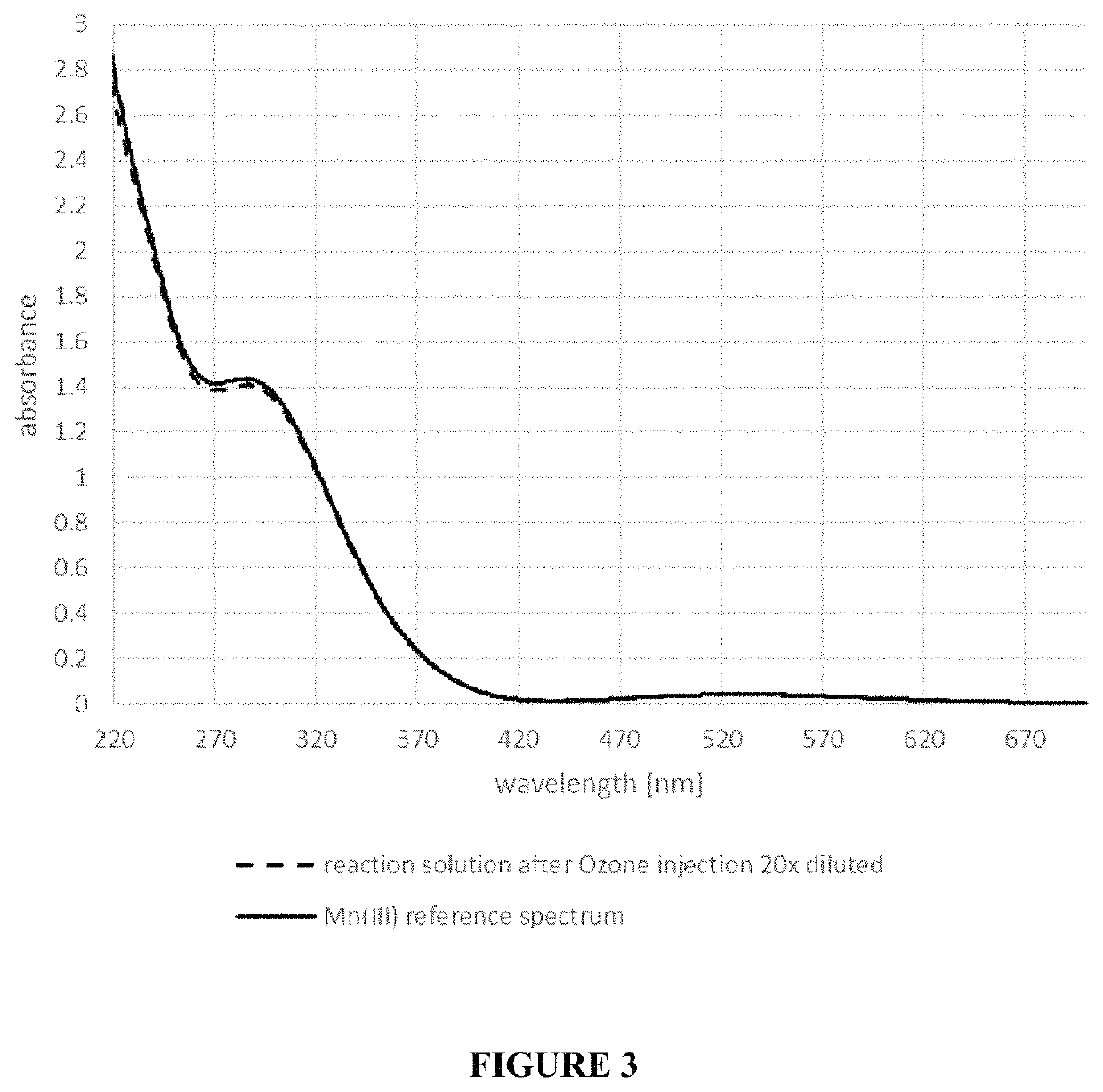
[0044]A OZONETECH ICT-10™ ozone generator (available from Ozone Tech Systems OTS AB) was used to generate 5.22 g / hour (4.35 g / L / hour) of ozone gas from pure oxygen. The ozone / oxygen gas mixture (11.7 wt % ozone) was passed at 0.5 L / min. for 18 min (1.57 g O3) through 1.2 L solution of 400 mL / L sulfuric acid 96 wt % (7.2 M sulfuric acid), 550 mL / L methanesulfonic acid 70 wt % (5.4 M methanesulfonic acid), 73 mL / L water, 11 g / L manganese(II) sulfate monohydrate (65.1 mmol / L) and 470 mg / L silver methanesulfonate (2.31 mmol / L) at 60° C. The pH of the aqueous acid etch solution was less than 1. The ozone was brought in contact with the aqueous acid etch solution via a PTFE frit with 3 μm pore size in a vertical tube of 4.3 cm inner diameter such that the travel length of the ozone gas through the solution was 75 cm. The time that the gas bubble required for traveling the 75 cm of solution was about 6 seconds.

[0045]During ozone injection in the aqueous acid etch solution, the color change...

example 5

[0053]An ABS test plaque was cleaned using a conventional and commercially available Cleaner PM-900 (available from Rohm and Haas Electronic Materials LLC) for 3 min at 45° C. Subsequently, the ABS plastic part was immersed for 10 min into the aqueous acid etching solution at 65° C. and then rinsed with deionized water at room temperature. After drying the sample was subjected to SEM investigation at 25,000× which is shown in FIG. 4. As shown in FIG. 4, the aqueous acid etch solution containing the Mn(III) significantly roughened the ABS surface as evidenced by the numerous pores.

[0054]Another ABS test plaque was cleaned using Cleaner PM-900 for 3 min at 45° C. The cleaner treatment removed soils and fingerprints from the surface, but left the surface unmodified or unchanged and hydrophobic. Subsequently, the ABS plaque was immersed for 7 min into the above-mentioned etching solution at 60° C. and then rinsed with deionized water at room temperature. The surface of the ABS appeared ...

the structure of the environmentally friendly knitted fabric provided by the present invention; figure 2 Flow chart of the yarn wrapping machine for environmentally friendly knitted fabrics and storage devices; image 3 Is the parameter map of the yarn covering machine
Login to View More

PUM

PropertyMeasurementUnit
current densitiesaaaaaaaaaa
current densityaaaaaaaaaa
current efficiencyaaaaaaaaaa
Login to View More

Abstract

Manganese-(III) species is generated and regenerated in a mixed aqueous acid solution containing manganese-(II) species by injecting ozone gas in the mixed aqueous acid solution such that ozone oxidizes at least some of the manganese-(II) species to the manganese-(III) species with at least 60% Mn(III) generation efficiency. The acids include sulfuric acid and an alkane sulfonic acid. The aqueous acid solution containing manganese-(III) and manganese-(II) species is used to etch polymer materials. The etch is a chrome-free etch method.

Description

FIELD OF THE INVENTION[0001]The present invention is directed to methods of generating manganese-(III) ions in mixed aqueous acid solutions using ozone. More specifically, the present invention is directed to methods of generating manganese-(III) ions from manganese-(II) ions in mixed aqueous acid solutions of sulfuric acid and alkane sulfonic acids using ozone, wherein efficiency of generation of the manganese-(III) ions from the manganese-(II) ions with the ozone is at least 60%.BACKGROUND OF THE INVENTION[0002]Prior to metallization a substrate surface containing organic polymers is typically etched to achieve good adhesion between the substrate surface and plated metals. Although great efforts have been made over the years by many chemical suppliers and the plating industry to replace currently used toxic etching solutions, no commercial product which is free of hexavalent chromium or Cr(VI) is currently available on the market to provide the efficiency desired by the metallizat...

Claims

the structure of the environmentally friendly knitted fabric provided by the present invention; figure 2 Flow chart of the yarn wrapping machine for environmentally friendly knitted fabrics and storage devices; image 3 Is the parameter map of the yarn covering machine
Login to View More

Application Information

Patent Timeline
no application Login to View More
Patent Type & Authority Patents(United States)
IPC IPC(8): C25C1/10C08J7/14
CPCC25C1/10C08J7/14C09K13/06C23C18/24C23C18/208C23C18/32C23C18/285C23C18/30C01G45/12C09K13/04H01L21/30604H01L2924/01025
Inventor SCHEYBAL, ANDREASWEITERSHAUS, KATHARINABALANTRAPU, KRISHNA
Owner ROHM & HAAS ELECTRONICS MATERIALS LLC
Features
  • R&D
  • Intellectual Property
  • Life Sciences
  • Materials
  • Tech Scout
Why Patsnap Eureka
  • Unparalleled Data Quality
  • Higher Quality Content
  • 60% Fewer Hallucinations
Social media
Patsnap Eureka Blog
Learn More