[0005] DeLorme provides mapping
software that enables a user to print sets of adjacent maps on 8.5".times.11" standard-sized paper. The margins may be
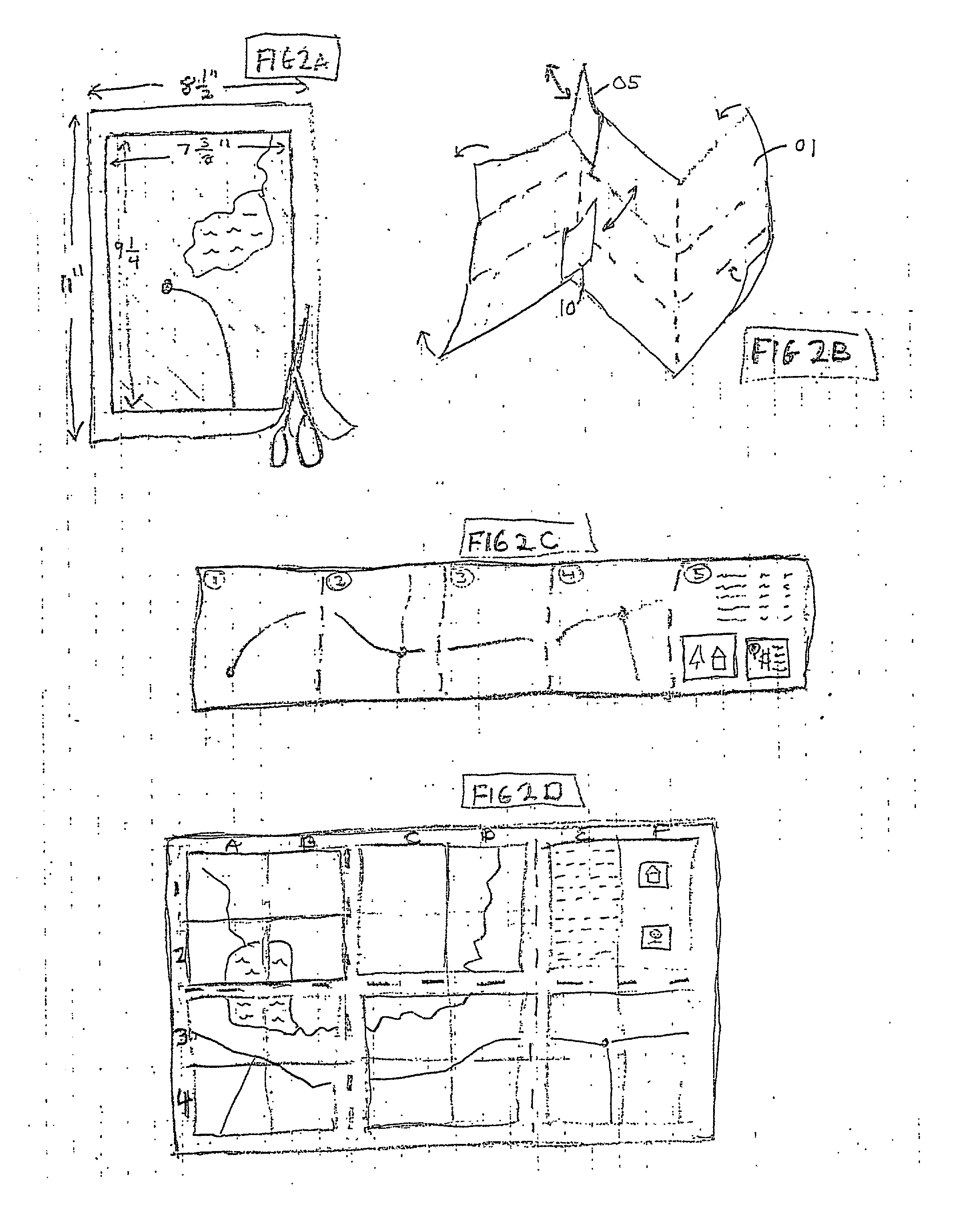
cut off and the multiple pieces of paper assembled together--like a quilt or mosaic--to form a relatively large composite map. This technology enables home and small office
personal computer users to print-out and tape or
thumb-tack together large-size "sheet" or "wall" maps, using inexpensive
consumer market printers and standard-sized paper--rather than more costly and complicated plotters or other specialized equipment and oversized paper. DeLorme offers that
software technology as a component named MuralMaker. Recently, the MuralMaker capabilities have been made available for topographical printed map output from DeLorme's 3-D TopoQuads.RTM. mapping software on CDROM or DVD--as an add-on tool supplied with DeLorme's other mapping software products identified as TopoToolS.TM. or Xmap.RTM. Geographic. The noted software products enable users to customize composite maps of various sizes. However, there does not presently exist a suitable protective holder for retaining such customized, composite maps.
[0006] Starting with its Map`n`Go 1.0 mapping software product first released in July of 1994, DeLorme has facilitated automated routing based on user selection and input of starting point, final destination, and one or more optional waypoints. This software for calculating optimum routes further included capabilities for printing detailed sets of maps along a computed
route. One such form of a route-related map printout is described in DeLorme's CARS U.S. Pat. No. 5,559,707 at col. 4, line 58 to col. 5, line 16 and col. 14, lines 12-27 with reference to FIG. IN. For longer routes, such helpful travel route hardcopy output could include a series of multiple "strip" maps of the recommended route, showing critical intersections and turning points, as well as detailed driving directions, text and / or graphic information about points of interest along the way. Such sets of route-related information printouts can be used with the present map holder invention.
[0007] Relatedly, DeLorme's CAMLS U.S Pat. No. 5,848,373 described and claimed a
system which included coordination among portable distributed digital devices and corresponding printed maps by means of common alphanumerically named map grids. FIG. 14C in the issued CAMLS patent, for example, illustrates a
wireless pager receiving information including a map grid designation of a specific accident site--in the form of alphanumerical text--which the user can then locate by means of the corresponding
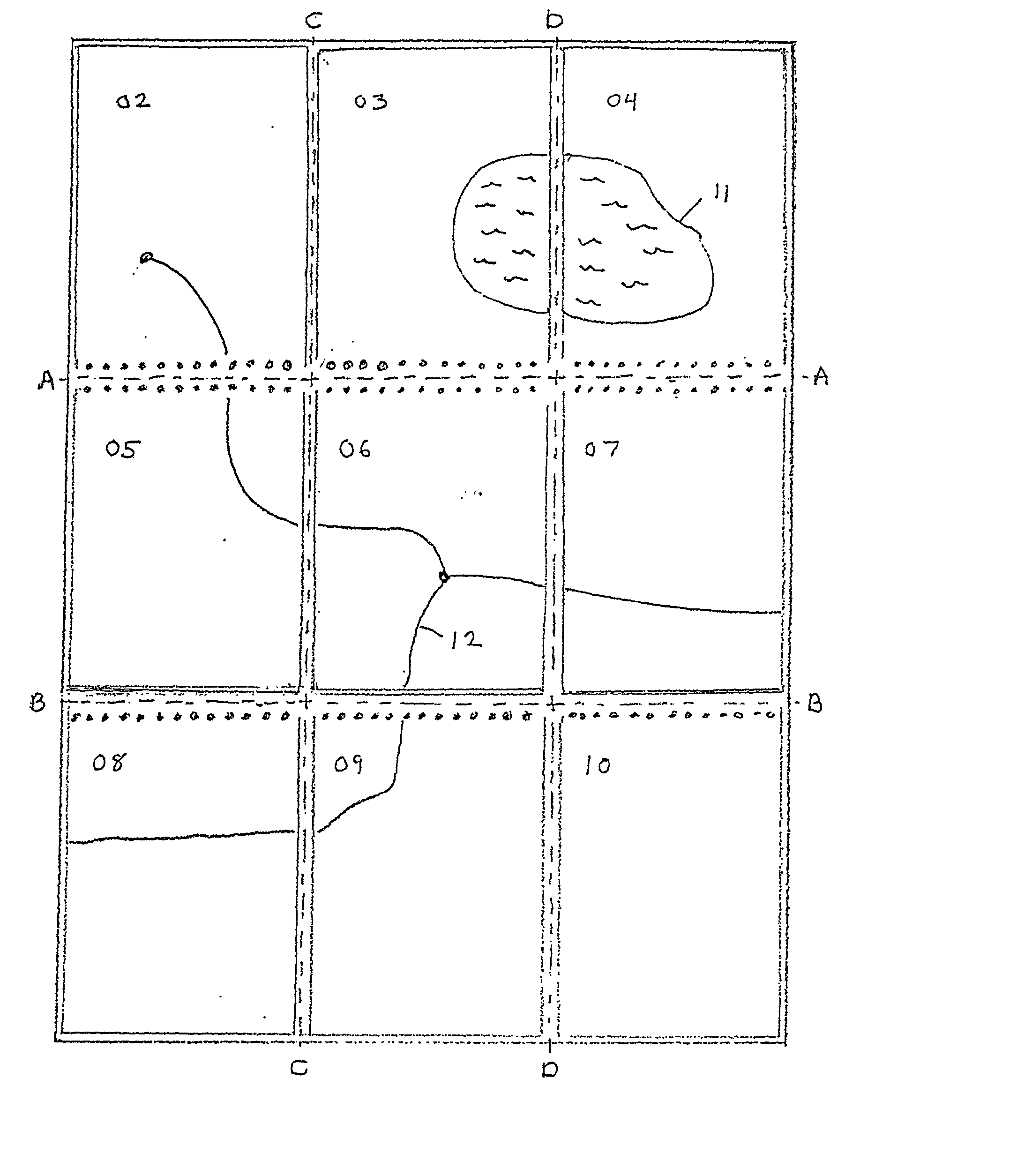
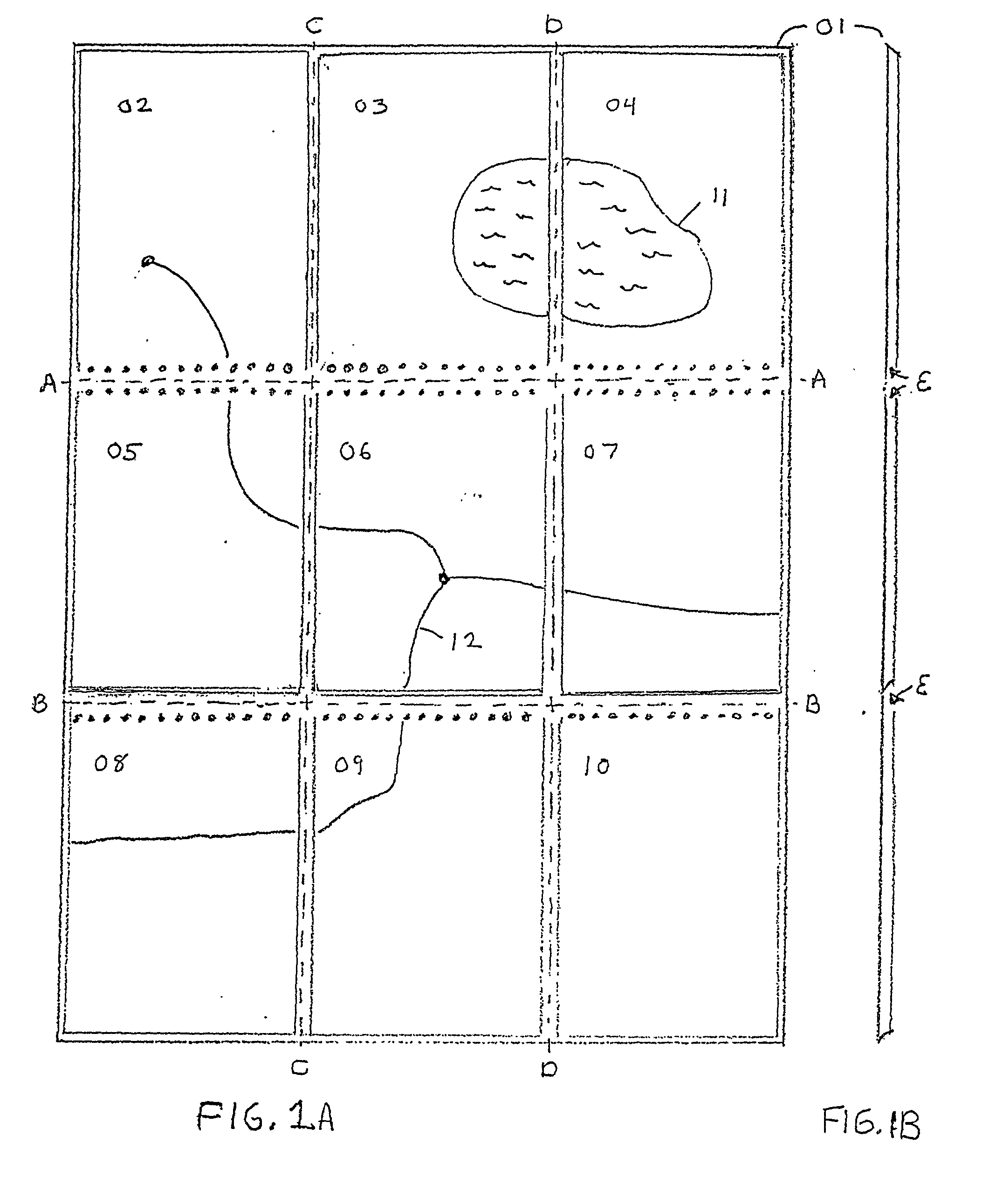
grid system as printed on the pages of a map book. As an alternative to this companion book, or a sheaf of map printouts, the present map holder invention can serve to assemble, demarcate, and enable
visualization of a whole set of map printouts of adjacent areas, including the corresponding
system of identifiable map grids, as an aid in ascertaining geographic locations.
[0009] Therefore, the overall object of the present invention is to provide a device to transparently contain, organize and protect maps and other related travel information hardcopy or print output generated by
geographic information system software. Preferably, the transparent container folds up for convenient storage and focused use. However, the container or holder should readily unfold in order to present the "big" cartographic picture and / or other related travel information. In other words, an important object is to improve upon loose collections of paper maps, written route directions, text and / or pictorial information about nearby points of interest--easily deranged and / or damaged. Bound booklets or stapled sheaves of maps and other travel information provide a strictly serial form of organization--requiring the user to flip and find between multiple pages of adjacent maps and / or other related travel information.
[0012] The holder of the present invention provides a convenient storage method that enables a user to compose and retain a customized map structure, which can be viewed as a single unit, wherein the particular map or other travel information components may be changed, as desired, simply by replacement within the compartments. The overall transparent map holder is also designed to fold up and unfold for portability, ease of storage, and more convenient or focused use. These and other advantages of the present invention will become apparent upon review of the following detailed description, the accompanying drawings, and the appended claims.



 Login to View More