However, this filter for catching PM is clogged along the trap of PM, and the exhaust
gas pressure (exhaust
gas pressure) rises as the trapped amount of PM increases, it is required thereby to eliminate PM from this DPF, and therefore, several methods and systems have been developed.
Among them, there is a
system for eliminating PM by
combustion through the heating of the filter with an electric heater or a burner, or back washing by flowing the air in the opposite direction; however, in the case of these systems, the
fuel efficiency deteriorates, because PM is burned by supplying
heating energy from outside, and the regeneration control is difficult.
In addition, in the case of adopting these systems, often two lines of exhaust passage provided with DPF are installed, PM trap and filter regeneration are repeated alternately, thereby tending to increase the size and cost of the
system.
However, even in these continuous regeneration type DPF systems, it is still necessary to rise the exhaust gas temperature to the order of 350.degree. C., and the aforementioned reaction does not occur, and the filter can not be regenerated by PM oxidation in an engine operation state with a low exhaust gas temperature such as idling operation, extremely
low load operation or the like, and PM continues to be accumulated in the filter, causing the problem of filter clogging.
For instance, in the idling operation,
low speed or extremely
low load operation when the engine break is operated on the downhill, the fuel is burned scarcely, a low temperature exhaust gas flows into the continuous regeneration type DPF apparatus, lowering the catalyst temperature and deteriorating the catalyst activity.
If the idling or extremely
low load engine operation is sustained, PM trap progresses without supply of a hot exhaust gas that can oxidize and eliminate PM; therefore, PM can not be oxidized and eliminated while PM trap continues, resulting in the progress of filter clogging.
This progress of filter clogging increases the exhaust
gas pressure and deteriorates the
fuel efficiency and, moreover, when the exhaust gas pressure rises excessively along with the progress of filter clogging, the engine will stop, and if things come to the worst, it will develop to the disability of restart.
Therefore, it is planned to rise the exhaust gas temperature by retarding the injection timing, in the engine fuel injection; however, a misfire of injected fuel may be provoked if it is tried to rise the exhaust gas temperature by retarding considerably the injection timing, a limit occurs in the injection timing retarding angle, leading to the occurrence of a limit for the exhaust gas temperature rising, and the range of possible temperature rising comes to be reduced.
Nevertheless, concerning this main injection retard, there are problems of misfire, deterioration in output torque and
fuel efficiency as explained below.
Moreover, there is a case where the injection quantity is reduced in order to intend to optimize the main injection quantity in respect to the required exhaust gas temperature, in order to improve the fuel efficiency, the kindling
charcoal becomes insufficient and flames off if the
pilot injection quantity of that moment is constant.
Because of these problems of misfire, a limit is developed in the rising of exhaust gas temperature, and, the decrease of the
oxygen concentration becomes unable to be achieved.
Also, as for torque output, when this retard control of main injection is performed, the engine output torque lowers as the
combustion of the main injection is delayed, making impossible to maintain a high output torque, so there is a problem that this retard control of main injection can not be used in the case of desiring to maintain an output torque.
Howsoever, if it is tried to maintain a combustion
flame until the timing when the main injection is injected, only by a single sub injection, it becomes necessary to increase the fuel injection quantity in this sub injection, causing the problem of fuel efficiency deterioration.
At the same time, torque is generated by this sub injection, deteriorating the drivability.
In addition, as the injection quantity of the
pilot injection increases / decreases in accordance with the retard amount, injection quantity of the main injection, the fuel will not be consumed unnecessarily allowing to save the fuel compared to the case of simple increase of the
pilot injection quantity, and the increase of fuel consumption can be limited to the minimum.
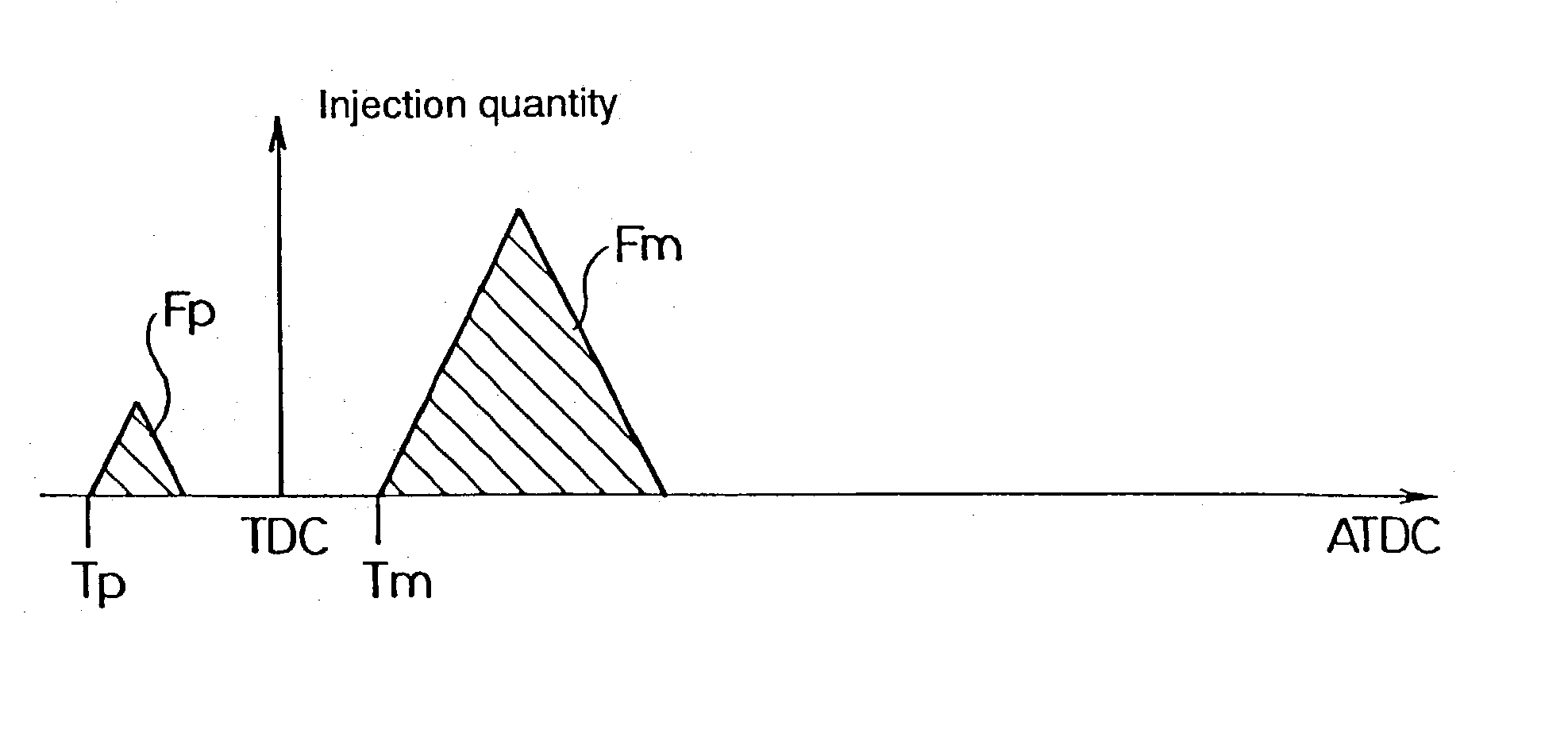
Moreover, as this injection quantity Vp of the
pilot injection Fp increases / decreases in correspondence to the retard amount Rm of the main injection Fm, according to a relation determined preliminarily by experiment or others, the fuel would not be consumed unnecessarily, and the deterioration of the fuel efficiency can be limited to the minimum.
Moreover, as this injection quantity Vp of the
pilot injection Fp increases / decreases in correspondence to the injection quantity Vm of the main injection Fm, according to a relation determined preliminarily by experiment or others, the fuel would not be consumed unnecessarily, and the deterioration of the fuel efficiency can be limited to the minimum.





 Login to View More
  Login to View More