Transmitting apparatus with bit arrangement method
Active Publication Date: 2005-08-18
FUJITSU LTD
View PDF9 Cites 16 Cited by
Summary
Abstract
Description
Claims
Application Information
AI Technical Summary
This helps you quickly interpret patents by identifying the three key elements:
Problems solved by technology
Method used
Benefits of technology
Benefits of technology
[0065] The present invention uses a transmitting apparatus comprising a segmentation unit for segmenting data and an error detection code for said data into N blocks, an error correcting encoding unit for respectively executing the error correcting coding process on the N blocks, an arrangement means for arranging N blocks of systematic bits and redundant bits obtained after the error correcting coding process into a plurality of bit sequences, and a transmitting unit for transmitting the data after execution of amplitude phase modulation corresponding to each signal point on the phase plane indicated by each bit sequence arranged, wherein the arrangement means equalizes the number of systematic bits of N blocks to be arranged in the side where an error is more easily generated.
Problems solved by technology
There are a number of problems to be found in the prior art described above.
Accordingly, there arise problems in that a difference in tolerance is generated among the blocks resulting from arrangement of signal points even when the same kind of bits are used in the blocks in any case of systematic bits and redundant bits, and moreover reception quality itself is also different in accordance with the block used, creating a difference in quality among the blocks.
Moreover, there exists the problem that when an error correction process in the turbo coding process is to be executed, a block having higher tolerance has a margin of error correction that handles the occurrence of further error, but a block having lower tolerance likely falls into the situation in which an error is generated that exceeds the error correction capability, and therefore such a condition is not effective.
Method used
the structure of the environmentally friendly knitted fabric provided by the present invention; figure 2 Flow chart of the yarn wrapping machine for environmentally friendly knitted fabrics and storage devices; image 3 Is the parameter map of the yarn covering machine
View more
Image
Smart Image Click on the blue labels to locate them in the text.
Viewing Examples
Smart Image
Click on the blue label to locate the original text in one second.
Reading with bidirectional positioning of images and text.
Smart Image
Examples
Experimental program
Comparison scheme
Effect test
first embodiment
[0081] Description of the First Embodiment
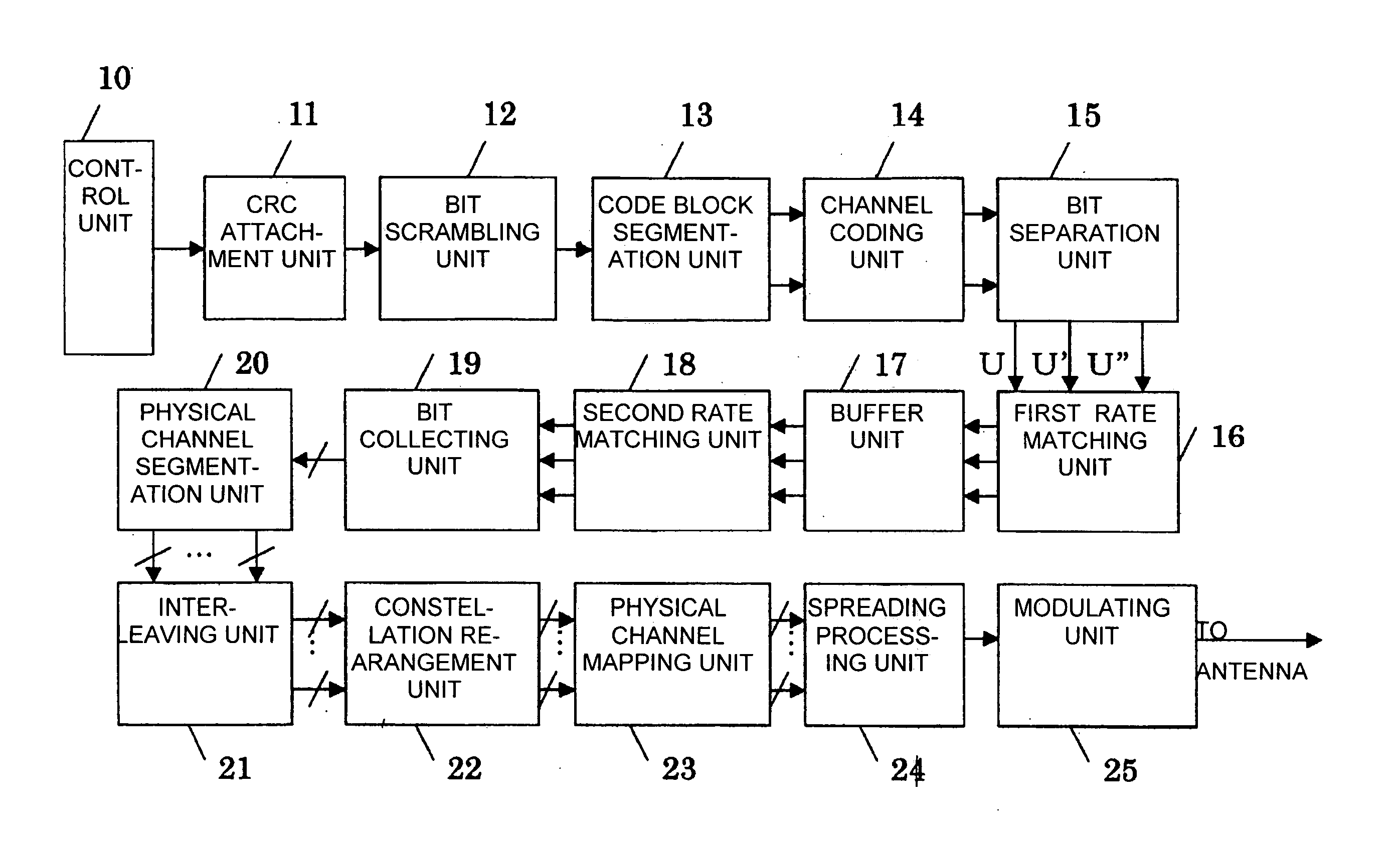
[0082]FIG. 5 illustrates an exemplary transmitting apparatus of the present invention.
[0083] As an example of the transmitting apparatus, the transmitting apparatus (radio base station) of the W-CDMA communicationsystem corresponding to the HSDPA described previously will be described first. This transmitting apparatus can also be adapted to the transmitting apparatus used in the other communication system (for example UMTS).
[0084] In FIG. 5, reference numeral 10 designates a control unit for controlling each unit (11 to 25 or the like) by sequentially outputting the transmission data (each data to be transmitted within one sub-frame) to be transmitted through the HS-DSCH. The HS-DSCH is the shared channel and therefore the transmit data to be transmitted sequentially is respectively allowed to be destined to different mobile stations.
[0085] Numeral 11 designates a CRC attachment unit for adding a result of an arithmetic operation to the...
second embodiment
[0137] Description of the Second Embodiment
[0138] Next, another method of the bit arrangement method in the bit collecting unit will be described in detail.
[0139] This method is characterized in the arrangement method of the bits B of the remainder of the systematic bits described above.
[0140] In particular, while the bits B of the remainder are arranged at the (A+1)-th row, the column in which the systematic bits are arranged is defined as 1+c×(k−1)÷(Nsys−A×Nc)>. Here, k=1, 2, . . . , Nsys−A×Nc. For example, when the setting is executed as Nsys=24, the number of redundant bits=16, Nr=4, and Nc=10, the following results are obtained:
Nr==2.
[0141] Column 1 in which the systematic bits are arranged
=1+=1
[0142] Column 2 in which the systematic bits are arranged
=1+=3
[0143] Column 3 in which the systematic bits are arranged
=1+=6
[0144] Column 4 in which the systematic bits are arranged
=1+=8.
[0145] Therefore, the regions indicated with the oblique lines in FIG. 10 are defined as the region...
the structure of the environmentally friendly knitted fabric provided by the present invention; figure 2 Flow chart of the yarn wrapping machine for environmentally friendly knitted fabrics and storage devices; image 3 Is the parameter map of the yarn covering machine
Login to View More
PUM
Login to View More
Abstract
A transmitting apparatus comprising circuitry operable to generate a plurality of bit sequences using bits included in a first data block and a second data block, circuitry operable to control the plurality of bit sequences to correspond to a signal point on the phase plane, comprising a bit sequence generating unit operable to control the generation of the bit sequences to adjust an occupation rate occupied with predetermined bits included in the first data block to be closer to an occupation rate occupied with predetermined bits included in the second data block in regard to bit positions of the predetermined bits, based on an error tolerance of the respective bit sequences generated resulting from the correspondence to a signal point on the phase plane, and circuitry operable to transmit the signals obtained by multi-level modulations in accordance with each signal point.
Description
BACKGROUND OF THE INVENTION [0001] 1. Field of the Invention [0002] The present invention relates to a transmitting apparatus that generates bit sequences so as to tend to equalize error tolerance among blocks of data that are transmitted. [0003] 2. Description of the Related Art [0004] Standardization is now under development for the W-CDMA system which is a system of the 3rd generation mobile communication systems of the 3rd generation Partnership Project (3GPP). As a theme of the standardization, the High Speed Downlink Packet Access (HSDPA), which can provide a maximum transmission rate of about 14 Mbps in the downlink, is specified. The HSDPA employs an adaptive coding modulation scheme and is characterized, for example, in that the QPSK modulation scheme and the 16 QAM scheme are adaptively switched in accordance with the radio transmission environment between the base stations and mobile stations. Moreover, the HSDPA also employs the HybridAutomatic Repeat request (H-ARQ) sc...
Claims
the structure of the environmentally friendly knitted fabric provided by the present invention; figure 2 Flow chart of the yarn wrapping machine for environmentally friendly knitted fabrics and storage devices; image 3 Is the parameter map of the yarn covering machine
Login to View More
Application Information
Patent Timeline
Application Date:The date an application was filed.
Publication Date:The date a patent or application was officially published.
First Publication Date:The earliest publication date of a patent with the same application number.
Issue Date:Publication date of the patent grant document.
PCT Entry Date:The Entry date of PCT National Phase.
Estimated Expiry Date:The statutory expiry date of a patent right according to the Patent Law, and it is the longest term of protection that the patent right can achieve without the termination of the patent right due to other reasons(Term extension factor has been taken into account ).
Invalid Date:Actual expiry date is based on effective date or publication date of legal transaction data of invalid patent.


 Login to View More
  Login to View More