
Gold code generator design
a generator and gold technology, applied in the field of pseudonym generators, can solve the problems of difficulty in parallel implementation of gold code generators in arithmetic logic units or other computational units that operate on parallel data, and achieve the effect of reducing the range of output taps and being easy to implement parallel implementations
- Summary
- Abstract
- Description
- Claims
- Application Information
AI Technical Summary
Benefits of technology
Problems solved by technology
Method used
Image

Examples
Embodiment Construction
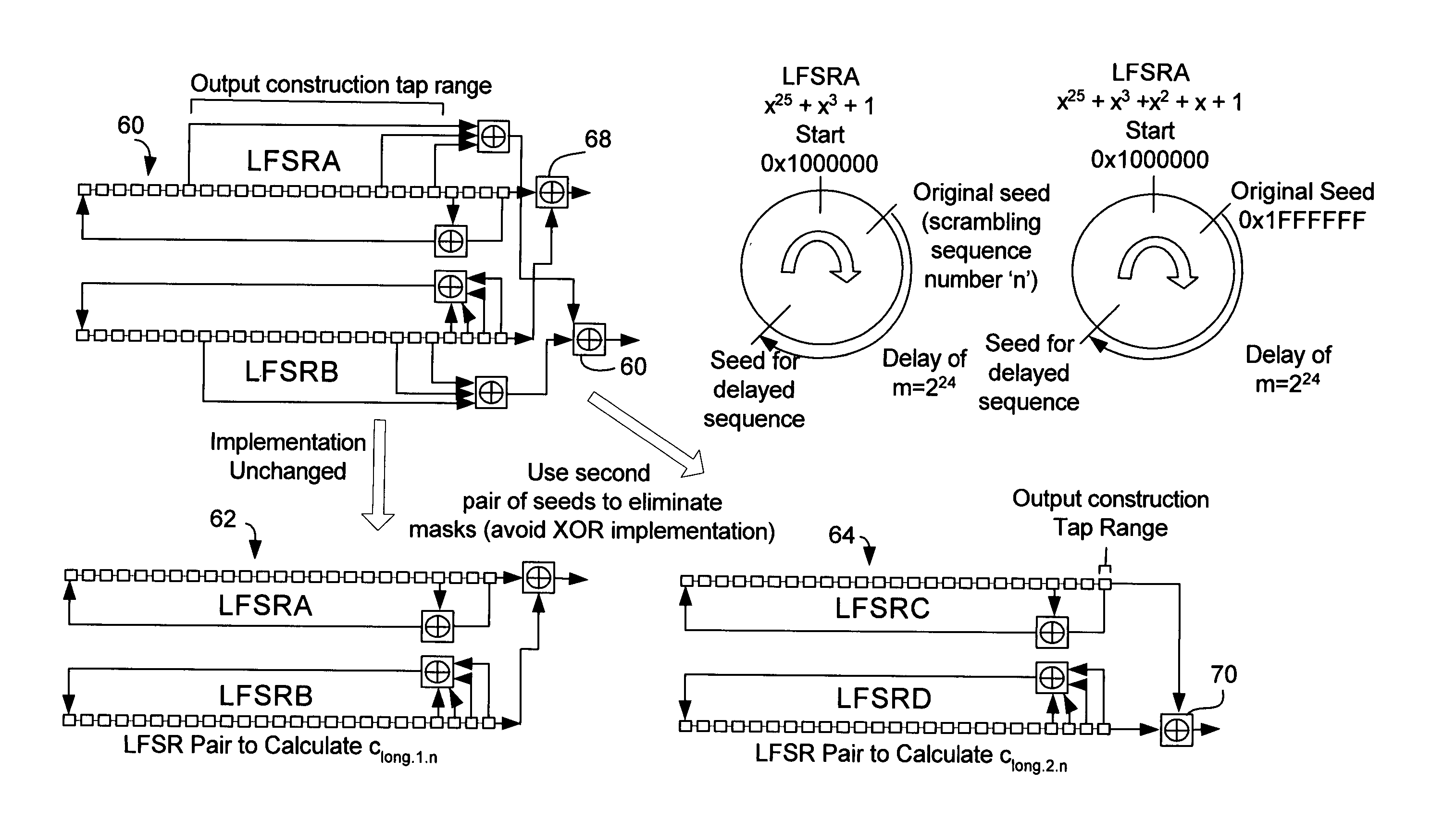
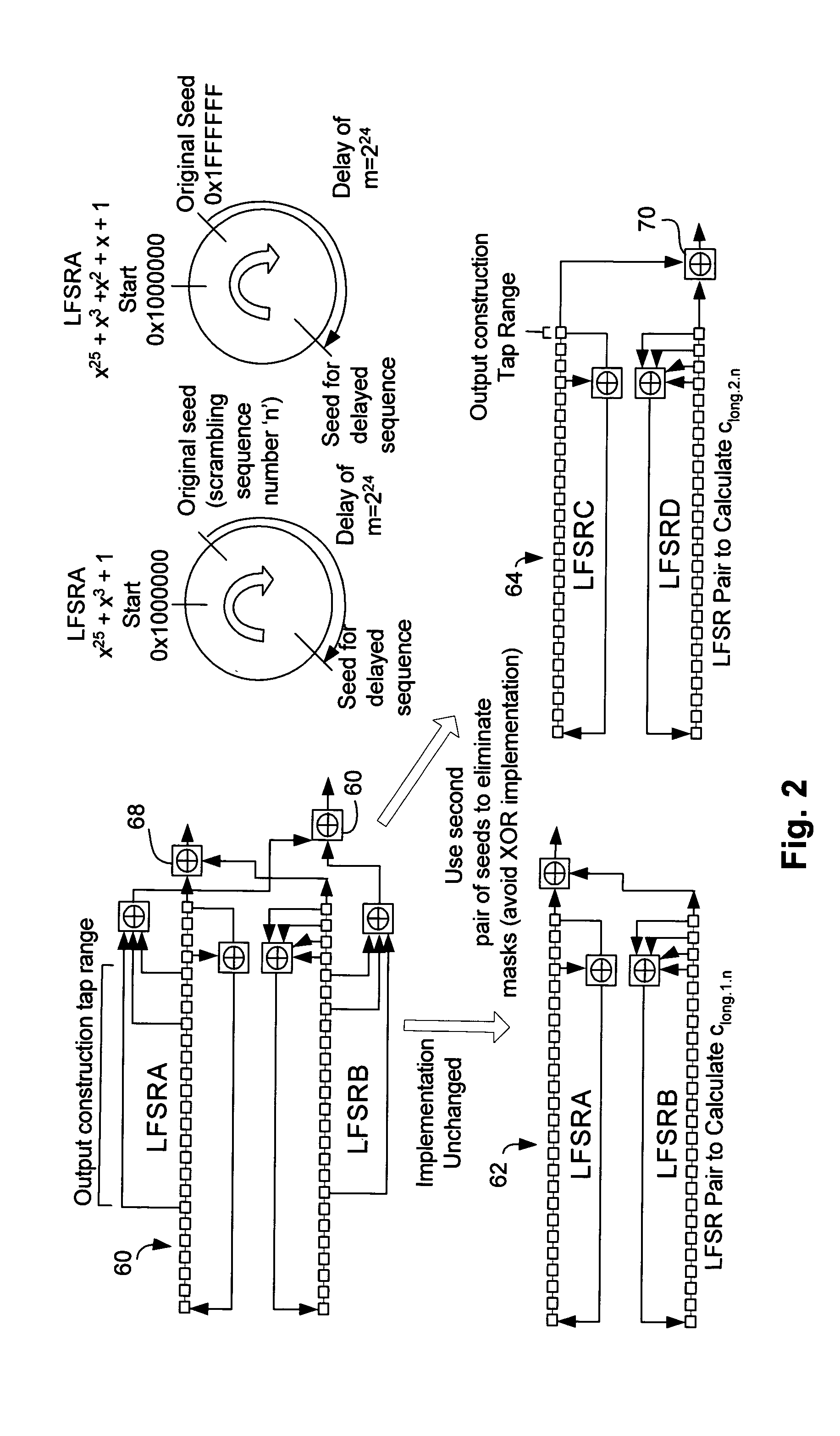
[0022]FIG. 2 illustrates the conversion of the gold code generator 60 as defined in the UMTS specification into an equivalent representation using two pairs of linear feedback shift registers, pairs 62 and 64. The output from unit 66 of the gold code generator 60 is equivalent to a delayed sequence of the output unit 68. In the present invention, multiple pairs of the linear feedback shift register are used, the second pair of linear feedback shift registers uses a second pair of seed values such that output of the second pair of linear feedback shift registers 64 is a delayed sequence of the sequence produced by the output 66 of the gold code generator 60.
[0023] Although the equivalent representation uses more resources, this equivalent representation can be implemented in a parallel implementation that produces multiple output bits. Such a representation is especially useful when implemented with a reconfigurable chip in which reconfigurable elements are configured by configurati...
PUM
 Login to View More
 Abstract
Description
Claims
Application Information
 Login to View More