Conduction block verification probe and method of use

a technology of verification probe and conductivity, which is applied in the field of medical devices and methods, can solve the problems of reducing the heart's ability to properly function as a pump, increasing the risk of acquiring a number of potentially deadly complications, and affecting the quality of life, so as to improve the performance and efficiency of energy emission, reduce the impedance, and increase the conductivity

a technology of verification probe and conductivity, which is applied in the field of medical devices and methods, can solve the problems of reducing the heart's ability to properly function as a pump, increasing the risk of acquiring a number of potentially deadly complications, and affecting the quality of life, so as to improve the performance and efficiency of energy emission, reduce the impedance, and increase the conductivity

US20060015165A1Active Publication Date: 2006-01-19ATRICURE

Image

Smart Image Click on the blue labels to locate them in the text.
Viewing Examples
Smart Image
  • Conduction block verification probe and method of use
  • Conduction block verification probe and method of use
  • Conduction block verification probe and method of use

Examples

Experimental program
Comparison scheme
Effect test

Embodiment Construction

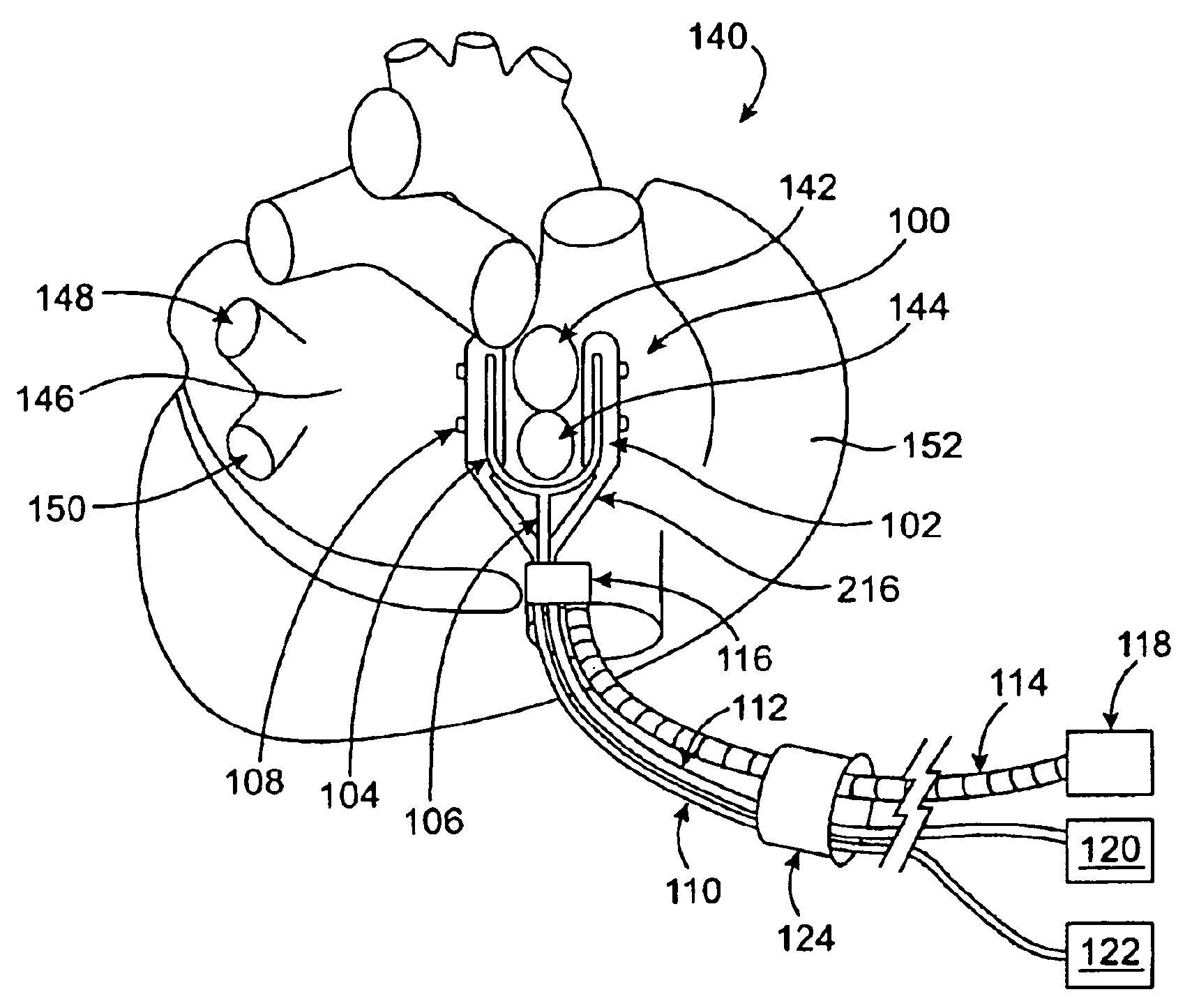
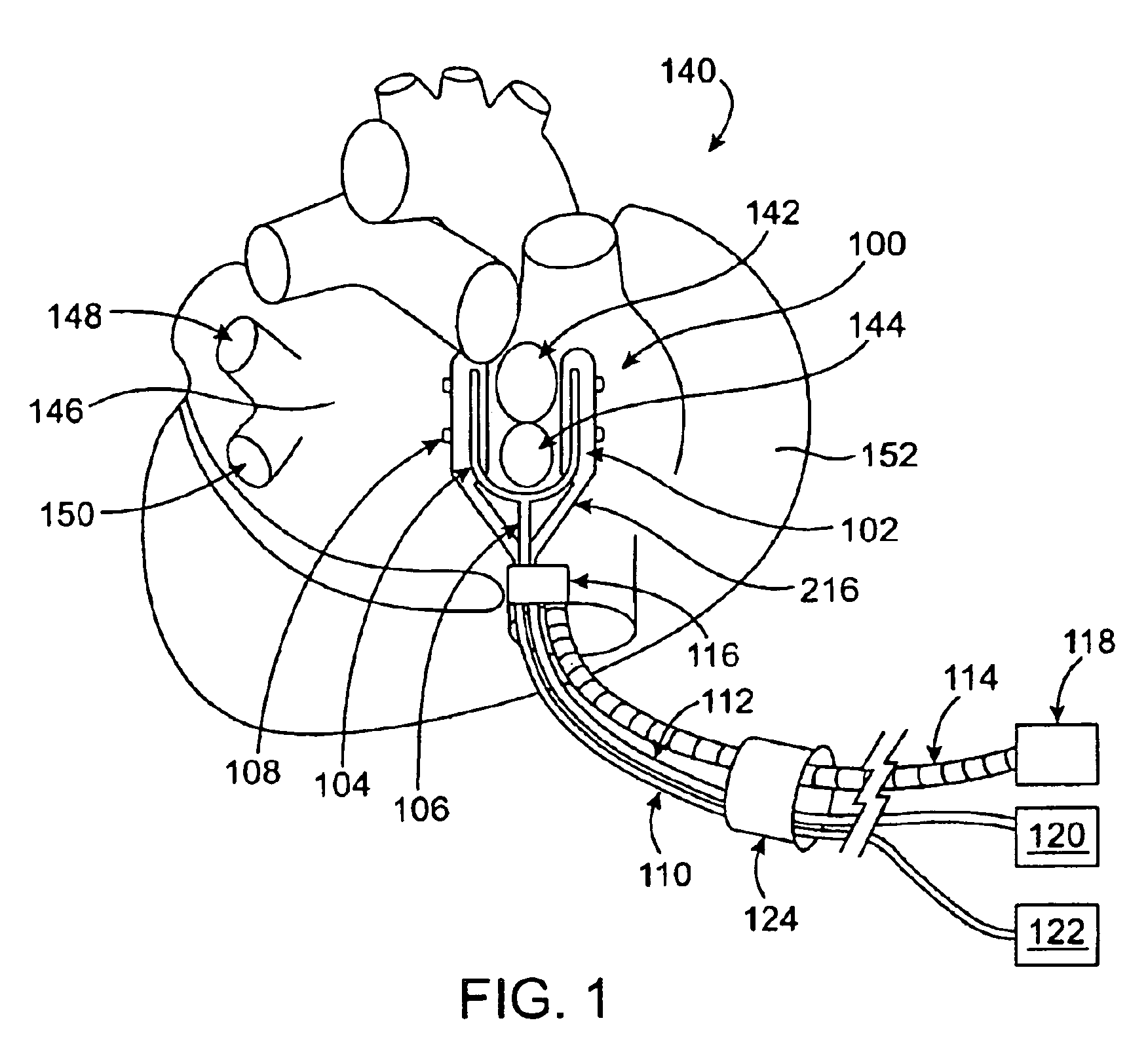
[0078] The present invention relates generally to medical devices and methods and more specifically to devices and methods for ablating cardiac tissue for treating cardiac arrhythmias such as atrial fibrillation. Ablation of cardiac tissue in various patterns has been shown to disrupt conduction pathways in the heart to ameliorate or eliminate AF or other arrhythmias. The devices and methods will often be used to ablate epicardial tissue in the vicinity of at least one pulmonary vein, but various embodiments may be used to ablate other cardiac tissues in other locations on a heart.

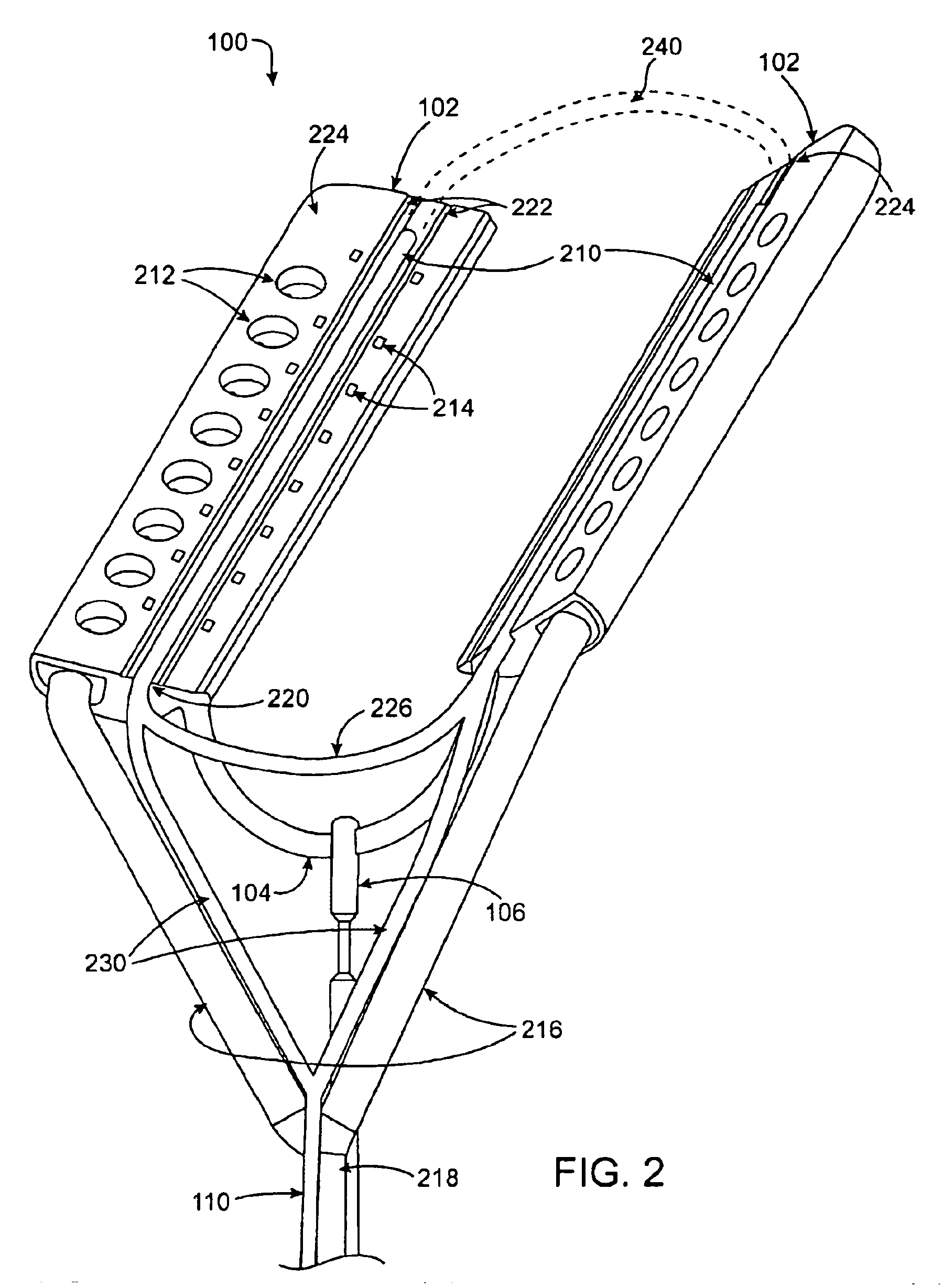
[0079] Generally, ablation devices of the invention include at least one tissue contacting member for contacting a portion of the epicardial tissue of a heart, securing means for securing the ablation device to the tissue and at least one ablation member coupled with the contacting member for ablating at least a portion of the tissue. In various embodiments, the devices have features which enable the devi...

the structure of the environmentally friendly knitted fabric provided by the present invention; figure 2 Flow chart of the yarn wrapping machine for environmentally friendly knitted fabrics and storage devices; image 3 Is the parameter map of the yarn covering machine
Login to View More

PUM

No PUM Login to View More

Abstract

Devices and methods provide for ablation of cardiac tissue for treating cardiac arrhythmias such as atrial fibrillation. Although the devices and methods are often be used to ablate epicardial tissue in the vicinity of at least one pulmonary vein, various embodiments may be used to ablate other cardiac tissues in other locations on a heart. Devices generally include at least one tissue contacting member for contacting epicardial tissue and securing the ablation device to the epicardial tissue, and at least one ablation member for ablating the tissue. Various embodiments include features, such as suction apertures, which enable the device to attach to the epicardial surface with sufficient strength to allow the tissue to be stabilized via the device. For example, some embodiments may be used to stabilize a beating heart to enable a beating heart ablation procedure. Many of the devices may be introduced into a patient via minimally invasive introducer devices and the like. Although devices and methods of the invention may be used to ablate epicardial tissue to treat atrial fibrillation, they may also be used in veterinary or research contexts, to treat various heart conditions other than atrial fibrillation and / or to ablate cardiac tissue other than the epicardium.

Description

CROSS-REFERENCES TO RELATED APPLICATIONS [0001] The present application is a continuation-in-part application which claims priority of U.S. patent application Ser. No. 10 / 988,021, which was filed on Nov. 12, 2004, which is a continuation-in-part application which claims priority of U.S. patent application Ser. No. 10 / 410,618, which was filed on May 27, 2004, which is a continuation-in-part of and claims priority of U.S. patent application Ser. No. 10 / 272,446, which was filed Oct. 15, 2002, which claims priority to U.S. Provisional Patent Application Ser. No. 60 / 337,070, filed Dec. 4, 2001, entitled “Methods and Devices for the Least Invasive Cardiac Surgery of Atrial Fibrillation.” U.S. patent application Ser. No. 10 / 988,021 also claims the priority to U.S. Provisional Patent Application Ser. No. 60 / 519,726, filed Nov. 12, 2003, entitled “Ablation Device.” The entire contents of these applications are hereby incorporated by reference.BACKGROUND OF THE INVENTION [0002] The present in...

Claims

the structure of the environmentally friendly knitted fabric provided by the present invention; figure 2 Flow chart of the yarn wrapping machine for environmentally friendly knitted fabrics and storage devices; image 3 Is the parameter map of the yarn covering machine
Login to View More

Application Information

Patent Timeline
19 Jan 2006
Publication
US20060015165A1
IPC
A61B5/042; A61N1/05; A61B18/00; A61B18/14; A61F7/00
CPC
A61B1/12; A61N1/0587; A61B18/14; A61B18/1402; A61B18/1442; A61B18/1477; A61B18/148; A61B18/1492
Inventors
BERTOLERO, ARTHUR A.; IBRAHIM, TAMER