

High refractive-index, hydrophilic, arylsiloxy-containing monomers and polymers, and ophthalmic devices comprising such polymers
a technology of arylsiloxy-containing monomers and polymers, which is applied in the field of high refractive index, hydrophilic, arylsiloxy-containing monomers, macromonomers, polymers, etc., can solve the problems of less popularization of rigid iol implants in the market, increased incidence of postoperative complications, and less desirable than other materials with respect to minimal incision siz
- Summary
- Abstract
- Description
- Claims
- Application Information
AI Technical Summary
Benefits of technology
Problems solved by technology
Method used
Image

Examples
Embodiment Construction
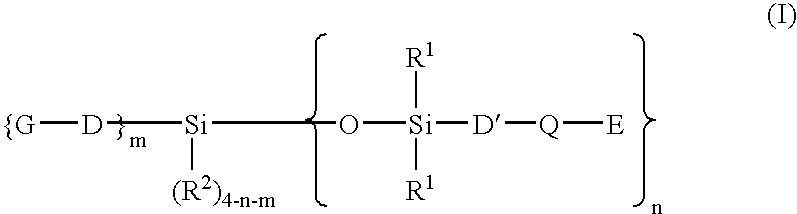
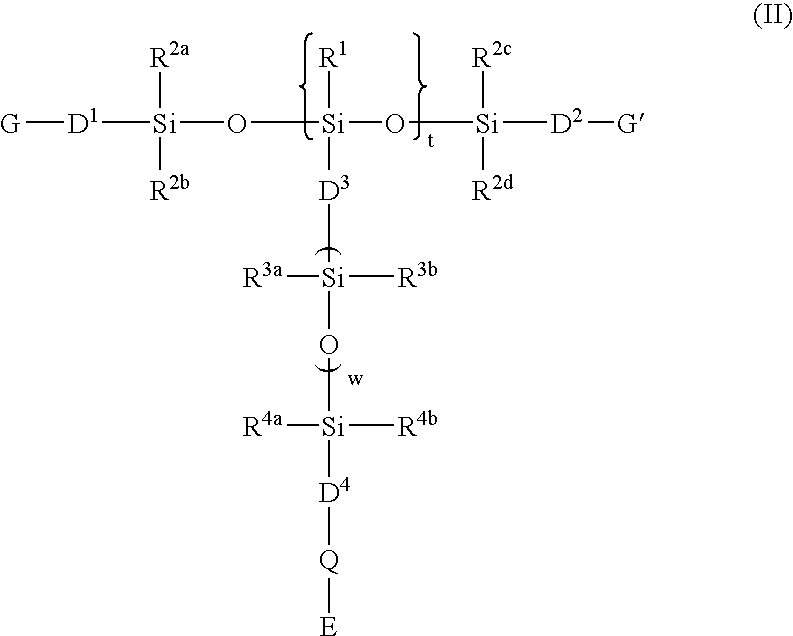
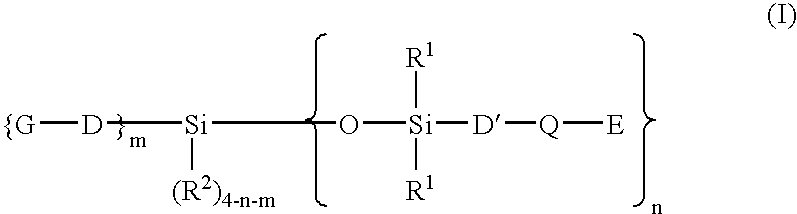
[0018] In general, the present invention provides hydrophilic, siloxy-containing monomers and macromonomers having high refractive indices and polymeric compositions comprising such monomers or macromonomers. A monomer or a macromonomer of the present invention has at least a polymerizable functional group, at least an aryl group, and at least a hydrophilic group, each attached directly or indirectly to a silicon atom of a siloxy group. A hydrophilic group can be attached indirectly to a silicon atom through a linking group that can comprise other hydrophobic or hydrophilic groups or a combination thereof. A hydrophilic group also can be attached through another siloxy group. The polymeric compositions of the present invention have refractive index of about 1.4 or greater. In some embodiments, the refractive index is in the range from about 1.4 to about 1.7. In some other embodiments, the refractive index is in the range from about 1.45 to about 1.6.
[0019] In one aspect, a polymeri...
PUM
| Property | Measurement | Unit |
|---|---|---|
| refractive index | aaaaa | aaaaa |
| elongation before break | aaaaa | aaaaa |
| refractive index | aaaaa | aaaaa |
Abstract
Description
Claims
Application Information
 Login to View More