It takes a considerable amount of time for individuals to divest themselves of their belongings and to remove laptops from their cases.
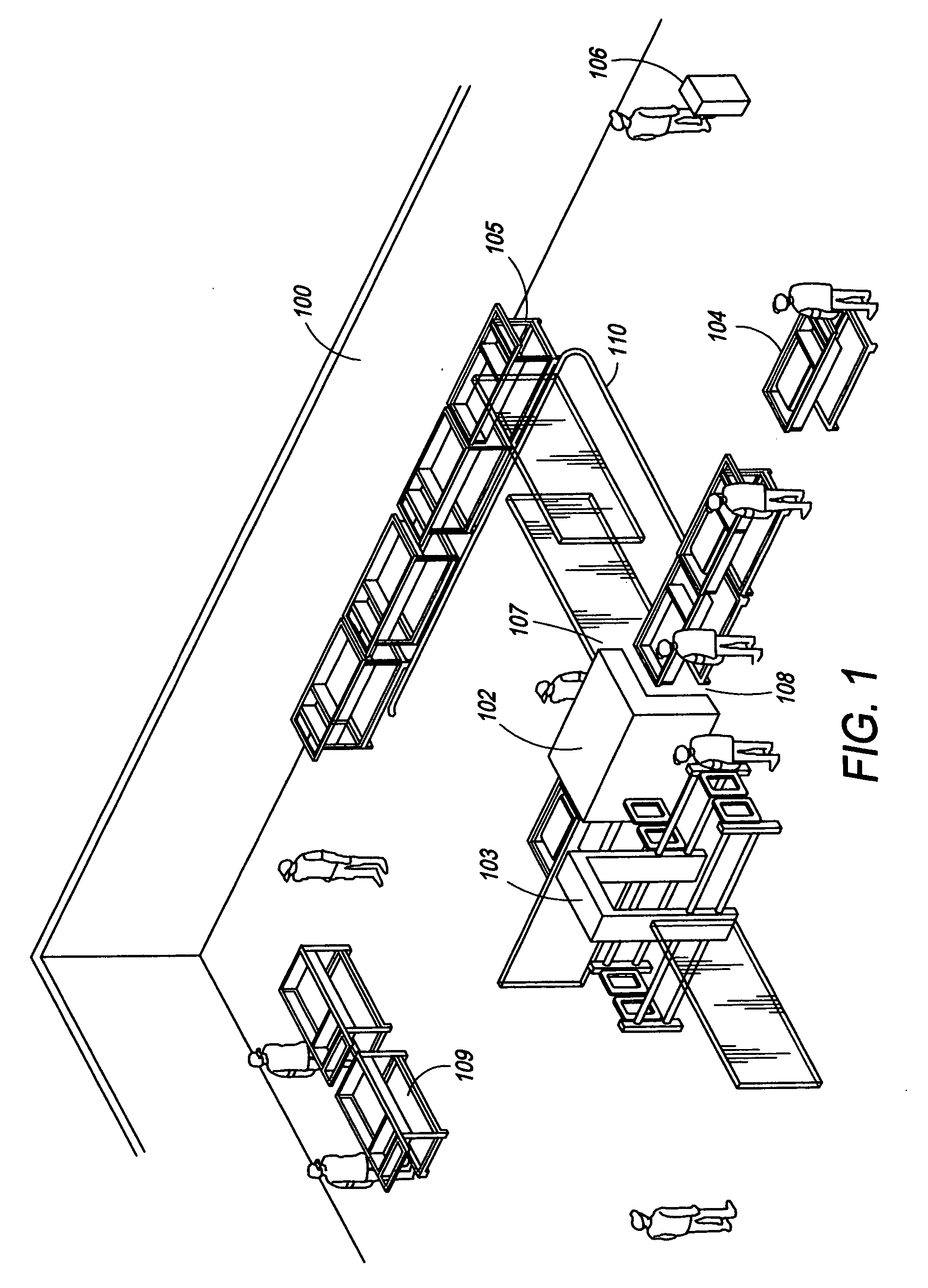
The conventional prior art security baggage and passenger screening systems described above are inefficient in the manner in which they are set up to receive and distribute both passengers and their carry-on baggage.
It takes a considerable amount of time for individuals to divest themselves of these belongings.
Thus, X-
ray machine operators spend more time waiting for passengers to divest themselves of their belongings and load them onto the conveyor than scanning bags.
Thus, the bags are left on the conveyor for approximately at least 1.5-2.0 minutes, thereby causing a back-up that forces the X-
ray machine operator to have to wait until such back-up is cleared.
Thus, even when individual passengers have access to the
machine, the process is still time-consuming as each
individual item to be scanned must be placed on the single
conveyor belt and then collected by the owner.
This is especially true for Computerized
Tomography (CT) scanning systems, which are much slower in operation compared with conventional X-
ray scanning systems.
In addition to the time it takes for the machine to operate, it may take some time for a passenger to reclaim and collect his baggage and other personal belongings, further creating a backlog in the scanning system.
In addition, such existing systems tend to have many other problems, including for example, several security personnel having excessive
downtime and a necessity for a dedicated operator for each
detector to direct traffic.
Additionally, passengers lack sufficient information regarding how to most efficiently pass through a baggage checkpoint or screening
station.
For example, passengers may wait in a screening
station or checkpoint lane full of passengers while a second lane remains completely empty, thereby causing unnecessary
delay.
Thus, the much desired streamlined and efficient function of the scanning operation is hampered.
Current systems lack appropriate means for indicating whether lanes, among a plurality of check
station lanes, are operational or closed.
Furthermore, passengers lack information regarding what items should be subjected to CT scanning, x-ray scanning,
metal detection, or hand searching, such as large buckle belts or shoes.
The presence of portable computing devices, such as laptops, further causes more
delay.
It takes a considerable amount of time for individuals to remove laptops from their cases.
Passengers often fail to efficiently remove such items from their carrying cases and, consequently, do not proceed through the scanning checkpoint efficiently.
Additionally, those areas contained within the scanning checkpoint or check station areas specifically allocated for passengers to divest themselves of their belongings are not set up to facilitate rapid and efficient divestiture of passenger belongings.
Along the same lines, the problem also presents itself when passengers collect their belongings and reload their items and replace portable computing devices in their cases.
Individual passengers also lack proper instruction on where to stand so as not to obstruct the natural flow of the X-ray scanning system line.
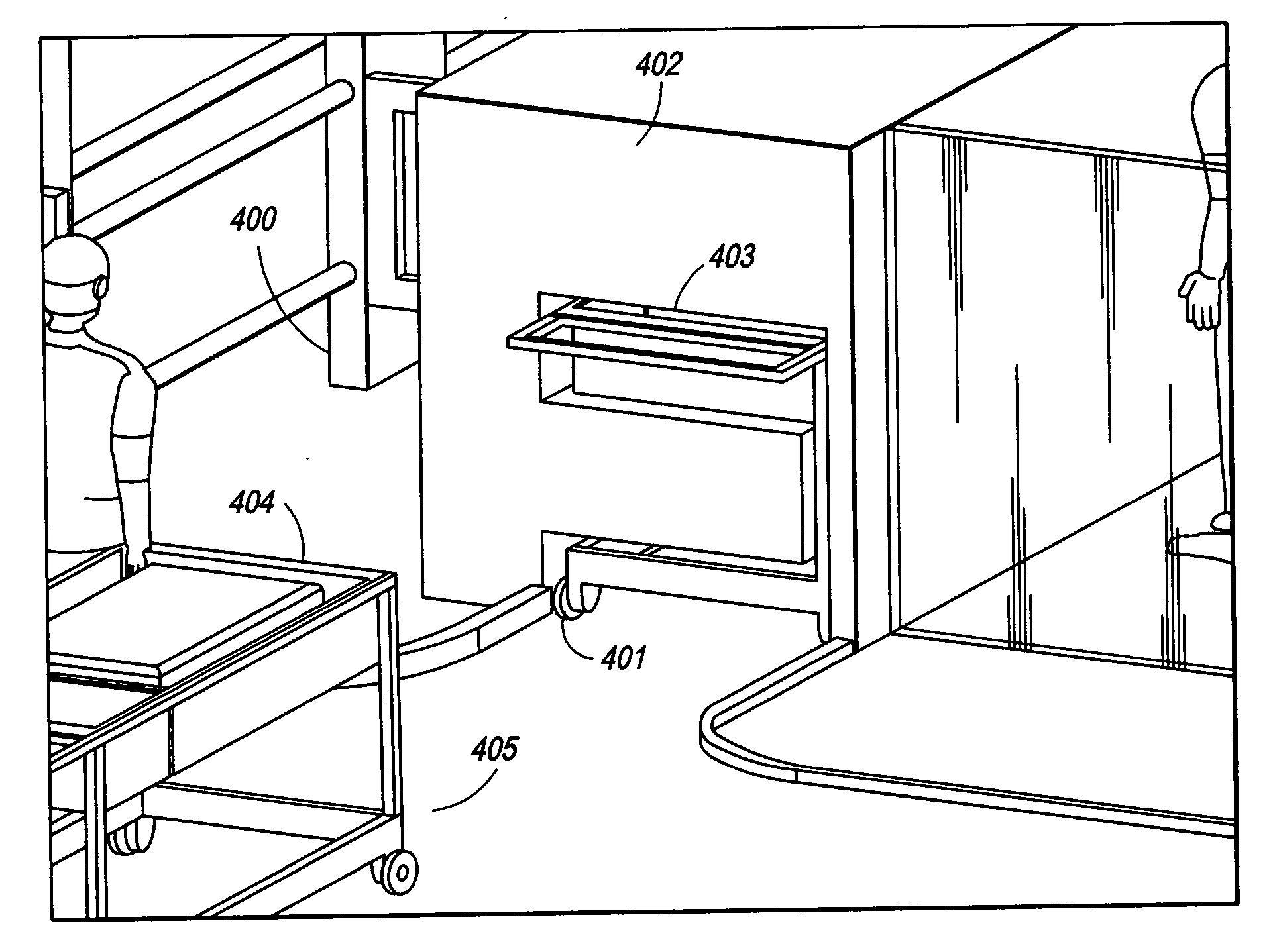
Conventional security screening systems lack appropriate means for handling carry-on baggage in its entirety prior to and / or during scanning.
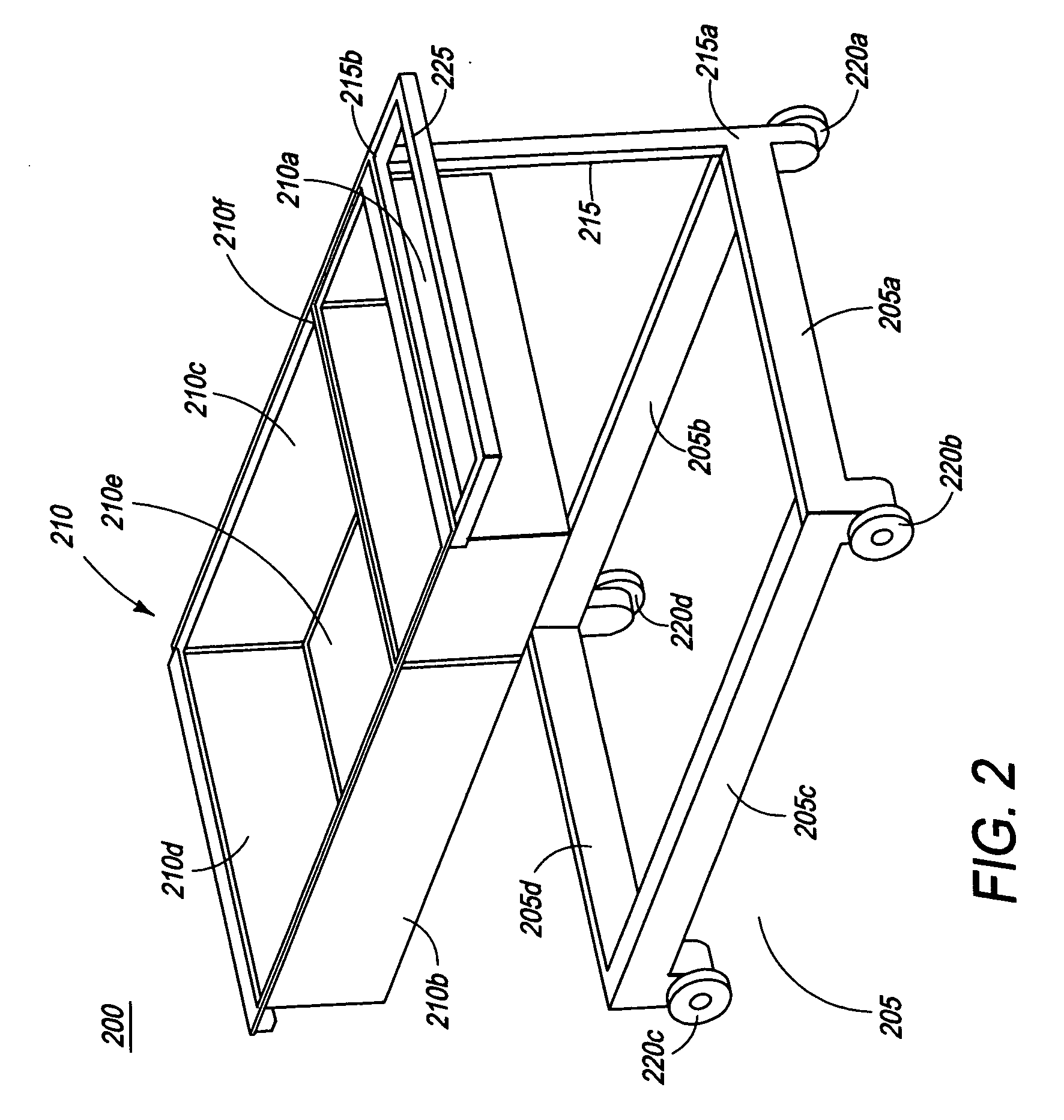
Traditional carry-on baggage carts are cumbersome and bulky in dimension, including towable, portable, or mobile carts.
These carry-on baggage carts present problems when scanned in conventional scanning systems.
For example, the design of the carts does not allow for conventional scanning systems to sufficiently scan due to the inadequate positioning of the carry-on baggage.
This, in turn, leads to the capturing, storing,
processing and development of incomplete and imprecise X-ray images.
Metal bars of existing cart designs may also hinder the path of the X-ray, thus obscuring some of the items placed on the cart from scanning.
This also leads to imprecise capturing, storing,
processing and development of x-ray images.
In addition, in scanning conventionally designed carry-on baggage carts, it is difficult to contain the x-
ray radiation; to scan an existing, conventional carry-on baggage cart, the x-ray machine would need a large opening.
Thus, in such systems, costly safeguards would need to be implemented to protect the general public and x-ray operators.
Despite these prior art efforts to improve methods, apparatuses, and systems for scanning carry-on baggage, the above mentioned problems have not been solved.
The prior art methods fail to disclose methods and systems that alleviate
delay during the divestiture process.



 Login to View More
  Login to View More