

Porous PTFE materials and articles produced therefrom
a technology of porous ptfe and materials, which is applied in the field of porous ptfe membranes, can solve the problems of reducing the permeability of liquid or gas through the membrane, reducing the permeability of the membrane, and reducing the efficiency of the capture of small particles, so as to achieve low flow resistance, small pore size, and high strength
- Summary
- Abstract
- Description
- Claims
- Application Information
AI Technical Summary
Benefits of technology
Problems solved by technology
Method used
Image

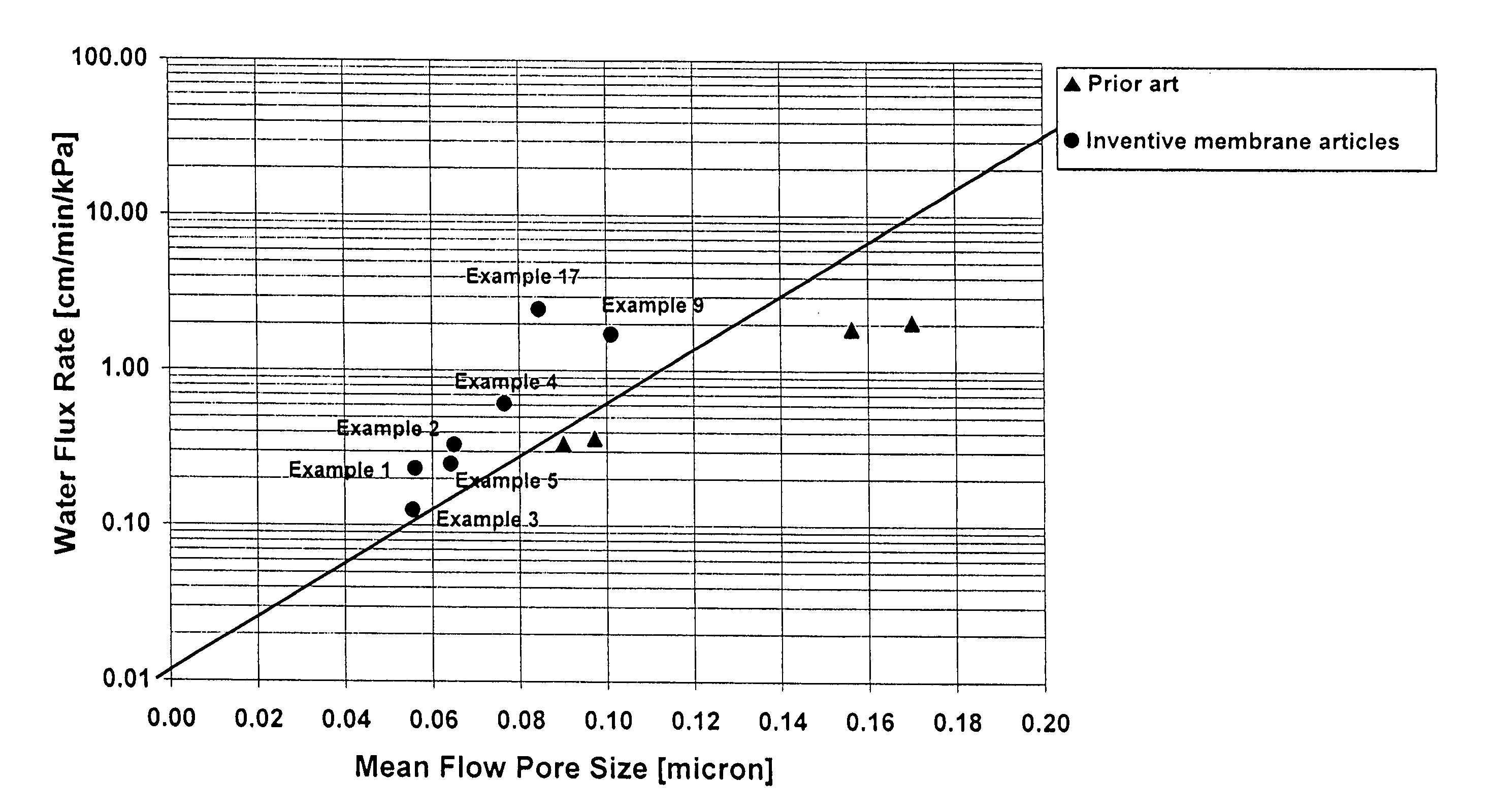
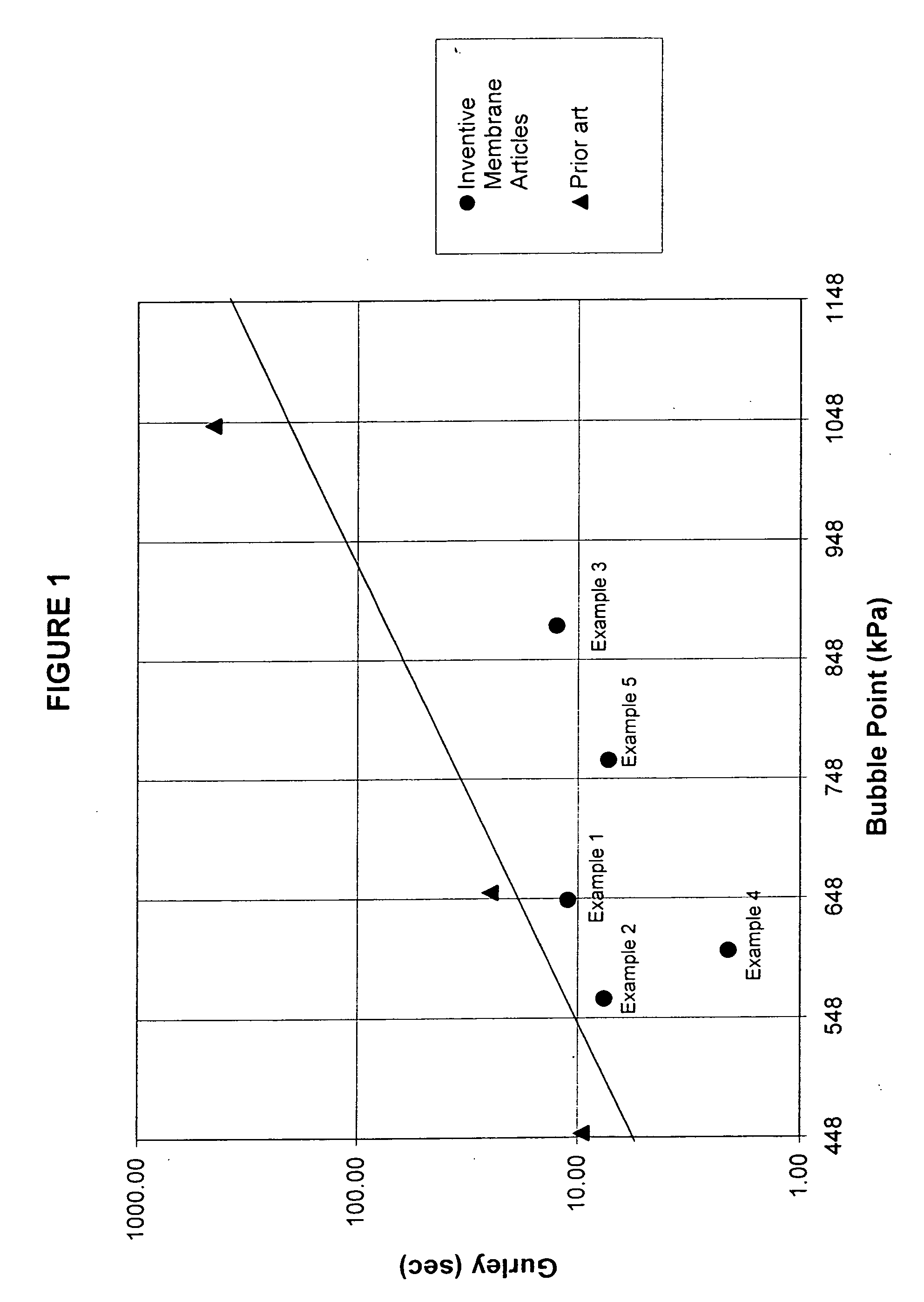
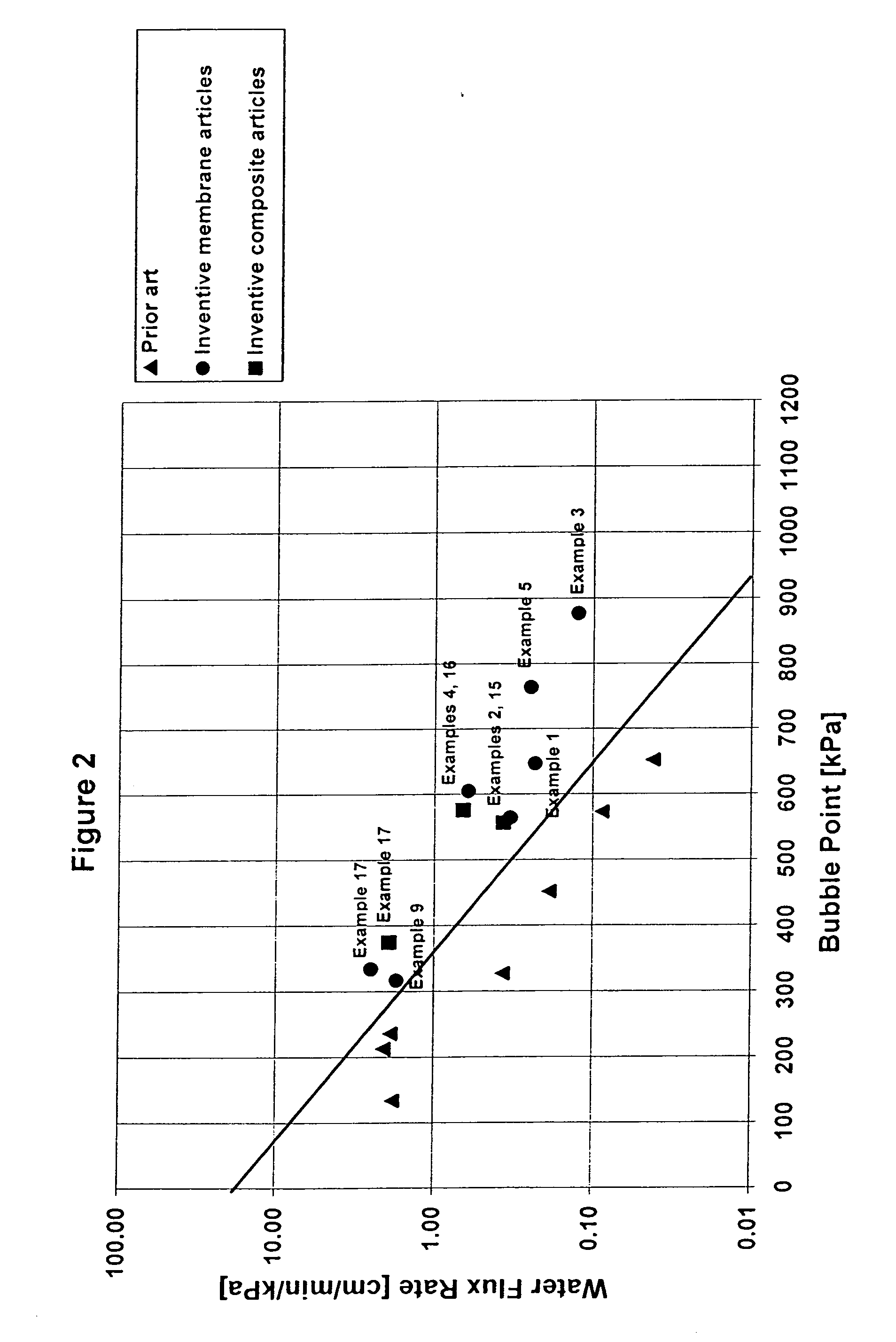
Examples
example 1
[0062] Fine powder of PTFE polymer (Daikin Industries, Ltd., Orangeburg, N.Y.) was blended with Isopar K (Exxon Mobil Corp., Fairfax, Va.) in the proportion of 0.196 g / g of fine powder. The lubricated powder was compressed in a cylinder to form a pellet and placed into an oven set at 70° C. for approximately 12 hours. Compressed and heated pellets were ram extruded to produce tapes approximately 15.2 cm wide by 0.73 mm thick. Three separate rolls of tape were produced and layered together between compression rolls to a thickness of 0.76 mm. The tape was then transversely stretched to 56 cm (i.e., at a ratio of 3.7:1), restrained, then dried in an oven set at 270° C. The dry tape was longitudinally expanded between banks of rolls over a heated plate set to a temperature of 340° C. The speed ratio between the second bank of rolls and the first bank of rolls, and hence the expansion ratio, was 8:1. The longitudinally expanded tape was then expanded transversely at a temperature of appr...
example 2
[0064] Fine powder of PTFE polymer (Daikin Industries, Ltd., Orangeburg, N.Y.) was blended with Isopar K (Exxon Mobil Corp., Fairfax, Va.) in the proportion of 0.196 g / g of fine powder. The lubricated powder was compressed in a cylinder to form a pellet and placed into an oven set at 70° C. for approximately 12 hours. The compressed and heated pellets were ram extruded to produce tapes approximately 15.2 cm wide by 0.73 mm thick. Three separate rolls of tape were produced and layered together between compression rolls to a thickness of 0.76 mm. The tape was then transversely stretched to 56 cm (i.e., at a ratio of 3.7:1), restrained, then dried at a temperature of 270° C. The dry tape was longitudinally expanded between banks of rolls in a heat zone set to a temperature of 340° C. The speed ratio between the second bank of rolls to the first bank of rolls, and hence the expansion ratio, was 13:1. The longitudinally expanded tape was then expanded transversely at a temperature of app...
example 3
[0066] Fine powder of PTFE polymer as described and taught in U.S. Pat. No. 6,541,589 was blended with Isopar K (Exxon Mobil Corp., Fairfax, Va.) in the proportion of 0.202 g / g of fine powder. The lubricated powder was compressed into a cylinder to form a pellet and placed into an oven set at 70° C. for approximately 12 hours. Compressed and heated pellets were ram extruded to produce tapes approximately 15.2 cm wide by 0.73 mm thick. Three separate rolls of tape were produced and layered together between compression rolls to a thickness of 0.76 mm. The tape was then transversely stretched to 56 cm (i.e., at a ratio of 3.7:1), restrained, then dried at a temperature of 250° C. The dry tape was longitudinally expanded between banks of rolls over a heated plate set to a temperature of 345° C. The speed ratio between the second bank of rolls and the first bank of rolls was 15:1. The longitudinally expanded tape was then expanded transversely at a temperature of approximately 360° C. to...
PUM
| Property | Measurement | Unit |
|---|---|---|
| Fraction | aaaaa | aaaaa |
| Fraction | aaaaa | aaaaa |
| Fraction | aaaaa | aaaaa |
Abstract
Description
Claims
Application Information
 Login to View More